Simple Living

The Hugelkultur Project

A while back, when we  decided to take on the project of cutting down our 70-foot tall (plus or minus) honey locust tree in the back yard, I began doing research on what in the world we’d do with all the wood.  As you may know, a lot of the smaller branches have become mulch for the garden.  But someone from the Take Back Urban-Homesteading(s) community on Facebook suggested to me to build a ‘hugelkultur.’  A hoogle-whater?  So, of course I Googled it.

I’ll try to save you some time.  A hugelkultur (pronounced “hoogle-culture” – I think), is basically a raised bed in which wood or other carbon-rich materials is buried.  Some people lay logs directly on the ground, use a tractor to dump a pile of dirt on it and then start planting on their new, hill-shaped bed.  (I like the info in this link).

The advantages of this method of gardening is that the wood, as it rots, acts as a sponge, making it so you don’t have to water much.  Additionally, it releases nutrients over time into the soil, making it so you don’t need to fertilize.  And, as it rots, it leaves plenty of air space in the soil, so you don’t need to till.  Basically, it is a no-maintenance, self-composting bed.  The first year or two, especially with green wood like ours, it will actually draw nitrogen from the soil in order to start decomposition.  But thereafter, it will supposedly do nothing but give back.

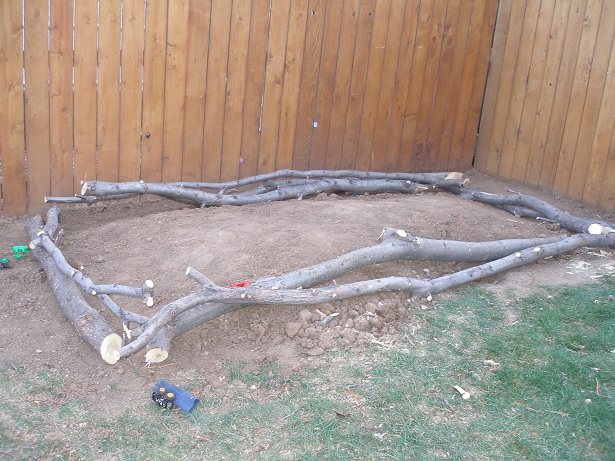
Sounds like a good plan to us!  So we decided to give it a try in the boys’ backyard garden bed.  We don’t have lots of spare topsoil just lying around everywhere, nor the desire to buy any, so we thought it would be a better use of what we do have to dig down into the ground and bury the wood with our own topsoil and subsoil.

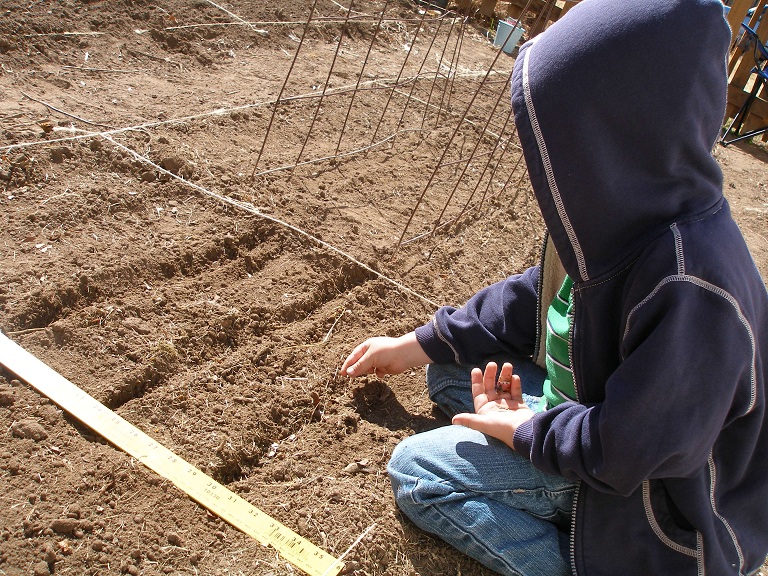
We dug down a good 12-14 inches.  Then we laid in some of the branches that were too thick to go through the wood chipper.  Then we buried them.  This left us with basically an instant raised bed, as promised.  We used some of the bigger, straighter limbs from the tree to make an edging (not yet complete).  Otherwise the boys would truck that dirt all over the back yard before anything could be planted there.

After an afternoon of being (unnecessarily) compacted by a 22 month old in a Tonka truck pushed by a 4 year old.

Fortunately for us, we have plenty of nitrogen-rich compost, thanks to the chickens.  We mixed a bit of that in to compensate for the initial anticipated nitrogen loss/Tonka truck compaction.  Henry wants carrots, tomatoes and watermelon in his bed this year.  We’ll keep track and let you know how it goes!

Does anyone out there have experience with a hugelkultur?  What about deterrents for little boys and their ride-on toys?  😉

Categories: Garden, Hugelkultur, Simple Living, Sustainability, Urban Homesteading | Tags: , , , , , , , | 6 Comments

We Call it an Icebox

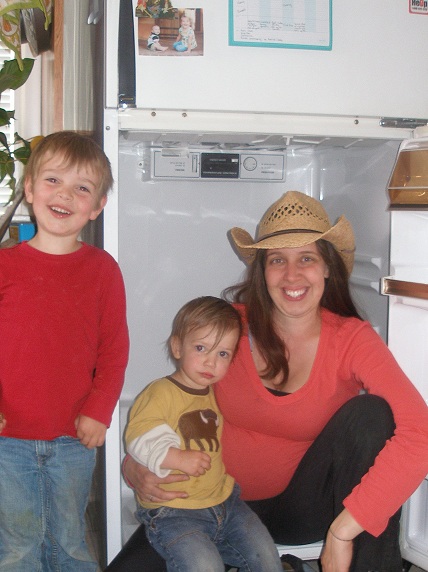
May 1st, we officially began our experiment.  We unplugged the fridge!  I was encouraged at how on-board Rick really was.  On Saturday night, he even made sure that we had jugs of water in the freezer, in order to be prepared for the first day using our freezer compartment as an icebox.

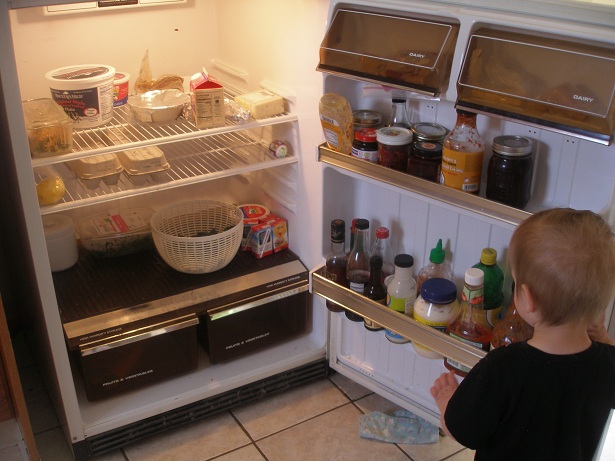
Yesterday was really only a half day with the new system.  I should have prepared better on Saturday by doing all the cleaning and stuff ahead of time, but I was distracted by trips to the garden center.  So, on Sunday morning, Rick cleaned out the freezer while I went to the grocery store.  When I got home, I cleaned out the fridge and we set up the new system in the former freezer compartment (what will from here on out be referred to as the icebox).  The actual unplugging took place around noon.

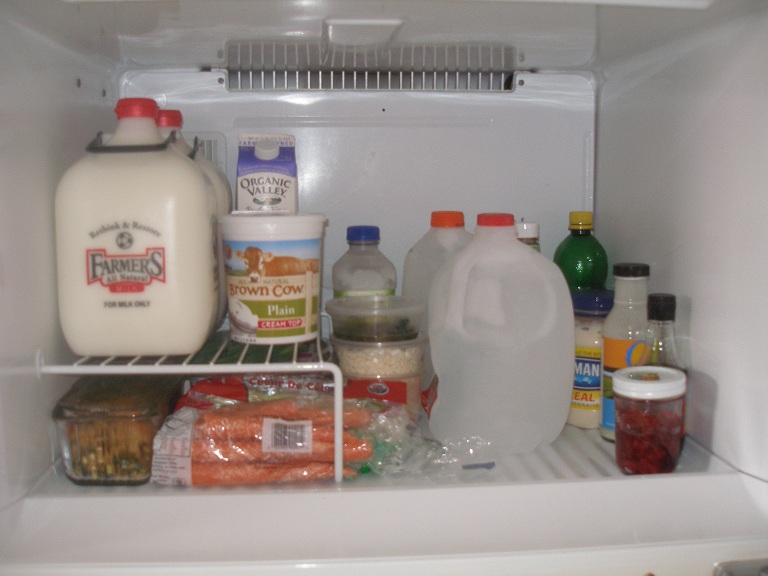
Here’s what the icebox looks like now.  This is our full week’s worth of refrigerated food, including two gallons of milk, a few condiments I wasn’t sure about leaving out, some leftover greens that we bought last week, and the eggs for my sister that were already in the fridge before.

I’ve done a little rearranging already, putting the less perishable items like carrots, in the door, and keeping the soft cheeses further back by the frozen water jugs.  Also, that container of left-overs on the very bottom left was promptly eaten by me after cleaning out the bottom of the fridge.  It was after lunch time and I was hungry!

I’ve actually had a hard time resisting the temptation to continually open the icebox to feel if things are cold in there, but I know keeping the door closed is crucial to the success of the experiment.  Rick has suggested getting a thermometer that we can keep in there so we won’t worry, and we’re going to experiment with different ice-jug configurations to make sure we’re making the best use of the space and coolness (is that a word??).  He also suggested that we keep the jugs on a towel or something, that way we won’t have to constantly be wiping down the interior of the icebox, since the jugs will probably sweat as they melt.  For someone who thinks I’m crazy, he seems awfully involved, huh?  I guess it’s not just me after all.

Categories: Food, Simple Living, Unplugging the Fridge | Tags: , , , , , , | 10 Comments

Getting Ready to Unplug

I’m not crazy.  Really.  I’m not.  I just read a lot of green-type articles and blogs, and I think .  I think a lot.  When I mentioned my latest idea to Rick, he became very quiet.  You know, the kind of quiet where someone clearly thinks you’re off your rocker, but is trying to figure out how to say so and if it’s really true?

Perhaps it’s because he’s experienced with my “thinking episodes.”  He calls it a ‘wild hair,’ or my ‘latest project.’  But I know he hasn’t forgotten how those nagging little thoughts of mine plague me until I drag him and the rest of my family into some project or other that the rest of society at large would consider crazy.

Consider for example when I started thinking about chickens.  In our back yard.  In the city.  Or when I started thinking about bees.  BEES!  Now we have a coop, eight hens, and an empty bee hive waiting for a second try with a new swarm.

Then there was the time I started thinking about the microwave.  I’m pretty sure this is what Rick’s mind flashed to when I mentioned to him this latest “wild hair.”  You see, lately I’ve been thinking about our fridge.  I’ve I’ve thought about it a lot actually over the last few years.  Our fridge was here in our house when we moved in.  So we knew it was at least 8 years old… and recently, I can’t seem to stop thinking about how much energy it’s using.  As the appliance that consumes the most energy in American homes, the refrigerator, running 24/7, I have been concerned about all the kilowatts leaching out of our meter.

I called the manufacturer of our refrigerator, model and serial numbers in hand.  I was surprised to learn that our fridge was not as old as I thought.  Made in June of 2001.  But I was dismayed at the big 863 kWh that it was consuming.  New refrigerators of the same size and style are consuming less than half than that.  Ours is consuming more than the old 15 cubic foot chest freezer from 1984 in the garage – that consumes a whopping 601 kWh, nearly fifty-percent more than what a similar modern freezer consumes.  This seems like a big problem to me.

Initially I thought the solution to this problem would be for us to get a new fridge and a new freezer.  See that was my first thought (i.e. not crazy!!).  But we don’t really have the $600 to shell out for a new freezer, let alone $800-1400 for a new fridge.  Then I started paying attention to what our fridge was actually doing.  The freezer on top usually stores the frozen CSA veggies and random meats brought in from the chest freezer for the current week’s dinners.  The refrigerator only really contains our eggs, dairy, condiments, and an excess of greens and celery.  Sometimes there are left-overs in there for a day or two (max, we’re good left-over-eaters around here).  I defrost foods on the counter the day I need them.

In other words, we’re not really using much space in the fridge, and some of the things we have in there don’t really even need refrigeration.  Eggs are shelf stable for quite a long time, and in Europe, they are even sold on the grocery shelves unrefrigerated.  Many condiments are shelf stable as well, despite warnings to “refrigerate after opening.”   And, around our home, lots of them get used up way before they’d ever spoil in the cabinet (peanut butter and jelly, soy sauce or sesame oil, for example).  So my second thought was to look for a smaller fridge.  An apartment-sized or even a dorm-sized fridge.  But I found out that they consume a lot of energy as well.  Nearly what a large fridge consumes.  And they have a pretty hefty price tag, even on craigslist.

Now I was questioning what we really needed.  For basically just storing our milk, yogurt, half and half, and the occasional bowl of left-over noodles or extra head of kale, what did we need?  Do you see where I’m going here?

I’m thinking about going without a fridge.  Let me say it again, so you know it’s not a typo… I’m thinking about going without a fridge.

So you can see why I was surprised that Rick didn’t immediately pass out when I mentioned to him a few weeks ago that I’ve been thinking about the fridge.  I have to give him a lot of credit.  He silently listened to my idea.  I explained my idea, talking fast because I could hear the doubt oozing through his silence.  We have coolers and I had an idea about using the top freezer portion of the fridge as sort of an ice box.  His next question, an incredulous statement really, was “you really expect me to run out to the freezer during the freezing-cold winter to swap-out ice packs because you don’t want to use the fridge?”  but he had answered his own question.  In the winter it would be cold.  We could keep things outside the back door on the patio.

As what I was suggesting started to sink it, I think I heard a muttering or two of “my wife really is crazy” and a sort of stifled laugh.  But there was some weird resignation coming through the phone.  I broke the news to him while he was at work, you see.  Safer that way, I figured, and it would give the idea a little time to stew in his head before he got home and could really talk about it. I was afraid he’d dismiss the idea out of hand.

When he got home I had my argument all ready.  It would be an experiment.  For just a month.  One month.  And we’d keep the freezers.  And it wasn’t as if we couldn’t use refrigeration… the ice box idea was just a old-fashioned, lower energy form of that.  I promised that we’d only unplug the frige for now, and if it wasn’t working we could just plug it back in and bag the whole thing.  Rick asked surprisingly few questions.  He sort of shrugged.  I asked if he told his co-worker of my idea, and when he admitted that he had, he told me his coworker’s response was, “Do you encourage her?”  I think he must have confessed that he does, so he really didn’t have a lot of argument against it.

After a few minutes, he asked about the summer, when the CSA is in full force and we have more veggies than we know what to do with.  Won’t they all just wilt and go to waste without a fridge to keep them in?  I had thought about this and confessed I didn’t have a total solution… yet.  But my tentative plan was that since I wasn’t going to be working on the farm this year or driving an hour each way every week, I’d have six extra hours and a lot more energy on farm day to get veggies washed and put up properly before anything wilted.  We’d put the things we were going to save for the winter in the freezer the day they came into the house instead of waiting a day or two, and we could use coolers for the melons.  Rick eyed me suspiciously.  But he said I could try it in May if I wanted.  We’d tackle the summer if we decided to continue the experiment.

I have read a bit about going without a fridge in the past, and since deciding to embark on this project.  Proponents like Sharon Astyk and Greenpa give me a lot of hope.  I’ve read the arguments that Deanna at the Crunchy Chicken makes against unplugging the fridge too.  But I think that this really can work for us.  Sharon Astyk has a fairly simple system going that I plan to emulate.  No, we won’t be drinking gallons of milk in a single day.  We’re not the first to try something like this.  And if things work, we’ll probably unplug the fridge for good.  We’ll turn that space into a pantry area to store our canned goods, and we’ll save money for a new, energy-efficient freezer.

Crunchy asks if it’s cheating to use a freezer in your effort to not use a fridge, but the truth of it, at least in my eyes, is that it’s not.  I see them as two different tools.  (You really should read  all the comments on that thread, by the way – you might just get converted by Sharon & Greenpa).  Rick hunts and that is the greenest, healthiest, most organic and humane way to get meat.  Not to mention most economical.  But it would be a waste if we couldn’t freeze it.  The CSA share provides more local, organic veggies than we can eat in a summer.  But local fresh veggies are a rarity here during Colorado winters, and what ever you can find is usually very expensive.  So canning, drying and freezing summer’s excess is another economical, practical, and efficient way to eat well all winter.   And, sadly, even our very out-of-date freezer is running more efficiently than our less out-of-date fridge.

So, let the experiment begin.  I hope you follow along with me in May as we try unplugging the fridge.  If anyone out there has done something like this in the past I’d love to hear your experiences.
Categories: Food, Independence Days, Simple Living, Sustainability, Unplugging the Fridge, Urban Homesteading | Tags: , , , , , , , | 16 Comments

Why I Blog and How I Became an Urban Homesteader

Four years ago, at the beginning of March, I started this blog.  At first I began tentatively, not sure who would ever read what I had to say, unsure of if I even had anything to say at all.  Unsure of what my blog was about (I hadn’t even really read other blogs), I titled it “Journeys and Adventures” and just sort of typed whatever came to mind, the latest happenings in our lives, reviews of articles I read or documentaries I watched.

I quickly noticed a theme.  I wanted to be a farmer.  But I lived (live!) in a city.  During my first month of writing I covered the garden or buying our first chicks in at least every-other post.  I did not know anything about “urban homesteading” or that people called themselves this or that other people we like me at all – playing farmer on little patches of earth, where ever their feet had landed them in life.

There were lots of Monday morning posts chronicling the progress of our garden over the weekend or the construction of our chicken coop.  And I began to understand that this was therapy – the gardening, the chickens, and the writing about it.  I took more pictures, I squeezed more into the dirt we had.  I found more dirt and eeked out more spaces to grow things.  I dreamed of a bee hive.  But this space remained a sort or personal journal.

One day, as Rick was reading, he asked why I didn’t make the blog public, since only friends and family had access to it at this point.  I thought about it for a while and decided I was afraid to put myself out in the open to any and everyone.  But he encouraged me to do it, convinced that people would like what I had to say, and enjoy reading about our crazy adventures in playing at urban farming.  So I did, and I decided to change the name of the blog too, so that it would reflect more of what it was now about.

I thought about the name change for a long time, mulling over terms like green, dirt, crunchy, city, suburbs, farming, etc.  Through lots of reading, I discovered the term urban homesteading and found it described what we were doing.  I still thought we virtually were alone in doing it, but I knew the phrase was the right one for our family and our journey.

A search engine led a writer for the Denver Post to my blog, and he contacted me, wanting an interview for a story he was doing on urban homesteaders.  Because I was skeptical (hey! I didn’t know this guy), I refused to be interviewed without Rick home, so I missed my chance.  Timing was off and he couldn’t come on the day Rick could be here.  But I was so excited when the article came out.  I discovered we were NOT alone.  There were people in my own neighborhood doing this.  People all over Denver!

Now look:

There is a reason I’m taking the time to write this trip down memory lane.  It’s not because it was my blog-iversary. It’s because today is the third Day of Action for Urban Homesteaders across the internet.

Back in February of this year the Dervaes family of Pasadena, CA trademarked the terms “urban homestead” and “urban homesteading.”  I am not linking to who the Dervaes family is, but in short, they are a father and three grown children growing lots of food in a small area in California.  They are a family church, with the father being the pastor and to my knowledge, the children are the members.  A church of what is pretty unclear.  From what little I know of them, they’ve done a lot with their space and many in the urban homesteading community admired them.  I never really read much about them until now.

So the big deal?  They sent out cease and desist letters to bloggers, businesses and organizations (even a library) who were using the two trademarked terms.  They want credit with links every time the phrases are typed.  I’ve seen the letters.  They sent one to Denver Urban Homesteading, our local indoor farmers market, and had their Facebook page (and main marketing tool) shut down.  Problem is they don’t have the legal grounds to do this.  They didn’t invent the phrases, nor were they the first to use them.  And their trademark does not give them the right to restrict the use of the English language in the way they claim.  I know this because I know the owner of Denver Urban Homesteading.  James, the person I worked with on Denver’s inaugural chicken coop tour (with the Denver Botanic Garden’s) last year, and the one I helped to make the Free the Chickens video with, also just happens to be a lawyer.  Apparently the Derveas picked on the wrong homesteader.

Bloggers and urban homesteaders across the country have been outraged by the actions of people who were supposed to be leaders within our community.  A Facebook page was created and quickly grew to over 6000 fans supporting the canceling of the trademarks and begging the Dervaes family to, at the very least, help us understand.  There have even been claims that the Dervaes’ are plagiarizing others‘ work (some of it used to support their claim to the trademarked phrases?).  But the D-family closed all the comments on their many blogs.  They temporarily took down their facebook page.  They refused to answer email and letters.  The only communication was denial of any wrong doing and to claim they were being persecuted, they were under attack.  They did not (and still don’t) approve of the fact their letters were put out in the open.  A quick Google search will lead you to the letter if you want to read it.

Through all of this, over the last month-plus, I’ve stayed silent.  All this uproar literally struck fear into my heart.  I called my mom, nearly in tears.  I told my BFF.  I temporarily changed my blog name.  I followed fellow bloggers as they posted and united in two previous Days of Action (read my favorite post on all of this here, from Northwest Edible Life).  But I was afraid.  This blog holds my heart.  Like I said it is my therapy.  And it’s my personal journal.  And it holds videos of my boys’ first steps and first words.  I don’t want to loose any of it.  Not over words.

But I’ve collected my thoughts.  I’ve decided I can’t be silent because all of this is too important to me.

So, today, on this Urban Homesteader’s third Day of Action, I’m asking for your help.  Please go to Change.org and sign the online petition to Cancel Trademarks on Urban Homestead and Urban Homesteading.

This petition is addressed to Jules Dervaes, and despite fears that he won’t listen to this community, the petition can be used to help support our cause in other ways.  It is a petition, a protest, and a plea to the Dervaes family.  Whether or not they listen, legal actions are also being taken.  Because like all the others, I too, am an Urban Homesteader.  Thanks.

Categories: Beekeeping, Chickens, Community, Food, Garden, Independence Days, Simple Living, Sustainability, Urban Homesteading | Tags: , , , , , , | 5 Comments

Getting Back on the Menu Planning Wagon

Ack – the day is almost over (at least nap time is almost over) and I’m just now sitting down to post for the week!  So it’s a simple and short one.

One of my other goals for 2011 is to get back on that menu planning wagon again.  I’ve written about planning menus many-a-time before, and it really does save time, money and sanity, as well as usually results in healthier and tastier meals for the family.  I don’t know exactly why I stopped planning menus last year.  Or when, for that matter.  BUT I have seen our budget take a hit.  Usually in the summer we have so much food around that much goes to waste if we’re not careful to plan what to eat and what to store.  But in the winter, I’m often lazy and forget to get things down from the freezer or wait to go shopping until our house is mistaken for Old Mother Hubbard’s.

This week, as I was helping Rick make the grocery list (he’s been shopping AND cooking while I’ve been gestating), I realized that I was finally sick of the “what’s for dinner tonight” question that one or both of us asks every night.   This week’s menu is pretty simple.  I used some example menus from one of the magazines I subscribe to.  But it’s not cheating.  It’s just getting the ball rolling again.  Here’s what’s on the docket for the week:

Tonight: Spicy Black Bean Soup
Tomorrow: Potato-onion Frittata
Wednesday: Mushroom and Black Bean Tortilla Casserole
Thursday:  Butternut Squash Pasta Bake
Friday: Orechetti with Spicy Bacon-Tomato Sauce
Saturday: Pheasant Noodle Soup

On Sunday, we are celebrating Rick’s thirtieth birthday by going out for barbecue and bowling with friends.  I’m excited about this, since it’ll be a fun night out.  For my birthday, my mom is taking me to see Riders in the Sky on Friday.  I can not contain my excitement!  I’ve been a fan since I was a kid!  Yee-Haw!

Categories: Food, Menu Planning, Simple Living | Tags: , , | 1 Comment

Free the Chickens!

As promised, here is the video that we participated in making to help get Denver’s laws changed to allow chickens.  Sadly the editor misspelled our name, but I think the point is still there.  😉  Please share with your friends to help raise awareness on this issue.

To learn more about how you can help, go to www.freethechickens.com

Categories: Chickens, Community, Food, Simple Living, Sustainability, Urban Homesteading | Tags: , , , , , , | 8 Comments

Handmade Halloween – Bat Tutorial

Since last week I posted a tutorial for sewing a homemade garden gnome costume, I thought I’d share how I made H’s bat costume for this Halloween as well. This costume was also very inexpensive to make, and very easy.  It took me about 2 hours total, including trying to keep E distracted from pushing the stitching buttons on the sewing machine and away from the straight pins. Click the pictures for close-up views.

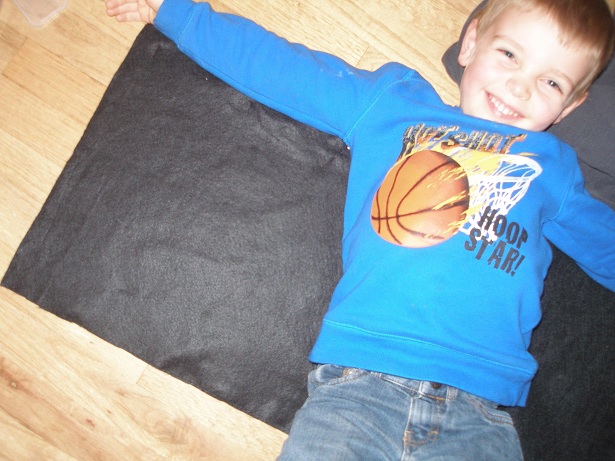
I started with a black jacket from Goodwill ($1.99) and took it with me to the fabric store.  Using the jacket as a reference, I bought 3/8 of a yard of black felt ($1.58) .  With the material folded in half, I had H lay on the felt with his arm outstretched and used straight pins to mark his wrist, elbow, armpit and waist.

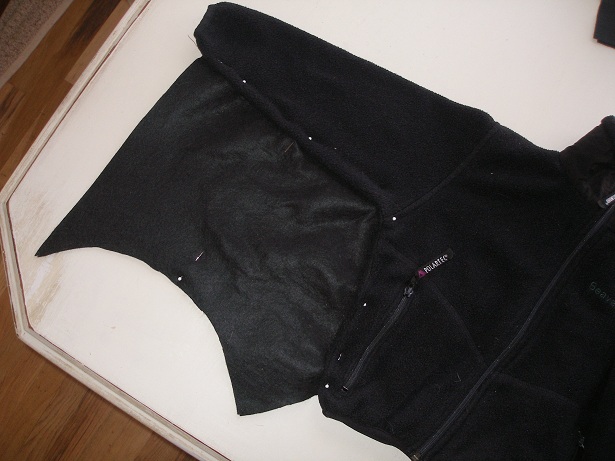
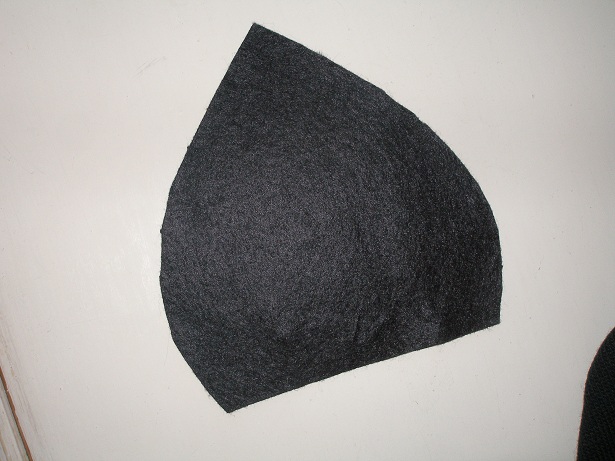
Cut a wing shape using these measurements.  You could mark the felt with chalk, make a paper template, or freehand it (I just eyeballed it).  With the jacket zipped up, pin felt to the arm and side seam of the jacket.  Flip the jacket over and trim away any extra felt.  (I love that this jacket has a reflective patch on the back hem – good for trick-or-treating).

Unpin the felt from the jacket, but keep the pin marking the elbow in place.  You now have one wing that is two pieces of felt.  Use this as a guide to cut another two pieces of felt for the other wing, and mark where the elbow will be on the second wing.

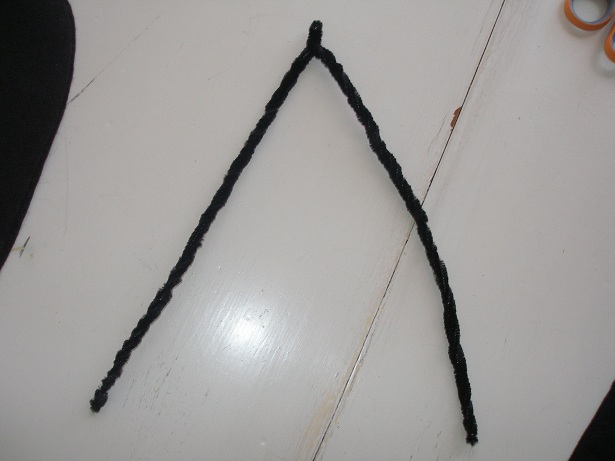
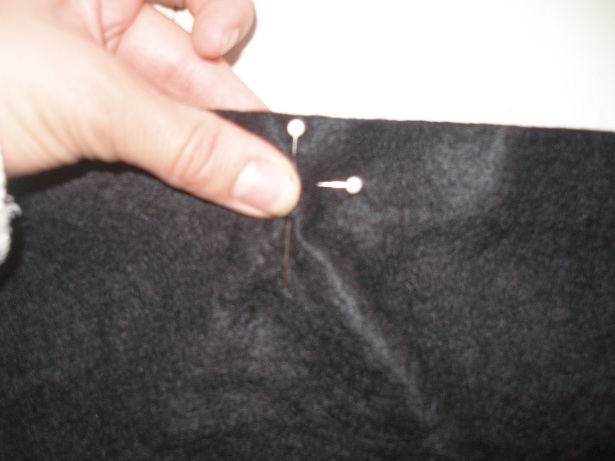
Working with one wing at a time, twist together some pipe cleaners (77 cents for 25).  I used seven for each wing.  Center the… uh, stem(?) of the pipe cleaners at the pin that marked the elbow, between the two layers of felt.  Pin the pipe cleaners in place.

Bend pipe cleaners so that they make lines out to the points of the wings and pin securely between felt pieces.

Top-stitch both pieces of felt together, starting with the outside edges.  Then top-stitch on either side of each pipe cleaner. It might be fun to use contrasting thread so you can see the stitching.  Repeat this on the second wing.

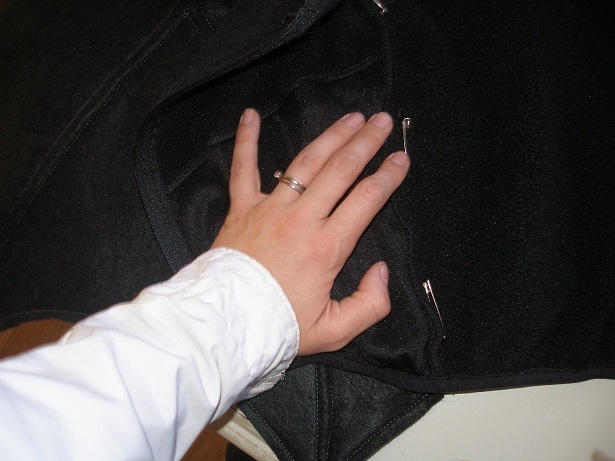
Now you will secure the wings to the jacket.  You could sew them in place, use hot glue, or if you want to reuse the jacket later, use safety pins.  I used safety pins.  I pinned the jacket at the wrist, elbow, armpit, waist and hem.  Then I had H try on the jacket, adjusted the wings as needed and added more safety pins.
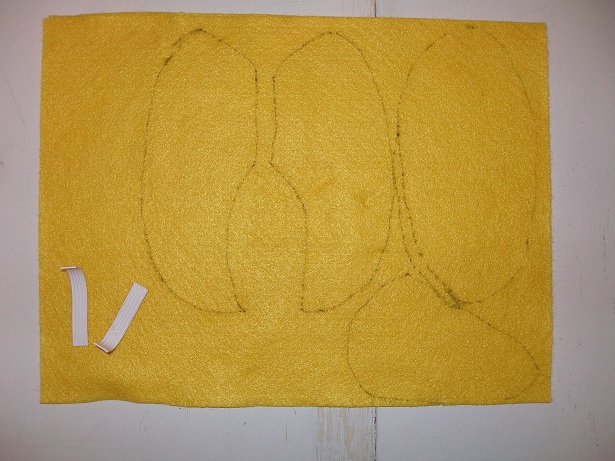
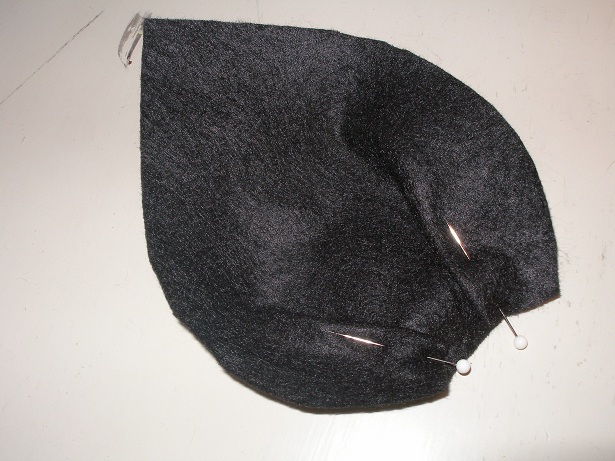
For the bat ears, I cut two pieces of felt in the shape of an ear.  Make sure they are big bat ears, not little cat ears!  You could do double layers of felt, top-stitched together here too, but I was running out of nap time and patience with Emmett, so mine are only one layer thick.  Pin and stitch pleats into each ear.  You might want to experiment with one or two pleats, etc.

Pin the ears to a black knit hat ($1.50 new).  Flip the hat over a stitch the ears on.  Alternatively, you could hot glue or pin the ears in place.

Ta-da!  A bat costume for $5.84 plus tax.  If you’re keeping tally, that’s $9.53 for two Halloween costumes this year.  If you could find a black hoodie at Goodwill instead of a jacket and a hat, that would save you even more.

When the 31st rolls around, H will wear his costume with black pants too.  He loves his costume – just what he wanted.  What are you doing for Halloween?  Do you dress up?  Are you making homemade costumes?  Carving pumpkins?

Note:  Please feel free to share this tutorial on your own blog, just include a link back here!  Thanks!

Categories: DIY, Thrift | Tags: , , , | 12 Comments

Handmade Halloween – Garden Gnome Tutorial

Last year, we found the funniest costume and we really wanted it for E (who has earned the nickname “Angry Elf”).  But we couldn’t find it in E’s size.  This year, Target is carrying the costume – for $20.

Basically these are brown and plaid, super-thin pajamas with a felt hat, fake beard and felt booties.  TWENTY dollars!?!?

So, I tried my hand at making it myself.  E already had hand-me-down green corduroy overalls and a red plaid shirt from H, so that part was easy.  Turns out, the rest was easy too.  Click the pictures for a closer view.

I got four pieces of 9×12″ felt for a dollar at Hobby Lobby.  Make that seventy cents – since it was my lucky day and the felt was 30% off.  And a piece of white craft fur for $2.99.

Step one: using two pieces of felt, trace and cut out hat shape.  Make sure to leave a seam allowance and that the brim will fit your babe’s noggin, plus a little wiggle room since the beard will be sewn into the hat.  I had to sew in little extra felt triangles since E needed just slightly more than 18 inches (pictured later).  Trace a beard shape on the back of the craft fur and cut out.  I suggest making the beard at the bottom of the piece fur so that you won’t accidentally cut the hair that hangs down at the bottom too short.

Step two: Cut two eyebrows from scraps of the craft fur.  Trim them to be a bit shaggy and then pin them to the front of the hat.  Sew eyebrows on.

Step three: If you need to add a bit of felt to make the brim fit your little one’s head, sew triangles to the back piece of the hat.  You can see my little triangles already attached where the beard is pinned.  Cut a six to seven-inch piece of thin elastic (I had some of this left over from a earlier project).  Center, pin and sew the elastic to the inside of the back hat piece.  Pin and sew the beard ends to the ends of the elastic.  Note that I sewed them as shown in the picture, but if I had a do-over, I’d turn the beard ends out before sewing them on so they’d lay more naturally when the hat is worn.  Details, people.  😉

Step four:  Pin the right sides of the hat together, sew and trim up any threads.  Turn right side out.  Voilà!

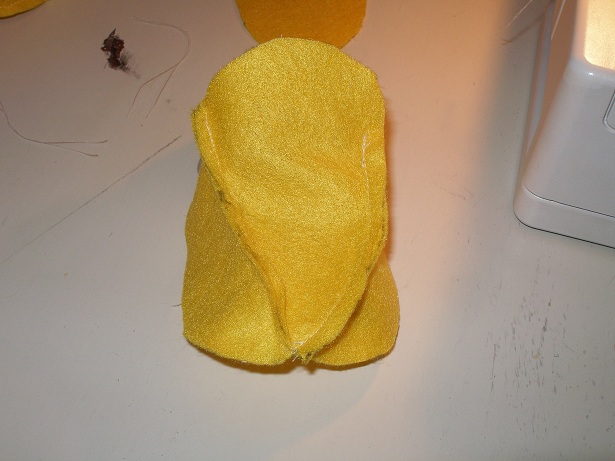
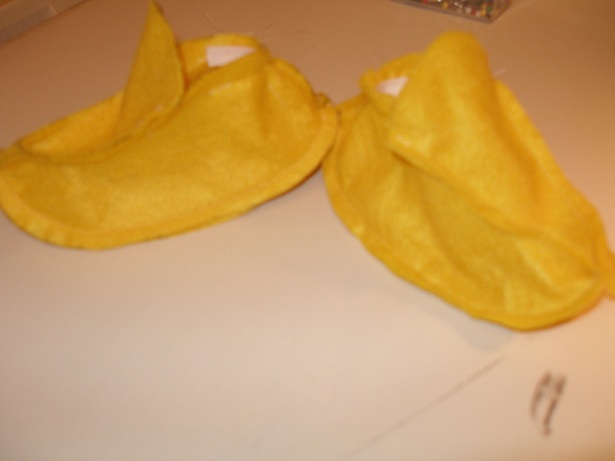
For the shoes, trace and cut a sole, a tongue and two sides of a shoe that will fit your kiddo on two pieces of felt (or on one piece and cut both pieces at the same time).  Give the sides a nice curl, so when it’s put together the toes will curl a little.  Cut two 1.5-2-inch pieces of thin elastic.

Sew the backs of the shoe sides together, right sides out/wrong sides together.  The seams should be showing on the outside of the shoe.  Next sew the elastic to the inside, centering with the center of the back of the shoe.  Then sew the sides to the tongue, again, wrong sides together.

You’ve just made the “upper” of a felt elf shoe.  Although, the story books would usually have it happen the other way around… the old shoemaker would be proud.  At any rate, they should now look like sole-less shoes.  Pin the soles to the upper, again, with the seams showing on the outside.  Sew the soles on.

All done.  Little gnome shoes.  Not the best to use in a house with hardwood floors, unless your gnome can’t walk.  But they will do for one night on the streets, begging for candy and creeping out old people.

Finally, dress the Angry Elf as a happy garden gnome.  And laugh all the way back to Target to return that ridiculously over priced costume.  You just made yours for $3.69 plus tax.

Note:  Please feel free to share this tutorial on your own blog, just include a link back here!  Thanks!

Categories: DIY, Thrift | Tags: , , , , | 18 Comments

Create a free website or blog at WordPress.com.