20 Weeks: The Space Between

So you may have noticed that it’s been THREE WEEKS since I last posted an update on my 20 Week Organization Challenge.  The good news is that I’ve given you plenty of evidence to support the fact that I haven’t just been laying around this whole time.

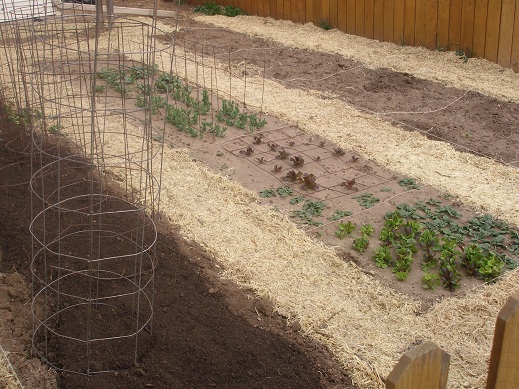
I’ve entered into my third trimester with this baby, and the need to get projects completed has gone into some kind of overdrive.  Poor Rick.  We hammered out the garden and he’s been working hard at the tree, and we’ve been collecting materials for the various other to-do’s this summer. Mostly with the beautiful weather, my head and heart have been outside and I’ve let the indoor projects sit on the back burner.  I’m so grateful to the wise woman who suggested that my updated 20 Week list might have a couple of gaps in it for a reason.

As I sat with my midwives, giving them a run down of all we’ve been up to and all the projects on the list yet to do, they asked what we’ve done to get ready for the baby.  Um…. I looked at Rick.  He grinned.  The crickets chirped.

So, as prescribed, a shift in focus has come about.  Not completely or anything.  Outside is still getting plenty of attention, but working inside is alright too.  We ordered our birth kit, the new car seat, and a grub hoe (see).  I got serious about cleaning out the former office-turned-storage room that will become the new baby’s room.  That of course meant that I had to get the downstairs junk room (let’s just call it the “spare room” for simplicity’s sake) reorganized quite a bit as well.

I had stored craft supplies on the changing table in the spare room, as well as a 4Runner’s cargo area full of stuff for the Goodwill.  The bookcase from the office was going to need to move downstairs to the spare room, the end table Rick was mending needed to move up.  Half my canning supplies are down in the spare room and three chairs we’re trying to sell on Craigslist are still in the nursery, leaving no room for the crib.  The area rugs we used in the office will need to go downstairs too.  These rooms are, in other words, impossible to organize separately.

I’ve shifted and shuffled, and taken that load of junk to the Goodwill.  I painted a wall, set up a bed, and cleaned out boxes that I’ve gone through twenty times since we moved seven years ago but never gotten rid of.  I moved two book shelves, reorganized DVDs and board games, got the end table upstairs and my business library put in order.  I’m nowhere close to done.  And, to be honest, my back hurts.

I’ve enlisted Rick’s help.  He helped me set up the bed, and I’ll need him to tackle the organization of his tools that are in the spare room.  I’ll also need him to carry the remaining furniture pieces from one place to the other.  I knew all this was coming.  The after picture on it will be worth three week’s wait – trust me.

Categories: 20 Weeks of Organizing | Tags: , | 4 Comments

Where’s the Meat?

Since my post last week when we unplugged the fridge I’ve gotten a lot of questions (mainly on my facebook page) about meat.  Are we vegetarian?  Are we switching to raw foods?  How do we plan to keep meat from going bad?  What about lunch meat?

Well, it’s pretty simple.  No we’re not vegetarian or switching to a raw food diet.  And we don’t store meat in the icebox (or the fridge).  Rick is a hunter.  The majority of our meat is some kind of game meat, mainly elk right now.  And we process his annual fall harvest (meaning we butcher and package the meat) ourselves.  That means all our meat is in vacuum-sealed packages, appropriately sized for our family.

When meat is on our menu, roughly three days a week in the summer time, I go out to the chest freezer in the garage, retrieve the prescribed package of protein and let it defrost on a plate on the counter, just in time to get cooked up for dinner.  If it’s a hot day in the summer and it defrosts quickly (we don’t have AC, I know you’re shocked), I put the plate in the fridge.  This is what I’ve always done in the past.  I plan to use the exact same method with the new icebox set up.

We generally don’t buy much in the way of meat from the grocery store.  It’s difficult to find humanely raised meat sources that don’t cost an arm and a leg.  That chicken we ate last week – regardless of it’s toughness, totally made Henry’s night – he loves chicken and we rarely eat it.  Lunch meat/deli meat is generally very processed and full of nitrates and preservatives.  Not very good for you in other words, and we basically never buy it.  The one meat we find ourselves bringing home periodically is bacon or bratwurst (the nitrite free kind on both counts).  But these are specific menu items that get used within a day or two of coming home from the store, and are a treat for us.  I don’t foresee a problem making half a pound of bacon last a day or two in the icebox.

When I announced this project, my mom, who really does think I’ve lost it completely, asked about the Thanksgiving turkey.  Well, luckily for the experiment, Thanksgiving isn’t in May.  But if it were and I were in charge of the turkey, I imagine I’d either buy it fresh a day or two ahead and keep it in the icebox (or a cooler with ice packs?) until T-day, use the cold water method to defrost it, or, as a last resort, ask the bachelor neighbor who runs a nearly empty fridge anyway to use his.

The other question a few people asked me (people who admitted they hadn’t been following along from the beginning) was where would we get the ice, since the fridge was unplugged and we were using the freezer compartment as a cooler?  The answer to that one is from the freezer in the garage.  We have two freezers in the garage, an upright and a chest freezer.  They are both full come September/October.  By the spring, we can usually consolidate to one and unplug the other.

Sadly, even the old 1980’s chest freezer is running more efficiently than our refrigerator was, and we would be running the freezer regardless of this experiment.  Our freezer contains a whole elk and countless pounds of frozen peaches and plums (around 200 pounds of fruit alone went in last September).  There are a handful of ducks from the winter, grouse from the fall, and a few fish from the summer time.  It holds all our excess farm and garden veggies that weren’t otherwise canned or dehydrated, though we’ve consumed nearly all of those by now.  In years past, when hunting’s been slim, we’ve bought whole pigs or a side of beef from local farmers.  Basically, we couldn’t eat sustainably on our budget without a freezer.  And, there’s room enough in the freezer for a couple of gallon-jugs of ice to use in our experiment.

So far, the switch hasn’t actually been too drastic.  I’ve found myself accidentally opening the refrigerator door to reach for the milk, only to find an empty cavern.  And I’ve made a conscience effort to collect and return items from the icebox all at once for recipes (let’s see, I need cheese, yogurt and the cucumber) in order to keep it as cool as possible in there.  It’s basically like using a cooler, or as CitySister said in the comments last week, it’s like camping!

Categories: Food, Simple Living, Unplugging the Fridge | Tags: , , | 7 Comments

Mother’s Day Big Brag

Wow!  Happy belated Mother’s Day!  Here’s my official brag about how great my family is and what a great weekend we had on the homestead.  This weekend I had requested to get the garden planted.  The plan was for me to spend Saturday with my mom and sister while Rick and the boys went with his mom to the botanic gardens, and for us to plant the garden on Friday after Rick was home from work and on Sunday.

On Friday, we planted corn, onions, and carrots with the neighbor and put in our tomatoes.  But Friday night, we got a call that our friend, Chris, had caught a swarm of bees for us, and another call that the CSA asparagus was ready to pick.

Some things just don’t wait.  So on Saturday morning, while the guys were at the botanic gardens with Grandma, my mom and sister came over here for bunch, and Chris brought us the swarm.

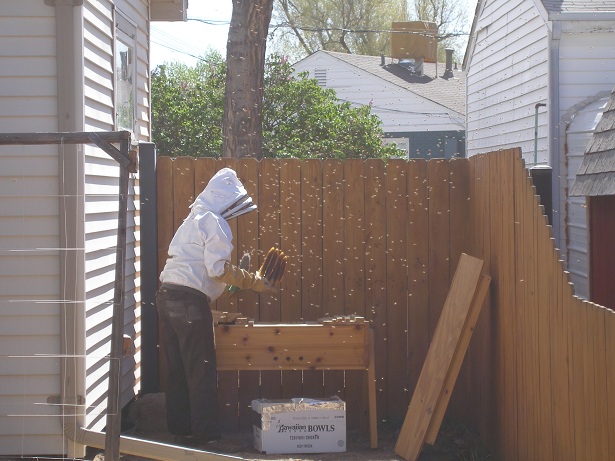
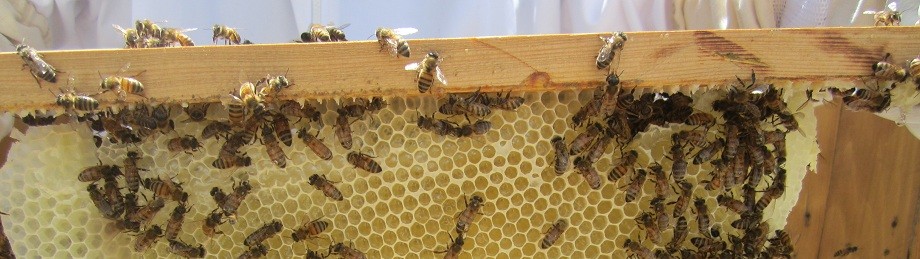
The bees we had last year left in the fall, we’re not sure why.  We think either the queen died or left since there were bees milling around aimlessly for a week or two before they were all gone.  There were no dead bees, just gone.  Last year’s swarm was also much smaller and our friend caught it later in the season while we were out of town.  He had installed them for us then, so this was the first time I got to experience putting bees into the hive, and Chris walked me through it.  My mom got to watch ME put the bees into the hive (and took pictures for us!).

These new bees were pretty cranky, they had been in the box for a couple days and were hungry and thirsty.  It took me three good tries to get the majority of them in the hive and get the bars on the top.  My initial trial of things, they sort of swarmed around my head and clung to the gloves I was wearing.  But they seemed to calm down significantly in a few minutes and I was able to knock the majority of the rest of them into the hive and get the bars on top without any trouble.  I was really surprised at how they clung to the box, and also how quickly they just took to the hive.

We put them in with the old comb that last year’s bees had left behind (we’re pretty certain there were no mites or diseases), and they settled down fairly quickly.  Many bees zoomed off to the water and sugar-water we had out for them, but others went to the entrance of the hive and started fanning their wings to spread the queen’s pheromones so the remaining bees in the box and the air (there were still quite a few) would come on in and start making the new hive their home.  It was really exciting and I’m sad Rick missed it again.

Then, it was back to brunch with the girls for me.  It was a really nice time (I made lavender pound cake and my sister made yummy pecan-dark chocolate scones).  When Rick and the boys got home, we headed up to the farm to pick asparagus.  It took us less than forty-five minutes to pick a good 25 pounds before we trimmed it all up.  It came out to about 14 pounds of asparagus, processed and frozen, plus some to eat fresh this week.

Sunday, for some unknown reason I woke up super early, before any of the guys rolled out of bed.  When they got up around 6:45, they gave me some sweet cards and kisses, and promised to build me a picnic table next week!  We got dressed and they took me out to Snooze (one of my favorite places) for breakfast.  Afterward, we came home and started up more planting work.

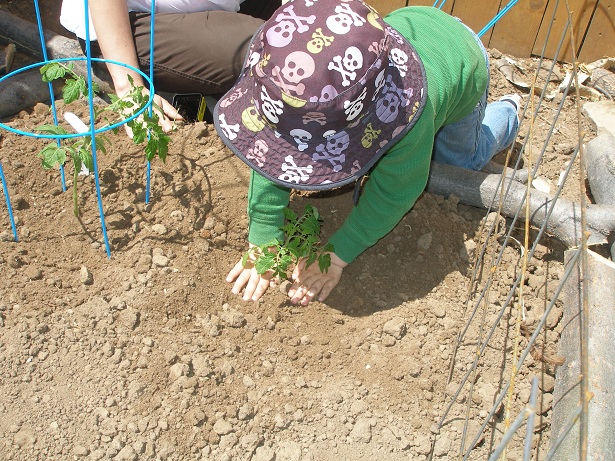
We did the boys’ hugelkultur bed first.  H planted watermelon, carrots (two kinds) and tomatoes (an heirloom red cherry and a “white” cherry that will actually be yellow).  The boys got a new real shovel and special, colored tomato cages.  My mom always said she wouldn’t be a mother without me, and I sort of feel the same about my boys, so they get treats on mother’s day too).  E ran around the hugelkultur while Rick scrambled to make barriers to keep him from trampling the seeds.

It was nap time before we knew it, and Rick and I spent the afternoon putting up asparagus (Rick did most the work), and planting out the rest of the main garden bed.  By the evening I had gotten plans for my new picnic table, an order placed for the grub hoe I’ve been lusting over, a [nearly] fully planted garden bed, four kinds of basil in my flower beds, a delicious sunburn on my shoulders, a home-made dinner with fresh asparagus, and a perfect day with my guys.  Lucky me!

I hope your Mother’s Day weekend was just as special as mine was!  What did you do?

Categories: Beekeeping, Food, Garden, Hugelkultur | Tags: , , , | 1 Comment

City Famer Review

I just realized I never posted my final review of City Farmer by Lorraine Johnson, so here it is.

I really liked this book.  The author is funny and addresses a lot of today’s major food issues in a lighter way.  Rather than making it feel like doomsday is coming, the book gives the reader hope that they can make a difference in their own city.  I liked that she called into question the perceptions of cultural and economic status of the people who garden, from the White House planting their lawn with food throughout different presidencies to HOA’s forbidding vegetable gardens (and the moral grounds to do that), to guerrilla gardeners getting arrested for planting at the offices of public officials (because then we’d have everyone and their uncle doing it).

As I continued reading I found myself inspired to start a community garden in vacant lots around my city and spying out places to plant fruit trees and asparagus patches on my way to the grocery store.  There are countless stories of communities coming together to create successful gardening projects in their home towns and neighborhood streets.  Schools, churches, business people, farmers and urbanites living in harmony, growing their own produce.

Johnson also briefly addresses beekeeping and romanticizes urban chickens.  Though I know a lot of urban homesteaders that are totally into keeping their mini flocks as pets, I’ve learned the difference between food and pets the hard way, so I have a somewhat less romantic view of urban hens.

Overall I recommend reading City Farmer if you want to be inspired to convince your neighbor to try vermicomposting and wonder if your city will allow you to plant vegetables in the medians of the streets.  It was encouraging to read how people everywhere are growing food, truly anywhere.

Categories: Recommended Reading | Leave a comment

The Hugelkultur Project

A while back, when we  decided to take on the project of cutting down our 70-foot tall (plus or minus) honey locust tree in the back yard, I began doing research on what in the world we’d do with all the wood.  As you may know, a lot of the smaller branches have become mulch for the garden.  But someone from the Take Back Urban-Homesteading(s) community on Facebook suggested to me to build a ‘hugelkultur.’  A hoogle-whater?  So, of course I Googled it.

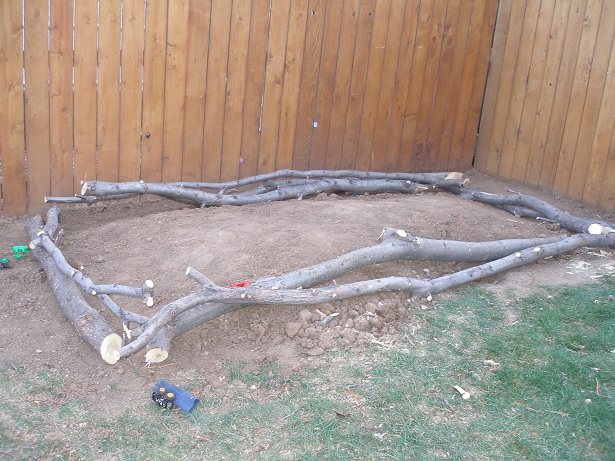
I’ll try to save you some time.  A hugelkultur (pronounced “hoogle-culture” – I think), is basically a raised bed in which wood or other carbon-rich materials is buried.  Some people lay logs directly on the ground, use a tractor to dump a pile of dirt on it and then start planting on their new, hill-shaped bed.  (I like the info in this link).

The advantages of this method of gardening is that the wood, as it rots, acts as a sponge, making it so you don’t have to water much.  Additionally, it releases nutrients over time into the soil, making it so you don’t need to fertilize.  And, as it rots, it leaves plenty of air space in the soil, so you don’t need to till.  Basically, it is a no-maintenance, self-composting bed.  The first year or two, especially with green wood like ours, it will actually draw nitrogen from the soil in order to start decomposition.  But thereafter, it will supposedly do nothing but give back.

Sounds like a good plan to us!  So we decided to give it a try in the boys’ backyard garden bed.  We don’t have lots of spare topsoil just lying around everywhere, nor the desire to buy any, so we thought it would be a better use of what we do have to dig down into the ground and bury the wood with our own topsoil and subsoil.

We dug down a good 12-14 inches.  Then we laid in some of the branches that were too thick to go through the wood chipper.  Then we buried them.  This left us with basically an instant raised bed, as promised.  We used some of the bigger, straighter limbs from the tree to make an edging (not yet complete).  Otherwise the boys would truck that dirt all over the back yard before anything could be planted there.

After an afternoon of being (unnecessarily) compacted by a 22 month old in a Tonka truck pushed by a 4 year old.

Fortunately for us, we have plenty of nitrogen-rich compost, thanks to the chickens.  We mixed a bit of that in to compensate for the initial anticipated nitrogen loss/Tonka truck compaction.  Henry wants carrots, tomatoes and watermelon in his bed this year.  We’ll keep track and let you know how it goes!

Does anyone out there have experience with a hugelkultur?  What about deterrents for little boys and their ride-on toys?  😉

Categories: Garden, Hugelkultur, Simple Living, Sustainability, Urban Homesteading | Tags: , , , , , , , | 6 Comments

-Chipping Away at the To Do List

As you might have noticed, by my lack of blog posts last week, I have been busy around this place.  We’ve been working diligently at getting the tree in the back yard cut down, the branches chipped, and the gardens set up.  So much so that we’ve actually neglected a few other things around here.  Things like ordering a car seat for baby number three as well as our birth kit.  I’m in my third trimester now, and we have pretty much nothing set up for the baby yet.

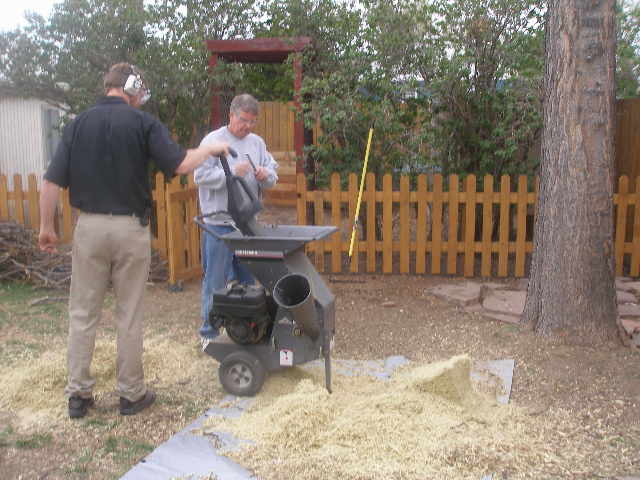
Here’s what we have been doing though.  Rick and the neighbor, Doug, got the wood chipper working and made short work of nine of the eleven piles of branches in the yard.  The other two piles were too big to put through the chipper, so they’ll have to wait.

There’s still more of the tree to cut down, but the weather has been uncooperative (too windy) to take down the tallest parts.  Hopefully this week, before the tree leafs out!

After expressing how chicken wire works just fine to protect your flock from predators, we lost two hens to a fox.  Now to our… erm… credit?  shame?  it wasn’t a failure of the chicken wire, so much as a failure to close up the coop at night.  I confess to being a lazy chicken owner, and leaving the coop open much of the time.  The hens put themselves to bed, and Josie, our big mutt, used to really help in keeping predators away.  But this is the first spring we are without her, and I really wasn’t thinking much about it until I found a hen dead one morning last week.  She was headless and we’re pretty sure Rick scared the fox away when he was leaving for work.  Somehow, neither of us heard a commotion in the coop, but it was windy and Rick thought he had heard the kids’ tent blowing around.  Turns out it was probably a chicken scuffle.

We of course cleaned up the mess, and that evening, just around sunset, when Rick went out to close the coop, he found dead hen number two.  It had JUST happened.  The neighbor had scared the fox as they walked by.  We think that the fox might have been coming back for the first hen that it left, and since it was gone, it killed another.  Since we found this one fresh – very very fresh, Rick butchered her up (discarding the part where the fox bit her – just her back) and we made chicken and dumplings.  She was actually our oldest hen, and I don’t think any amount of stewing would have made her legs edible – think really tough chicken jerky.  But we tried at least, and her breast meat was ok, and she made tasty broth.

The good news on the chicken front is we’re pretty sure those were the two hens that were eating eggs, and the older hen really wasn’t laying much at all anymore, so the fox saved us some trouble of getting up the nerve to off them ourselves.  We’ve not had anymore broken or eaten eggs, and our egg numbers are still about what they were, since now we’re getting them all instead of racing to beat the hens.  AND the chicken wire is still doing it’s job, as long as we keep doing ours.

This weekend we spread the wood chips to mulch the garden paths.  Our neighbor watched over the fence.  I know he thinks we’re crazy for going to the effort to mulch the tree instead of just hauling it to the dump, but I’m happy it’s going to good use, and hopefully it’ll work at keeping weeds down between the beds.

Otherwise, we made a trip to the garden center to get our tomato and pepper plants.  I’m excited to try a couple varieties that we’ve not done before.  I spent some time spreading compost in my tomato bed and the plants are hardening off this week to get ready to go to the ground this weekend.  I’m chomping at t he bit to get the summer things in the ground.  Just waiting for the weather to get on board too.

So this week I plan to get a few more things outside organized, but I also am going to try to focus on a few inside projects as well.  Like laundry and getting the baby’s room emptied.  There needs to be a balance, I know. The to-do list seems never ending this spring.  But little by little we seem to be getting items crossed off.

What have you been up to?

Categories: Chickens, Food, Garden | Tags: , , , | 7 Comments

We Call it an Icebox

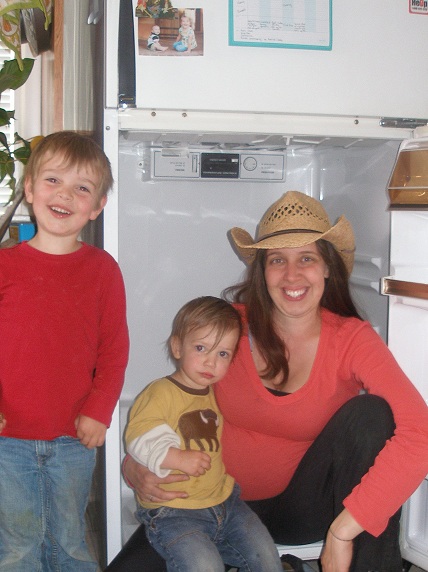
May 1st, we officially began our experiment.  We unplugged the fridge!  I was encouraged at how on-board Rick really was.  On Saturday night, he even made sure that we had jugs of water in the freezer, in order to be prepared for the first day using our freezer compartment as an icebox.

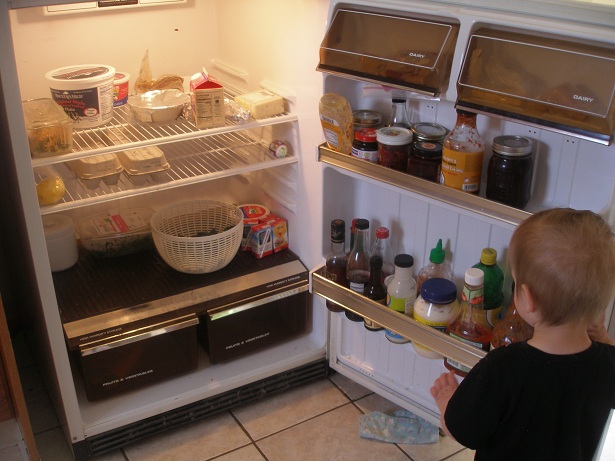
Yesterday was really only a half day with the new system.  I should have prepared better on Saturday by doing all the cleaning and stuff ahead of time, but I was distracted by trips to the garden center.  So, on Sunday morning, Rick cleaned out the freezer while I went to the grocery store.  When I got home, I cleaned out the fridge and we set up the new system in the former freezer compartment (what will from here on out be referred to as the icebox).  The actual unplugging took place around noon.

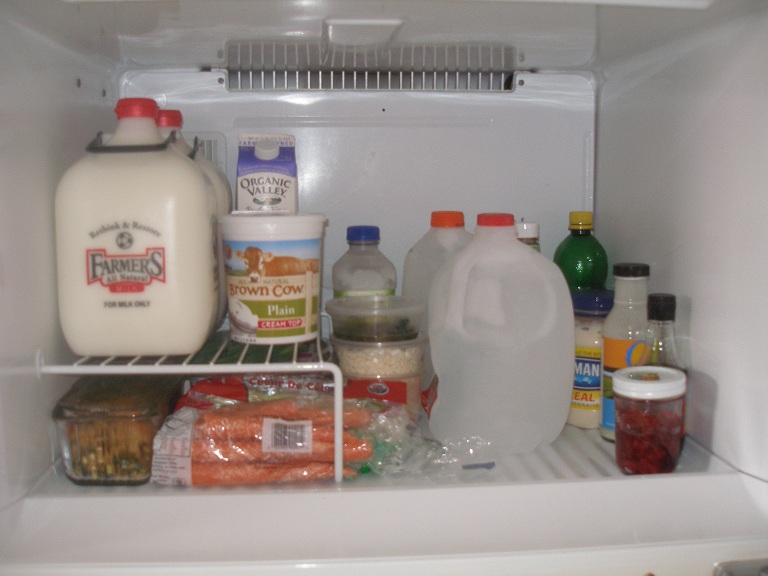
Here’s what the icebox looks like now.  This is our full week’s worth of refrigerated food, including two gallons of milk, a few condiments I wasn’t sure about leaving out, some leftover greens that we bought last week, and the eggs for my sister that were already in the fridge before.

I’ve done a little rearranging already, putting the less perishable items like carrots, in the door, and keeping the soft cheeses further back by the frozen water jugs.  Also, that container of left-overs on the very bottom left was promptly eaten by me after cleaning out the bottom of the fridge.  It was after lunch time and I was hungry!

I’ve actually had a hard time resisting the temptation to continually open the icebox to feel if things are cold in there, but I know keeping the door closed is crucial to the success of the experiment.  Rick has suggested getting a thermometer that we can keep in there so we won’t worry, and we’re going to experiment with different ice-jug configurations to make sure we’re making the best use of the space and coolness (is that a word??).  He also suggested that we keep the jugs on a towel or something, that way we won’t have to constantly be wiping down the interior of the icebox, since the jugs will probably sweat as they melt.  For someone who thinks I’m crazy, he seems awfully involved, huh?  I guess it’s not just me after all.

Categories: Food, Simple Living, Unplugging the Fridge | Tags: , , , , , , | 10 Comments

Getting Ready to Unplug

I’m not crazy.  Really.  I’m not.  I just read a lot of green-type articles and blogs, and I think .  I think a lot.  When I mentioned my latest idea to Rick, he became very quiet.  You know, the kind of quiet where someone clearly thinks you’re off your rocker, but is trying to figure out how to say so and if it’s really true?

Perhaps it’s because he’s experienced with my “thinking episodes.”  He calls it a ‘wild hair,’ or my ‘latest project.’  But I know he hasn’t forgotten how those nagging little thoughts of mine plague me until I drag him and the rest of my family into some project or other that the rest of society at large would consider crazy.

Consider for example when I started thinking about chickens.  In our back yard.  In the city.  Or when I started thinking about bees.  BEES!  Now we have a coop, eight hens, and an empty bee hive waiting for a second try with a new swarm.

Then there was the time I started thinking about the microwave.  I’m pretty sure this is what Rick’s mind flashed to when I mentioned to him this latest “wild hair.”  You see, lately I’ve been thinking about our fridge.  I’ve I’ve thought about it a lot actually over the last few years.  Our fridge was here in our house when we moved in.  So we knew it was at least 8 years old… and recently, I can’t seem to stop thinking about how much energy it’s using.  As the appliance that consumes the most energy in American homes, the refrigerator, running 24/7, I have been concerned about all the kilowatts leaching out of our meter.

I called the manufacturer of our refrigerator, model and serial numbers in hand.  I was surprised to learn that our fridge was not as old as I thought.  Made in June of 2001.  But I was dismayed at the big 863 kWh that it was consuming.  New refrigerators of the same size and style are consuming less than half than that.  Ours is consuming more than the old 15 cubic foot chest freezer from 1984 in the garage – that consumes a whopping 601 kWh, nearly fifty-percent more than what a similar modern freezer consumes.  This seems like a big problem to me.

Initially I thought the solution to this problem would be for us to get a new fridge and a new freezer.  See that was my first thought (i.e. not crazy!!).  But we don’t really have the $600 to shell out for a new freezer, let alone $800-1400 for a new fridge.  Then I started paying attention to what our fridge was actually doing.  The freezer on top usually stores the frozen CSA veggies and random meats brought in from the chest freezer for the current week’s dinners.  The refrigerator only really contains our eggs, dairy, condiments, and an excess of greens and celery.  Sometimes there are left-overs in there for a day or two (max, we’re good left-over-eaters around here).  I defrost foods on the counter the day I need them.

In other words, we’re not really using much space in the fridge, and some of the things we have in there don’t really even need refrigeration.  Eggs are shelf stable for quite a long time, and in Europe, they are even sold on the grocery shelves unrefrigerated.  Many condiments are shelf stable as well, despite warnings to “refrigerate after opening.”   And, around our home, lots of them get used up way before they’d ever spoil in the cabinet (peanut butter and jelly, soy sauce or sesame oil, for example).  So my second thought was to look for a smaller fridge.  An apartment-sized or even a dorm-sized fridge.  But I found out that they consume a lot of energy as well.  Nearly what a large fridge consumes.  And they have a pretty hefty price tag, even on craigslist.

Now I was questioning what we really needed.  For basically just storing our milk, yogurt, half and half, and the occasional bowl of left-over noodles or extra head of kale, what did we need?  Do you see where I’m going here?

I’m thinking about going without a fridge.  Let me say it again, so you know it’s not a typo… I’m thinking about going without a fridge.

So you can see why I was surprised that Rick didn’t immediately pass out when I mentioned to him a few weeks ago that I’ve been thinking about the fridge.  I have to give him a lot of credit.  He silently listened to my idea.  I explained my idea, talking fast because I could hear the doubt oozing through his silence.  We have coolers and I had an idea about using the top freezer portion of the fridge as sort of an ice box.  His next question, an incredulous statement really, was “you really expect me to run out to the freezer during the freezing-cold winter to swap-out ice packs because you don’t want to use the fridge?”  but he had answered his own question.  In the winter it would be cold.  We could keep things outside the back door on the patio.

As what I was suggesting started to sink it, I think I heard a muttering or two of “my wife really is crazy” and a sort of stifled laugh.  But there was some weird resignation coming through the phone.  I broke the news to him while he was at work, you see.  Safer that way, I figured, and it would give the idea a little time to stew in his head before he got home and could really talk about it. I was afraid he’d dismiss the idea out of hand.

When he got home I had my argument all ready.  It would be an experiment.  For just a month.  One month.  And we’d keep the freezers.  And it wasn’t as if we couldn’t use refrigeration… the ice box idea was just a old-fashioned, lower energy form of that.  I promised that we’d only unplug the frige for now, and if it wasn’t working we could just plug it back in and bag the whole thing.  Rick asked surprisingly few questions.  He sort of shrugged.  I asked if he told his co-worker of my idea, and when he admitted that he had, he told me his coworker’s response was, “Do you encourage her?”  I think he must have confessed that he does, so he really didn’t have a lot of argument against it.

After a few minutes, he asked about the summer, when the CSA is in full force and we have more veggies than we know what to do with.  Won’t they all just wilt and go to waste without a fridge to keep them in?  I had thought about this and confessed I didn’t have a total solution… yet.  But my tentative plan was that since I wasn’t going to be working on the farm this year or driving an hour each way every week, I’d have six extra hours and a lot more energy on farm day to get veggies washed and put up properly before anything wilted.  We’d put the things we were going to save for the winter in the freezer the day they came into the house instead of waiting a day or two, and we could use coolers for the melons.  Rick eyed me suspiciously.  But he said I could try it in May if I wanted.  We’d tackle the summer if we decided to continue the experiment.

I have read a bit about going without a fridge in the past, and since deciding to embark on this project.  Proponents like Sharon Astyk and Greenpa give me a lot of hope.  I’ve read the arguments that Deanna at the Crunchy Chicken makes against unplugging the fridge too.  But I think that this really can work for us.  Sharon Astyk has a fairly simple system going that I plan to emulate.  No, we won’t be drinking gallons of milk in a single day.  We’re not the first to try something like this.  And if things work, we’ll probably unplug the fridge for good.  We’ll turn that space into a pantry area to store our canned goods, and we’ll save money for a new, energy-efficient freezer.

Crunchy asks if it’s cheating to use a freezer in your effort to not use a fridge, but the truth of it, at least in my eyes, is that it’s not.  I see them as two different tools.  (You really should read  all the comments on that thread, by the way – you might just get converted by Sharon & Greenpa).  Rick hunts and that is the greenest, healthiest, most organic and humane way to get meat.  Not to mention most economical.  But it would be a waste if we couldn’t freeze it.  The CSA share provides more local, organic veggies than we can eat in a summer.  But local fresh veggies are a rarity here during Colorado winters, and what ever you can find is usually very expensive.  So canning, drying and freezing summer’s excess is another economical, practical, and efficient way to eat well all winter.   And, sadly, even our very out-of-date freezer is running more efficiently than our less out-of-date fridge.

So, let the experiment begin.  I hope you follow along with me in May as we try unplugging the fridge.  If anyone out there has done something like this in the past I’d love to hear your experiences.
Categories: Food, Independence Days, Simple Living, Sustainability, Unplugging the Fridge, Urban Homesteading | Tags: , , , , , , , | 16 Comments

Blog at WordPress.com.