Monthly Archives: August 2012

Wild Elk and Venison Jerky on Northwest Edible

From the Native Americans to The Hunger Games, people have carried jerky.  You know that if the zombie apocalypse hits, you’ll want some too.

I’m so excited that Erica at Northwest Edible Life has allowed me to do a guest post on her blog about my favorite way to preserve meat.

Rick got this recipe from his mom.  All the men in Rick’s family are big-time hunters, and my mom-in-law is the designated jerky maker for the family.  Her sons, brothers and dad all drop meat off at her house to have her transform it into this good stuff.

I’m sharing the secret recipe over at Northwest Edible.

Related articles
Categories: Canning and Food Preservation, Food, Hunting, Recipes | Tags: , , , , , | 5 Comments

Homestead Failures: Confessions of What I Didn’t Do

Every once in a while I come across someone who describes me in the most peculiar way.  There’s a great homesteading blog that says something like “the most organized homesteader I know.”  Or, one that shocks me even more, “This woman can do it all!”  Yeah.  Not so much.

I’m a bit bothered by these statements actually.  I try to be pretty honest on my blog – not just all shiny-happy all the time.  I’m not joking when I call myself the LAZY homesteader. I’m really, really great at coming up with an idea, gathering all the materials, and not following it through to completion.  Rick often plays clean-up to my projects.

I’m not sure if I’m more bothered by the fact that I’m somehow failing to communicate the realism of my life ( I have THREE kids that sometimes drive me to drink, people), or if it’s the imagined (implied?) pedestal that someone thinks I’m on that gets to me.

There are a lot of Judgey-Judgertons out there ready to tell you you’re not doing enough, you’re doing too much, you’re doing it wrong, or what you’re doing isn’t as important as what they’re doing.  I’m so not that.  I don’t ever want to communicate that.

I’m not sure exactly what the communication break down is, but I wanted to pause a moment to illustrate for you just how imperfect my life really is.

Please, come with me into the urban homestead confessional.  Forgive me Followers, for I have sinned.  It’s been 11 months since my last confession:

  • This year I planted beets that I failed to harvest until they were good for nothing besides pig food.
  • I’ve completely lost track of my Independence Days challenge this year.  I still have an egg count going though.
  • I never made pickles this year.  And I ignored the fact that my melons and cukes didn’t germinate, I didn’t replant them.
  • I decided to take on the Riot for Austerity.  And then I didn’t.
  • Last summer, I over-bought peaches.  I feel like I still have as many peaches in the freezer this year as I did last year.
  • This spring I used not-quite-finished compost in the garden and then grew lots and lots of weeds.  I generously gave some of this same compost to the neighbor.  I send H to pull weeds for him.
  • In 2011, I gave myself a 20 week organizing challenge: twenty weeks to organize twenty things.  I stayed on track for 8 weeks, went all sporadic, took a five month break, did three more posts on it at the beginning of the year, and then completely blew the project off.  I still have four items to go.
  • I collected too many chickens.  I was like the crazy cat lady of chickens.  We had 14 and they were all stressed and dirty and it stank.  We butchered three and are holding steady at 11 right now.  They are much happier and we’re loving the eggs.  But really I need to find a home for 4 more of them; I’m putting it off because I’m all attached or something.
  • I bought a grow light to start seeds with.  I sat it on the dryer and never opened it.  After four months, I dusted it off and returned it to Lowes for store credit.
  • I drove two hours, round trip, to pick three boxes of tomatoes from my CSA.  I let the husband wash them and then left them on the counter for 19 days until all but 22 were rotten.  At that point, I divided the remainder between the chickens and the compost bin.

What are some things you had the best intentions for but didn’t pan out as planned?  Have anything to confess?

Categories: Top 5, Urban Homesteading | Tags: , | 33 Comments

Venison Stew

When Rick and I got married, though I possessed a decent degree of skill in cooking, my meals were rarely balanced (“chicken breast is dinner… what to you mean what else are we having?”).  It took some time for me to learn that a meal included more than one thing.  But there was an exception to this; soups and stews.

I grew up in a home that made soups and stews regularly.  They were a staple in my parents’ home.  Both of my parents worked outside the home, so my mom is proficient at pressure cooking which made soup an easy weeknight meal.  She is also the master of slow cooking a stew for hours to get it just right.  I used to tell people my favorite foods were easy to remember; sushi, steak and soup!  (Mom makes a mean rare rib-eye too).  It’s tradition for our family to have a big pot of potato soup on Christmas day, which keeps everyone out of the kitchen and allows us to spend time together as a family instead.

I don’t know how Rick felt about stew before we got married.  I don’t get the impression that he had it much growing up.  For me it’s soul food.  There is nothing so good as a hot, delicious soup to warm you up at the end of a long or cold day.  I think our kids feel the same way.  If you were to ask H what is favorite food is he will either tell you potato soup or chicken noodle soup – the homemade stuff – which is my favorite as well.

Naturally, having wild game in the freezer means venison stew shows up on the menu pretty often in our home.  This recipe is one that I’ve developed by marrying my mom’s beef stew with elements of a venison recipe that an ex-coworker of mine shared with me from some now-forgotten cookbook.

Venison Stew

8 slices of bacon, cut into ½-inch pieces
1 large yellow onion, diced
2 lbs venison, cut into 1-inch cubes
3-5 cloves of garlic, minced or pressed with a garlic press
12 oz beer – something you like to drink, but not Guinness
4 cups water
1 tsp dried thyme
1 tsp dried marjoram
2 dried bay leaves
1 tsp salt
¾ tsp black pepper
3 carrots, peeled and sliced into ¼-inch rounds
3-4 potatoes, peeled or not, cut into 1-inch pieces
¼ cup fresh parsley, snipped

In a 4 quart dutch oven or other large pot, cook the bacon until crisp.  Remove the bacon with a slotted spoon and save for later.  Saute the onions over medium heat in the bacon grease until translucent, about 5 minutes.  Turn the heat up to medium-high and quickly brown the venison.  Add the garlic and saute for about 30 second.  Turn the heat back to medium and add beer, water and spices including salt and pepper.  Bring to a boil, reduce heat and simmer, partially covered for about two hours.

When venison is nearly tender, add the carrots and potatoes.  Simmer, uncovered for another 20-30 minutes until the potatoes are fork-tender.  Taste for salt.  If you wish, thicken the stew by mixing 1 cup of cold water and 1/3 cup flour in a separate container and slowly add it to the stew while stirring.  Reheat the stew to boiling  for 1 minute.  Serve topped with reserved bacon and snipped parsley.

Categories: Food, Hunting, Recipes | Tags: , , , , , | 3 Comments

The Gamey Taste of Game Meat, Part II

Every so often I publish a blog post either about hunting or with a picture of an elk steak in it.  Usually after this I get at least one or two questions about how to prepare game meat so that it doesn’t taste so “gamey.”  I hear lots of people saying they would hunt but they don’t like the taste of the meat, or that they just don’t know how to cook it. Likewise, whenever we serve game to friends and family, we get lots of surprised comments about how flavorful and good the meat is, not at all gamey as they expected.

In part one of this series I talked about the differences between beef and venison and how that affects the tenderness and juiciness of the meat.  It is important to know that wild game is not beef and therefore must be prepared differently and will taste different.  Today I’m going to talk about processing wild game and its relationship to the “gamey” flavor that venison often has a bad reputation for.  This is not a how-to, but rather an overview of the entire process.

What does venison taste like?

Deer, elk and antelope (as well as other game animals) each have a distinct flavor.  Antelope (pronghorn) and whitetail tend to have a bolder, wilder flavor, while elk tends to be less so.  Yak and bison taste the mildest, most similar to beef but slightly sweeter.  For the purposes of this post, I’m going to refer to them all as venison, despite the differences between the animals.  Mule deer, which is what we most often get in Colorado, is somewhat middle of the road on the wild-flavor scale.

First and foremost, let’s talk about what venison should taste like.  It should taste:

  • fresh
  • richer and more “meaty” than beef
  • bold with a lot of depth
  • of a mild sage or juniper flavor (depending on the animal’s diet)
  • according to some, similar to mutton, but much leaner
  • depending on the species, mildly sweet

Venison should not taste:

  • “off” or rotten
  • pungent
  • bitter
  • overly sweet
  • bland
  • like beef

Venison is darker in color than beef and should not ever smell bad or be tinged green or grey.  It is my opinion that the bad reputation of venison’s “gamey” flavor comes from poor processing habits and the serving of meat that is actually rancid or at least borderline.

What effects flavor:

The key to fresh tasting meat it to get it cool and skinned as fast as possible.  Leaving it hot or leaving the hide on will cause it to rot quickly and leave your meaty tasting quite “pungent” (i.e.: rotten).  This is important whether you plan to butcher the animal yourself or are taking it to a pro.  If you leave the hide on longer than necessary or don’t cool the meat quickly, it will have a bad flavor.

Often I’ve seen hunters leave their meat hanging, skin-on, in the garage to “age”  or “cure” the meat in hopes of making it more tender.  While properly aged meat is delicious, doing it in your attached garage is a very good recipe for rotten deer steaks.  Leaving your deer carcass hanging for days in a tree, barn, pole or garage is not aging it – it is rotting it.  Colorado weather is not conducive to the traditional buck poles of the Great Lakes states.  If you wish to age your venison, take it to a butcher or meat processor where it can be done safely, in a temperature controlled environment.

Additionally, avoid meat from trophy hunters, and avoid becoming one yourself.  Trophy hunters are usually after great big, hormone-filled bucks in the middle of the rut (mating season).  All those male deer hormones add a distinct musky flavor to the meat.  Does and cows taste much cleaner and nicer than bulls and bucks depending on when the animals are harvested.  Also, meat harvested during archery season in Colorado is going to tend to be more mild than meat from rifle season, because the archery season is before the rut.

Field dressing and cooling your meat:

Hunting is a tradition that is passed on from generation to generation, and so is processing meat.  “Processing” is a nice term for cutting and preparing an animal for consumption, including gutting, skinning and cleaning (a.k.a. field dressing).  While you can learn to do this on your own, I’ve found that most hunters have learned to do this in the field, taught by an experienced relative or friend.  Rick learned from his grandfather and uncles.

This means that if the teacher has bad meat processing habits, he (or she) will most likely be passing them on to the student.  And this leads to bad tasting meat.

Please, please, if you are not confident in your ability or the ability of your teacher to effectively process your animal, find someone who’s game tastes delicious to teach you.  Ask tons of questions, or just take it to a professional processor.

Packing out meat using game bags.

The real work of hunting is not in the tracking down and killing of the animal.  That is only where the work begins.  After harvesting an animal that is fully grown, looks healthy and is of the sex you have a license for (preferably with a shot through the heart and lungs), you should immediately open it up and gut it.

Be very careful during this process not to nick the intestines with your knife or let any of the digestive juices or fecal matter touch the meat.  Take your time and have someone who has more experience show you how to do this in the field.  Any meat that has come into contact with fecal matter or digestive juices is essentially ruined. 

Once gutted, your next move should be to remove the hide.  Take care to keep the hair and any dirt or debris off of the meat.  If it is a large animal, like an elk, you will need to quarter it to pack the meat out.  Put the skinned meat in game bags.  Game bags are inexpensive, protect your meat, and allow you to remove the hide in the field so that the meat can cool as quickly as possible.  They are well worth the small investment for the taste of your meat.

If you harvest a smaller animal such as a pronghorn or whitetail and wish to drag it from the field without quartering it, leave the hide on until you get it to a point where you can skin it as quickly as possible with out the meat becoming dirty. In either case, get the animal in coolers with ice as quickly as you can.  Keep coolers and ice in your vehicle.  If your animal is whole, saw though the sternum, pack the cavity with ice jugs and wrap it in a tarp until you can quarter it.

If it is possible, you should begin butchering the meat as soon as you are back to your work area.  If you must leave your animal overnight before you can butcher it, quarter it (if you didn’t before) and put the quarters in coolers with plenty of fresh ice jugs to get/keep it cool.

Some hunters will hang the meat, propping the body cavity open to allow it to cool overnight.  We have seen this done in the Colorado mountains where it gets below freezing each night during hunting season.  I don’t recommend this method of cooling because temperatures are not certain and can easily fluctuate, promoting bacteria growth on your meat.  If you choose to do it, make sure to quarter the animal and get it over ice first thing in the morning; sunny Colorado daytime temps can get well above 40 degrees even in late season hunts.  Also be aware that leaving your venison hanging overnight will invite bears and other predators to your camp.  Rick’s uncles have lost entire sides of an animal and incurred lots of damage to barn doors that way.

Butchering game:

Double-wrap and label your meat.

Before you begin butcher your animal, thoroughly wash your hands, knives, cutting surfaces, counters or tables and any other tools you might be using.  Butchering an entire animal is a big, messy job that most average kitchens can’t handle.  Many hunters end up using a garage or barn.  If you are among that group (we are), make sure your garage and work surfaces are scrupulously clean.  You are planning on eating this meat.  Don’t give yourself food poisoning.  Also, make sure you can keep the area cold.  Heat will rot your meat.  Dress in layers while you are cutting meat if you have to.  Lastly, make sure your knives are sharp and keep a sharpener handy.

While Rick’s family taught him how to process the animal up to this point, we don’t butcher the meat in the same way he was originally taught.  I cook quite differently than Rick’s mother and grandmother, so I prefer our meat in different cuts and thicknesses than those Rick used to bring home.  In this way, we are still learning to butcher meat ourselves.  We have read lots of books and studied diagrams, and still most of our cuts of meat (besides the back-straps and tenderloin) get the general label of “steak.”  Because of this, I’m not going to give specifics on butchering.  But here are the the points that I feel are important to share:

  • Keep everything clean.
  • Keep everything cold (40 degrees or lower).
  • Cut your steaks a little thicker than you think you should.
  • Throw away any blood-shot or bruised meat, typically around the wound.
  • Remove the silver skin (the white, inedible connective tissue over the meat).  It is easier to do it now than after you cook it.
  • Set odd bits and small pieces aside for hamburger or sausage.
  • Package your meat into serving sizes for your family.
  • Vacuum seal or double wrap your meat to prevent freezer burn.
  • Label your packages clearly with the date.

Finally, when butchering, don’t dawdle.  You are working against the clock to get your meat in the freezer before it rots.  If you need to take an extra day off of work, do it.  Don’t rush through the work, you must be careful not to cut yourself, but don’t put off the butchering.  It takes priority over other activities.

If you get the feeling that I’m blaming the negative connotations of “gamey” meat on it being rotten, you are right.  I stand firmly in the camp that if the meat tastes bad, it is bad.  By getting the meat skinned and cooled as quickly as possible, and by keeping it cold while butchering it, Rick and I have enjoyed much better tasting meat.  Not “gamey” at all, just fresh, wild and delicious.  The time invested after the animal is down is well worth it.  And enjoying the meat is the whole point.

If you’ve enjoyed what I’ve posted about cooking wild game so far, please subscribe to have my future posts shown in your RSS feed or emailed directly to your inbox by using the form in the sidebar at the right.  You can also find me on Facebook.  Thanks for reading.
Categories: Food, Hunting | Tags: , , , , | 16 Comments

The Gamey Taste of Game Meat, Part I

Every so often I publish a blog post either about hunting or with a picture of an elk steak in it.  Usually after this I get at least one or two questions about how to prepare game meat so that it doesn’t taste so “gamey.”  I hear lots of people saying they would hunt but they don’t like the taste of the meat, or that they just don’t know how to cook it. Likewise, whenever we serve game to friends and family, we get lots of surprised comments about how flavorful and good the meat is, not at all gamey as they expected.

Since hunting season is just around the corner for many parts of the country, and since our family mainly eats game meat, I thought I’d share a bit about how we process and cook the meat, and how we deal with the “gaminess” of venison and other meats. Over the next couple of weeks I plan to publish a series of hunting related posts, including recipes for cooking wild game.

Making wild game into a delicious meal was learned through trial and error over the last nine years of cooking and processing game.  We’ve made some discoveries that have really helped us.  When people refer to venison as gamey they are either speaking of the toughness or dryness that often occurs when cooking the meat, the distinctly wild flavor, or both.  It’s a bit backwards but I’m going to talk about cooking game meat first.  This addresses the toughness and dryness of venison.  In part two, I’ll talk about harvesting and processing game and how that directly affects the taste of your meat.

Eye fillet of grass-fed beef.

Eye fillet of grass-fed beef. (Photo credit: Wikipedia)

Venison is not beef.

It might seem obvious, but deer, elk and antelope are all very different from cattle.

When you cook beef, the fat and marbling you should look for when buying a steak keeps the meat moist, tender and flavorful.  A delicious juicy steak depends on it’s fat.  Nicely marbled beef can be tender and choice even cooked past medium.  This is because cattle is mainly fed corn to fatten them up (literally, to fatten them).

If you’ve ever cooked grass-fed beef, you know what I’m talking about.  Grass-fed beef is leaner than conventional corn-fed beef.  Often grass-fed beef is “finished” on corn (meaning the last few weeks of it’s life it gets corn to add in some fat).  And even if it is not, grass-fed beef still has more fat than venison.  Cows are bred to stand around and eat.  Cattle ranchers make an effort to keep their cattle from using their muscles.  Even if not confined, they don’t want them running around.  They want lazy, fat, contented cows.  They want tender muscle.  1,400 pounds of well-marbled, tender muscle.

We all know a muscle that is exercised gets harder, tougher, stronger.

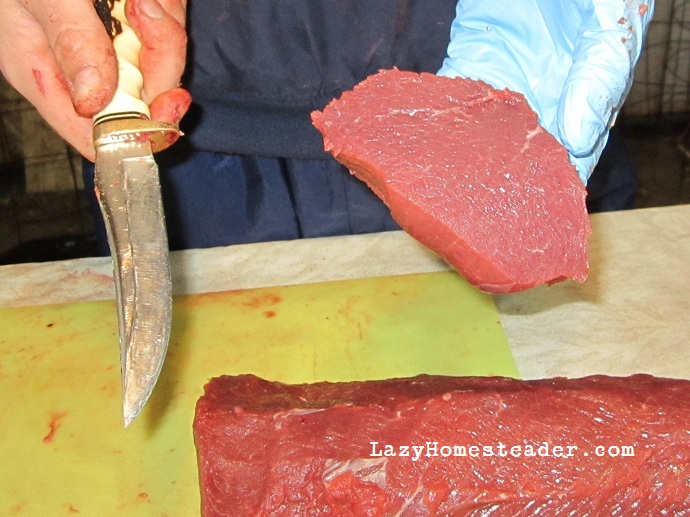
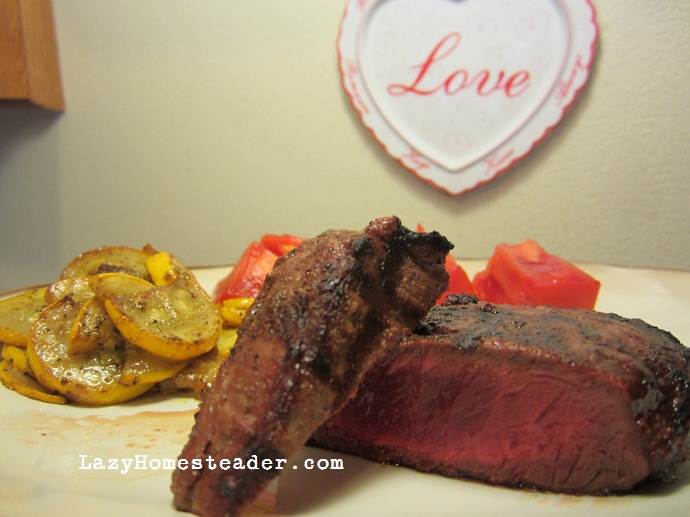
Elk fillet, same cut as beef shown above.

Deer (and certainly antelope) don’t just stand around all day filling their stomachs.  They live their lives using their muscles.  They have to keep on the move, running and jumping, staying away from predators.  They have to search out water and food.  Their food is not usually a lush field of grass or corn (unless they are Nebraskan whitetail).  It’s often patches of under-brush, sage and other soft-wooded plants.  Deer eat twigs and bark and shoots.  They are nearly fat-free beings, trim at 150 (or perhaps 400 for an elk) pounds, with the hardened muscles of athletes.

This means you can not cook venison the same way as you cook beef.  While you might like your beef steak medium- to medium-rare, your venison needs to be much closer to rare, else it becomes shoe leather.  It generally should not be cooked well-done or it will be ruined, dry and tough.

Likewise, grouse, pheasant and duck are not chickens.  You must add fat when cooking grouse and pheasant.  Duck is an entirely different bird and it’s breasts can be treated as red meat, cooked to medium-rare or medium.

How to cook wild game:

To start with, use thick cuts of meat.  If you get your game processed by a butcher, ask them to cut your steaks an inch thick or thicker.  Or if you process your meat yourself, use a ruler or make yourself a template when cutting, so your steaks don’t end up too thin.  The idea here is to preserve moisture as much as possible and not over-cook the meat.  Deer and elk steaks are going to be smaller than beef steaks anyway, so if your steaks are thicker, you have more leeway with this.  Remember, you can always cut your meat thinner if you need to later, or for other uses as you get used to cooking your game.

Venison greatly benefits from a marinade.  Most of the time we, at the very least, drizzle our elk, deer or antelope steaks with olive oil and let them sit in it for 20 minutes to half an hour before we cook them.  Olive oil, crushed garlic and thyme is a great, simple combination.

Before cooking we also add fat to the pan (or grill).  Heat your pan and add a bit more olive oil.  Then cook the steak, flipping once, being careful not to over-cook it.  Remember that venison is smaller and less forgiving than beef, so keep a close eye.

Bacon grease and lard are delicious, traditional ways to add fat to your venison.  A lard-seared elk steak, to die for.  Onions sauteed in bacon grease,  the perfect base for a venison stew.  Or keep it simple with olive oil.

After cooking, let your venison steaks rest for up to ten minutes, covered, before serving.

Notice that I didn’t mention salt?  This is because salt draws moisture from meat.  When cooking venison, salt should be added just before serving.

Important to remember here is that you can’t just take a beef recipe and make it into a venison recipe without accounting for the leanness of the meat.  You want to do your utmost to preserve the meat’s juices and moisture.

If you enjoy stir-fry and fajitas, I recommend using a flank-type steak, cooked whole to medium-rare and then thinly slicing.  Only add the sliced steak into the pan for the last few seconds (if at all).

Check out websites like Field and Stream’s The Wild Chef blog or Hunter-Angler-Gardener-Cook for lots of delicious, trusted game recipes.

If you’ve enjoyed what I’ve posted about cooking wild game so far, please subscribe to have my future posts shown in your RSS feed or emailed directly to your inbox by using the form in the sidebar at the right.  Thanks for reading.

Categories: Food, Hunting, Recipes | Tags: , , , , | 27 Comments

Seed Saving: Kohlrabi

I’ve mentioned before that we grow a variety of kohlrabi that get very large without getting woody.  The seeds are from Slovakia, Rick’s grandfather brings them to us.  Because we’ve never found this variety of kohlrabi in a seed catalog or garden center, and because Rick’s grandparents don’t go back to Slovakia regularly anymore, I decided that I better figure out how to save kohlrabi seeds.

Kohlrabi is a biennial, meaning it won’t go to seed until its second year of life.  Which meant in order for us to gather seeds, we’d need to keep it alive during the winter.  Last fall I left five large, healthy, likely looking candidates in the ground.  I imagined that I’d heavily mulch them with straw or leaves or something, but I never got around to it before the snow came.  So we took our chances.

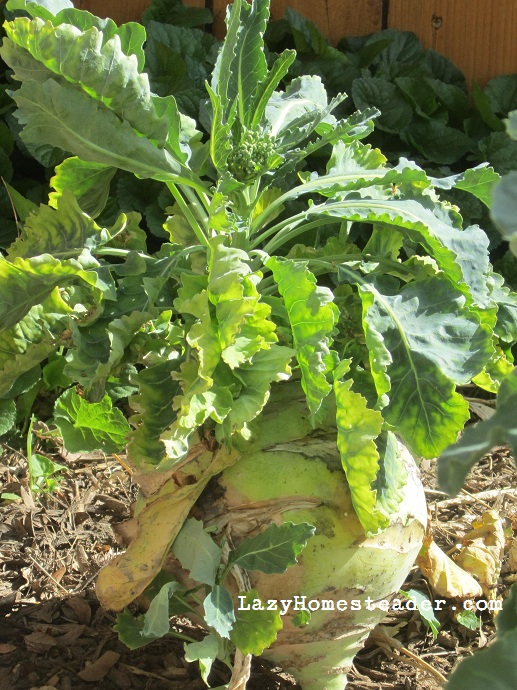
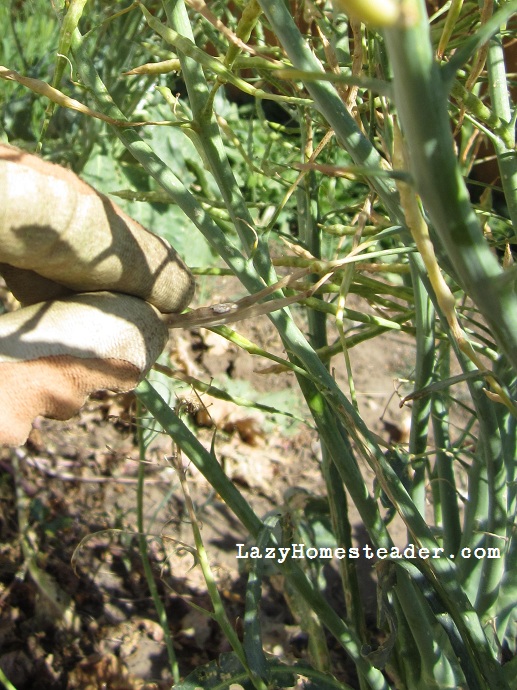
Spring came and the kohlrabi looked a little sad.  The leaves were very droopy.  Some of the smaller ones didn’t make it at all.  But by April, the three largest looked like this:

As they continued to grow, they cannibalized their bulbs and sent up great big stalks.

By May they had grown flowers.  Yellow ones.

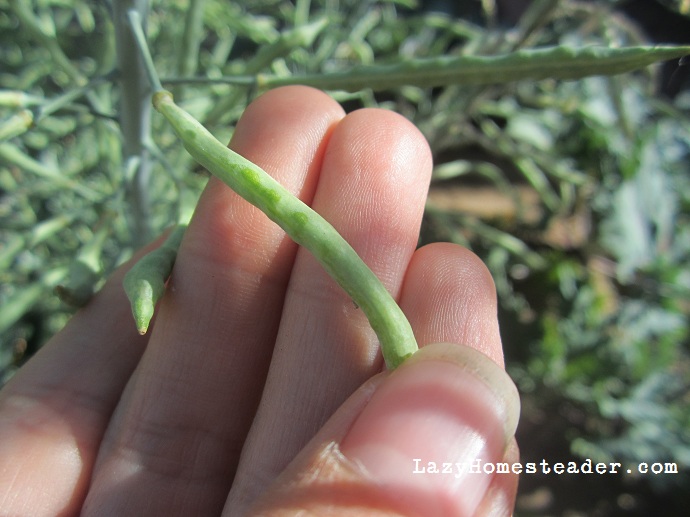
At the end of June they were setting seeds.

In July the pods started to dry and the birds started pecking away.  I was pretty nervous about losing everything that I’d been keeping alive for two years.

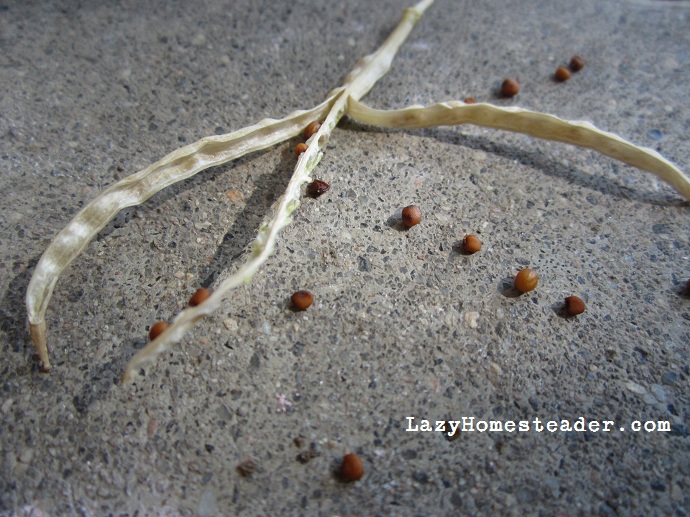
But I held out a little longer and when most of the pods were brown, I cut the stalks off and took them to the garage to dry completely.

And I am happy to report success in saving our first seeds ever.

I’m still working on separating them from the chaff.  I’m sure there’s a better way than what we’re doing… there has to be.  But I am very pleased that we will still have these special seeds.

Have you saved seed before?  Do you have a trick for separating the seeds from the chaff?

Categories: Garden, Sustainability, Urban Homesteading | Tags: , , , , | 17 Comments

May, June, July 2012 Independence Update

So, I’ve fallen so far off the Independence Days record keeping wagon, that to do an update is almost laughable.  😉  Just going off of the egg counts I’ve kept, and memory, here is what our summer has looked like.  But keep in mind, I’ve not kept track the way I intended to this year at all.  I’m not sure if I’ll keep record for the rest of the summer or not.  I will for the eggs… I’ve really enjoyed watching that tally.  But the rest?  I’m not sure.

Plant:  In May it was tomatoes, onions, basil, habanero peppers, chives, strawberries, beets, carrots, beans, cucumbers, zucchini, watermelon, sunflowers, Mexican sour gherkins, GIANT pumpkins, rhubarb, and lavender.  I transplanted a few things in July, but otherwise there was no planting after May.  Also – our strawberry plants all died.  😦

Harvest:

Eggs: 617, plus or minus.  There were about five days in July where we missed counting.
Spinach, chard, arugula, peas, mint, beets, garlic scapes, zucchini and summer squash, kale, cherry tomatoes, beets
Strawberries: 7 quarts
Asparagus: 12 lbs (approx.)
Sour cherries: 8 lbs after pitting
Garlic: 9.75 lbs
2 old hens and a cockerel

Preserve:

Frozen: 9.5 quarts chicken stock, 2 quarts turkey stock, 2# pizza dough, 5 quarts strawberries, 2.5 lbs cherries
Canned: 3 pints peach ginger preserves, 8 half-pints cherry jam, 7.5 half-pints strawberry preserves, 3.5 pints garlic scape pickles
Dried: 3 lbs sour cherries

Waste Not: Scraps given to chickens and/or compost pile

Want Not: 6 gallons of white vinegar, 10lbs baking soda, bulk baking powder, bulk pasta.  Got a few huge bins of clothes for C from friends (she’s covered until 3T!).

Eat the Food:  yes.

Build Community:

Neighbor shared rhubarb with us, hosted the May and July potlucks

Skill Up:

May: started on the flagstone patio
June: learned more about harvesting our honey (though still have not), and tending our top bar hive
July: learned to grout and repair tile

Categories: Chickens, Garden, Independence Days, Urban Homesteading | Tags: , , | 2 Comments

Bathroom Redo or How I Made Peace with Pink Tile

Over the last few years, we’ve slowly updated things in our old, dated bathroom.  A new light fixture here, a sink faucet there, new door pulls on the vanity.  That sort of thing.  We never were ready to shell out significant dough to redo the bathroom.  But over the last few weeks, we’ve managed to give the place a fairly major facelift for under $700.

It started off the way most of our projects do; with a “really easy” change.  I wanted to change out the old tub faucet and handles from who knows when (the 40’s maybe?) to some that were NOT corroded, actually turned and had a diverter that didn’t leak.  And, I wanted to replace the towel bar with a rack of five hooks (since we have five people that use the bathroom).  Two really easy things, right?

Except it took TEN trips to various hardware stores to find some handles that fit our tub.  No joke.

Only the faucet/diverter and the handles themselves are new.  The plate is original(?) and could not be replaced.  We just cleaned as much corrosion off of it as possible and searched and searched and went on an epic quest until we found handles that fit.

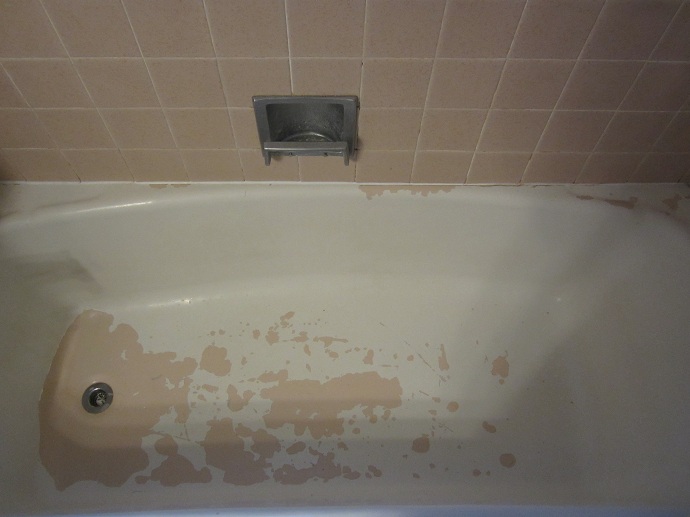
But the shiny new chrome made the recessed soap dish look so bad.  And, well, the painted tub from some prior refinishing job has been peeling for almost nine years now.  So…. we finally broke open the piggy bank and dove in.

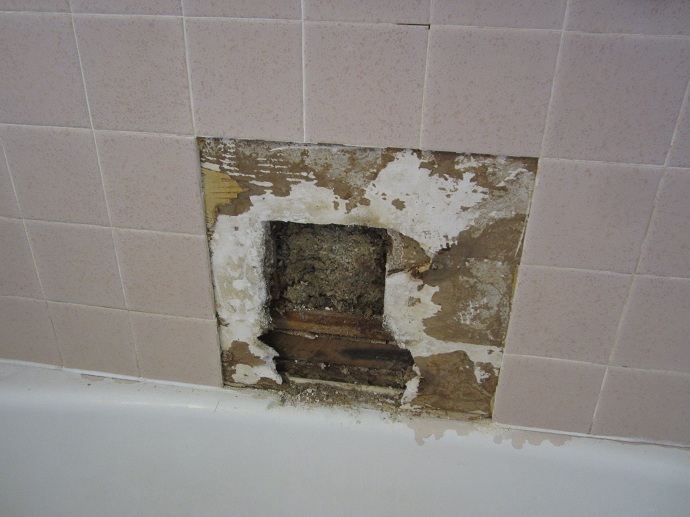
We literally had to rip out the soap dish.

And when we did, we were unsurprised (but discouraged) to find wet wall board.

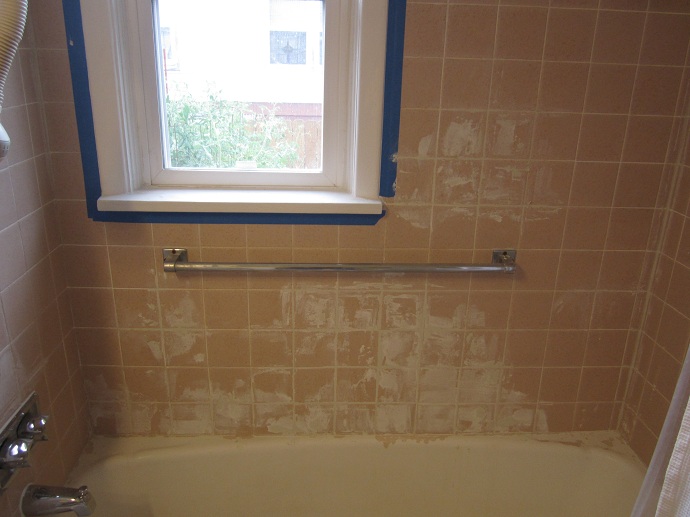
So after two days of drying it out, Rick cut away what couldn’t be saved and patched the hole.  And I re-tiled and re-grouted with tiles we found in the crawl space that matched (thank the good Lord for that find!).

It looks bad, but it was only nine tiles.  I was also replacing some loose and missing grout.  What do you think of all that pink tile?

While the grout dried, we started in with the paint.  Rick sanded the window frame and sill and I gave it a few new coats of paint.

It’s no secret that pink tile was never a dream choice of mine.  So when we moved in, I painted the bathroom blue to match my blue towels and held onto the hope that one day, we’d replace the tile.

Here is the original wall color under my old towel bar  (look pink grout lines on the floor too!).

And here is the old storage for the other various bathroom items:

And this is the new version:

All those containers were just sitting around the house.  Yay for free!

I finally wised up and realized we were not going to be replacing that pink tile anytime in the near future.  Besides, it is cheaper to buy new towels.   So we painted this sandy-cream color and installed my hooks.

And got a nice fluffy, girly rug to match my pink grout lines.

Don’t worry, I have a solid tan one that I can swap out.  I do have two little boys after all.

So, what about the horrid peeling tub?  You just know that baby was originally pink, right.

Well, here is the before in all its pink and white glory:

And here it is now:

I can’t even believe the difference.  It’s so amazing.

But it’s not even my favorite part.

Here is the only before picture I could find showing how the pink tile extends out of the tub/shower area to behind the toilet and sink all along the wall.  In it, you can also notice, just barely there, at Rick’s elbow, the old faucet handle.  And some random piece of hardware screwed into the shower wall, half-way up.  And, of course, blue paint and towels.

Here is the after shot.

With the new paint job, the girly bird-motif hand towels, and my planned chocolate brown bath towels, my bathroom actually looks good in pink.

I truly can’t decide which I’m more pleased with; the paint/towel/tile combo or the shiny new tub finish.  But either way, I’m one happy camper.

Oh, did I mention this is our only bathroom?

Yeah.  It was about time.

Categories: DIY | Tags: , , | 15 Comments

Blog at WordPress.com.