Posts Tagged With: Urban Homesteading

DIY Pallet Compost Bin

This weekend Rick and I decided to move our compost bin.  Rick built it last year out of seven pallets he was able to scavenge.  I looked through all my old photos and posts and can only find a few random pictures with it in the background and no photos of its construction.  But that’s ok, because it wasn’t that great.

I mean it worked, we had two full wheel barrows full of compost (we put it in the neighbor’s garden), but the bin was poorly located, and too hard to move.  First off, we put it too close to the house.  It was really convenient for taking compost scraps to the bins from the kitchen, but it did attract some mice which wanted to move right in next door (in our house) when the weather turned chilly.

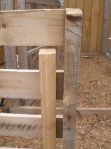
Basically the old bin was a two-bin system.  One side held compost that was almost ready and we added scraps to the other side.  Two of the pallets were hinged so we could open the bins and rotate things around as needed, but the whole thing was a bit unsteady and just awkward.  Here’s the best picture of it that I could find (that’s our neighbor, Haylee, in front of it helping Henry with his garden last spring).  See the vertical boards back there?

So when we tried to move it, it was all wobbly and heavy and kinda… well, you get the idea.  We decided we needed something better.  We built the bin Sunday afternoon reusing some of the same pallets and some scraps of lumber we had in the garage.  The new bin, with horizontal side boards, is in the chicken yard where they can have easy access to the goodies it will contain, and if it attracts mice, the chickens will take care of those for us too.  We’ll most likely build a second bin next to this one, as it was really easy (and we also generate too much yard waste for just one bin).

Here’s what we came up with, along with a “How-To” incase you want/need to build your own.

The design is based on a New Zealand Hot Box, modified to reuse the pallets we already had.  It’s roughly 3 feet high and about 4 feet square.  The size is, of course, dependent on the pallets you have.

Materials Needed:

  • (3) pallets in decent shape. Try to find ones with the top deckboards closer together, not further apart.
  • (4) 3′-6″ 2×2″ pieces of lumber.  We ripped a leftover cedar 4×4 post into fourths lengthwise.
  • At least (18) screws
  • (6) 1×6″ boards, approx. 4′ long each.  We had leftover fence pickets this size.  You could use (9) 1×4’s instead.
  • a saw, claw hammer, drill, measuring tape, sledge-hammer and helper

Directions:
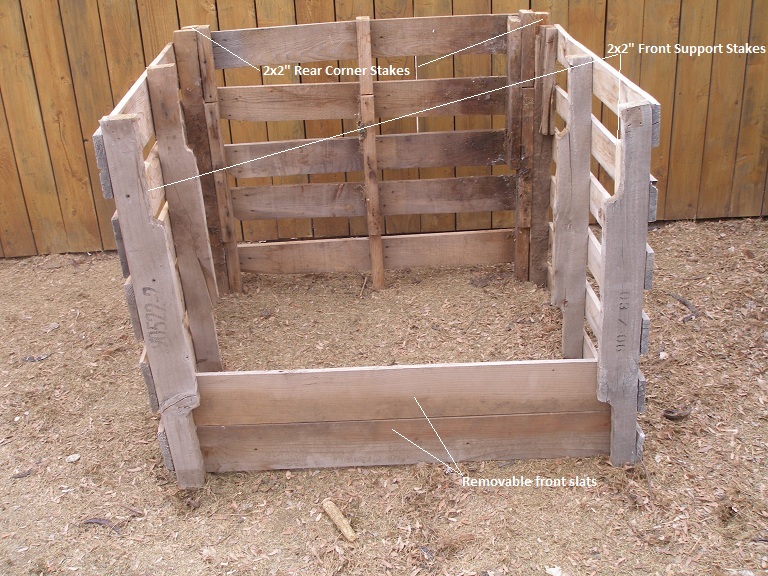
Photo A

  • Use a hammer to knock the bottom deckboards off of the pallets.  Click on Photo A to see labeled parts of the pallet.
  • You may also have to saw the center projection of the runner boards off on the sides of the pallet that will become the back of the bin.
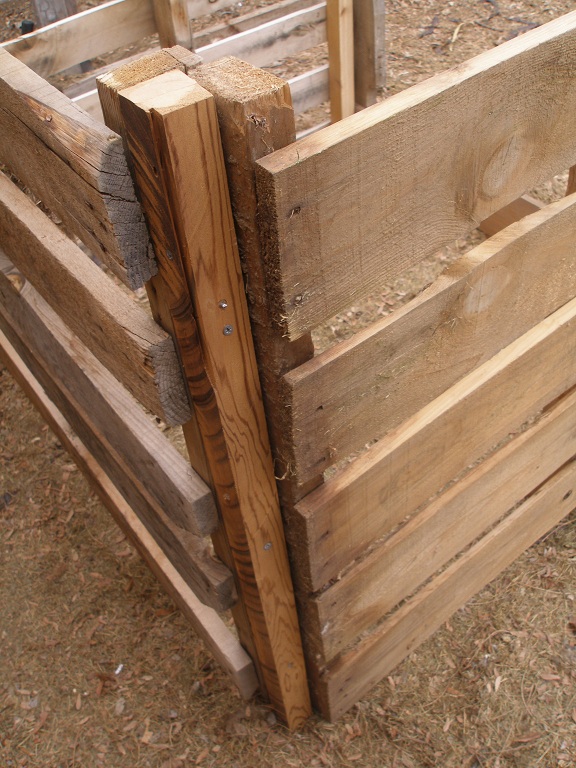
  • Using the saw, cut the ends of the 2×2″ stakes into a point.  These will be driven into the ground.  Two stakes will be used as corner stakes in the rear.  The other two will support the sides and make slots for the front boards.  See Photo B.
  • Photo D

    Photo C

    Measure the length of the pallet you plan to use for the rear of the bin.  With a helper drive a stake into the ground about 6 inches on each side of the rear. The stakes should be on the outside edge of the pallet.  Screw the rear pallet’s runners to the stakes (Photo C).  The wood on the pallets we used was quite hard, so we had to drill pilot holes first.
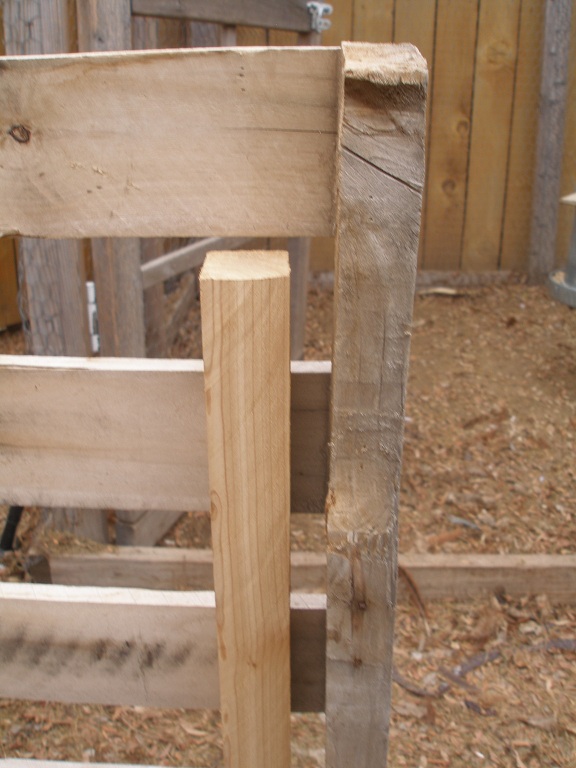
  • Have your helper hold the one side pallet in place while you measure and drive in the front support stake, making sure the side pallet is square to the rear.  The front support stake should be inside the pallet, butted up against the top deckboards and about 1 to 1½ inches from the runner that will be the front of the bin (Photo D).  Screw the side pallet’s runner to the back corner stake (again the rear stake should be on the outside edge of the pallet).  Repeat with the other side, making sure it is also square to the rear.
  • Photo E

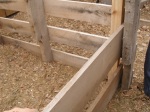
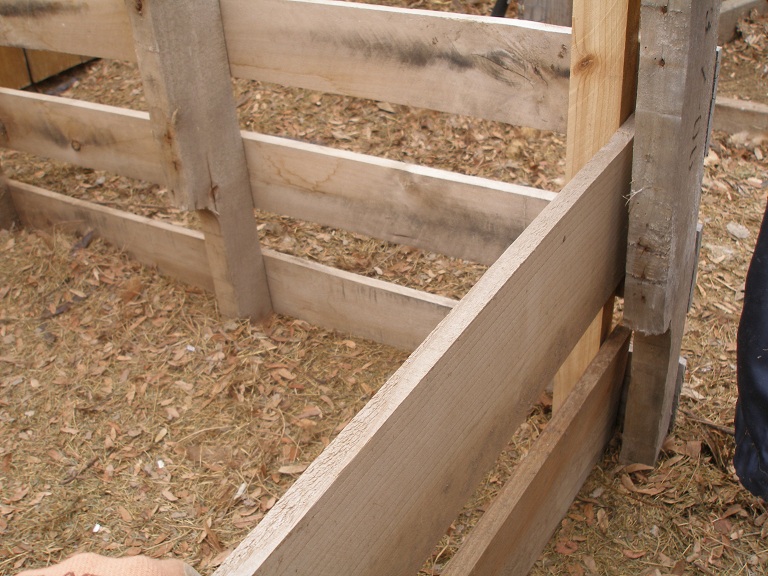
    Finally measure the distance between the two side pallets.  This will be the length you will need to cut the 1×6″ boards into the removable front slats.  Fill your bin with compost and slide the slats into the slot created between the front support stakes and the front runners on the side pallets (Photo E).  These slats can be removed when you want to turn the pile or use your compost.  These bins are easy to make and if you want a second or third bin to rotate your compost, it would be very easy to build additional bins adjacent to the first.
To see more of my Do-It-Yourself projects click the DIY category on the right.

Categories: Compost, DIY, Garden, Sustainability, Urban Homesteading | Tags: , , , , , | 12 Comments

Saying No to GMO

So we finally got our seeds ordered this week for the garden.  I’m excited, since it means spring is around the corner.  And, because it’s the first time we’ve ordered seeds.  We usually go to the local garden center, but their selection of organic, non-GMO seeds has been pretty limited in the last few years.  And beyond organic, non-GMO is very important to us.

There has been a lot of buzz recently about GMOs.  President Obama approved Monsanto’s GMO alfalfa, Round Up Ready sugar beets and a new biotech corn for ethanol production.  This is sad and scary news for all of us. Many of my readers know about GMOs and why they would want to avoid them, but I know there are quite a few people who don’t know anything about this issue.  So I thought I’d shed some light and share my knowledge of the subject, which contributes to the reasons for many of our own food choices.

GMO stands for Genetically Modified Organism, and companies like Monsanto have produced and patented these organisms, mainly seeds.  The seeds have been genetically modified to be able to withstand harsh herbicides like Round Up, so that fields can be sprayed with the chemicals which will then kill the weeds but not the crop.  Sounds like a plan, right.  Except they are seeds.

Let’s set aside the health effects of eating foods and food products made with these GMOs for just a minute and look at the idea of patented seeds.   Currently there are patents on certain GMO grain crops like corn, canola, and soy.  Think for a minute what that means – when these crops grow up, mother nature does to these seeds what she does to all seeds – throws them to the wind, feeds them to the birds, and mice, and squirrels.  She doesn’t know these seeds are patented.

So Farmer A is growing patented GMO corn.  And when his corn is ripe, a few birds come and pick at his corn, eating some.  And they fly a few miles away, and poop out the seeds.  Seeds that have been genetically modified, and those modification carry through the generation of seeds.  But they poop on Farmer B’s land, he doesn’t know, and he hasn’t paid for GMO seeds.

The next spring, Farmer B tills his land and plants his non-GMO crop of corn from seeds he saved for generations.  But those seeds the birds pooped out spring up too.  The company that Farmer A uses to get his corn from, knows Farmer B is down the road.  So they send out someone to take a sample of  Farmer B’s crop (without his permission) and sure enough, his crop turns up as GM positive – their genetically modified corn is growing right there, in his field.  He didn’t buy it from them – he must have stolen it.  And then they sue the pants off Farmer B and win because they own the rights to that seed – to that genetic strain- and he literally loses the farm.  Farmer A is not allowed to save seed, and Farmer B can’t steal it.  The company owns all rights to that seed and it’s future generations.

This is not far-fetched.  It’s happening today, in America.  The problem with patented seeds is that we humans can’t control everything.  Wind and birds and all of nature happens.  For more info on this check out fooddemocracynow.org or watch the documentary, The Future of Food.

So back to health, and how this affects you, the consumer, the eater.  Well, you can just read labels, right?  No.  Sorry.  The USDA and FDA doesn’t require that foods containing GMOs be labeled as such.  You’ve probably been eating GMOs for a long time now.  But it’s not like you sit around munching nothing but corn all day, right?  Well maybe, or maybe not.  In this case, you can check the label – corn and soy are in everything these days.  Really.

According to the USDA, in 2009, 93% of soy, 93% of cotton, and 86% of corn grown in the U.S. were GMO. It is estimated that over 90% of canola grown is GMO, and there are also commercially produced GM varieties of sugar beets, squash and Hawaiian Papaya. As a result, it is estimated that GMOs are now present in more than 80% of packaged products in the average U.S. or Canadian grocery store.*

GMOs are used to feed cattle, to make soda, in your cereal, your bread… you name it.  If it has high fructose corn syrup (and many other ingredients I can’t type or pronounce) it’s made from corn.  So a fast food meal – the burger, the coke, the fries cooked in canola oil, all corn and probably all GMO at that.

With Obama’s recent approval of alfalfa and sugar beets, two crops along with corn, that feed the majority of America’s commercially produced meat animals, we are in for more trouble.  And try keeping alfalfa seeds contained in a Kansas windstorm.  Yikes!

Ok, ok, they are hard to avoid, right.  But are GMOs safe?  Well the Non-GMO Project web site states:

In 30 other countries around the world, including Australia, Japan, and all of the countries in the European Union, there are significant restrictions or outright bans on the production of GMOs, because they are not considered proven safe. In the U.S. on the other hand, the FDA approved commercial production of GMOs based on studies conducted by the companies who created them and profit from their sale.

A few independent studies have been done on the subject.  Generally independent studies have been blocked by Monsanto and other producers of GMOs, but what has been found leads to questions over GMO safety.  Here’s a link studying  The Effects of Diets containing GM potatoes on Rats done in 1999, as well as an article siting many more recent studies that have been done.

It is possible to avoid GMOs, but it takes some research and planning and sometimes giving up a favorite snack.  Especially helpful is the True Food Shoppers Guide (a download-able iPhone app or printable guide).

Here is an article that I found very helpful as well, concerning ways to avoid GMO foods.  “Making My Family GO GMO Free”.  One of the simplest steps is to buy organic, or direct from a local farmer, whom you can ask what he’s growing.  You can also look for labels certifying that products are GMO free.

A while back I was told that the PLU codes on produce were used to indicate organic, conventional and GMO foods, however this is not exactly true, since using the five digit codes are optional.  (see PLU Codes Don’t Indicate GMO Produce and The Myth of PLU Codes and GMO Foods).

If you grow your own garden, like us, please be aware that Monsanto recently purchased a number of seed companies, so you’ll want to know what to look for when buying the seeds you’ll use this spring.  I found this resource most helpful: http://inspirationgreen.com/

I know this post is a bit preachy for me – but it’s a subject that I’ve been very concerned about for a while, and I couldn’t think how to share this info another way.  I hope you look further into this subject and take action (write a letter or sign a petition to help ban GMOs in America).

For more ways to take action go to:

http://www.fooddemocracynow.org/  and
http://www.nongmoproject.org/
Also check out http://truefoodnow.org/

*from http://www.nongmoproject.org/
Categories: Community, Food, Garden, Recommended Reading, Sustainability, Urban Homesteading | Tags: , , , , , | 5 Comments

Free the Chickens!

As promised, here is the video that we participated in making to help get Denver’s laws changed to allow chickens.  Sadly the editor misspelled our name, but I think the point is still there.  😉  Please share with your friends to help raise awareness on this issue.

To learn more about how you can help, go to www.freethechickens.com

Categories: Chickens, Community, Food, Simple Living, Sustainability, Urban Homesteading | Tags: , , , , , , | 8 Comments

Fruit

This weekend was the weekend of fruit.  On Saturday morning we went to Palisade for the second time this summer, and we came home with 319 pounds of peaches.  150 pounds were for friends, and we kept the other half for ourselves.  Then, Sunday morning, before we had even gotten a peach into the freezer, my brother-in-law came by with over 1500 Italian plums.  Thankfully the plums are a bit green, as we didn’t really have much time to mess with the fruit on Sunday.

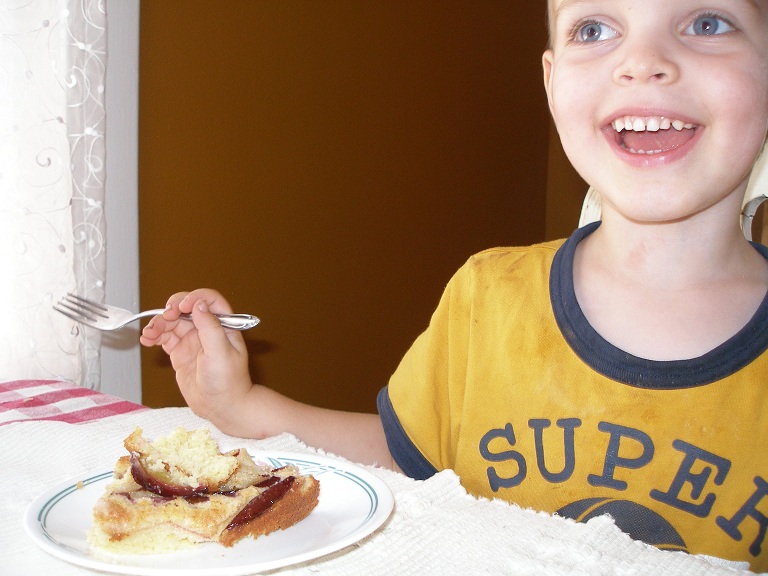
Monday, we ate some of the plums in a plum coffee cake, and then we went to our friend’s home outside of Allenspark.  Mike grilled and we gathered around the fire pit, and had a nice evening with friends (and peach cobbler), watching the smoke from the fire in Boulder county blow over the horizon.

On the way home we stopped outside of Longmont where we could see the fire above Boulder.  My pictures here don’t do it justice, but it was incredible.

Tuesday is farm day for me, when I go and work at the CSA.  I brought home our share, and had barely pulled into the drive when our friend, Rich drove up with twenty plus pounds of concord grapes!  These grapes are our favorite and they were very generous!

So we have a fruit filled week ahead of us.  I had actually planned to pick strawberries and raspberries this week too, but I am putting that off until next week in hopes that I can get somewhat caught up around here before adding more to it!

Here’s the update:

Plant something – nothing.

Harvest something – eggs, tomatoes, zucchini, peaches

Preserve something – three batches of peach preserves, two and a half boxes (approx. 30 lbs) of peaches sliced and frozen, 3½ pounds green beans frozen, 1 gallon bag of tomatoes frozen, 2 batches of carrot soup in the freezer.

Waste Not – compost and recycling, scraps to chickens, etc.  Lots and lots went to the goodwill over the last couple of weeks.

Want Not – nothing that I can think of right now.

Build Community Food Systems – all the fruit trading!  Yum!

Eat the Food – as mentioned, plum cake and peach cobbler.  Also eating all the yummy farm veggies.  Nothing out of the ordinary.  😉

Categories: Canning and Food Preservation, Chickens, Food, Garden, Independence Days, Recommended Reading | Tags: , , , , , , , , , | 1 Comment

Blog at WordPress.com.