Author Archives: Anisa

Unknown's avatar

About Anisa

Bustin' sod in the city, I spend my free time blogging and getting dirt under my nails along side my hard-working husband, three kiddos and urban chickens.

Vegetable Gardening Basic Training Part II

Welcome to part two of your first week of Urban Homesteading Boot Camp.  Yesterday I talked about the basics of selecting and preparing a site for your vegetable garden.  Today, we’ll cover layout, crop rotation, and, the best parts: planting and maintaining.

If you are planting in pots, the scale on all of this will be much, much less.  😉

Garden Layout
Once you have decided what to grow in your garden, you need to decide where in the garden to grow it.  One of the first things to consider is the height of the plants, at their maturity, that you intend to grow.  This is more important than companion planting because, as some friends of mine learned the hard way, while carrots do love tomatoes, carrots also love sunlight.  So first think about what grows high up and what stays low.  Tomatoes can get very tall, so can pole beans, corn, and cucumbers if you trellis them.  Summer squash can also shade out neighbors with their big leaves.  Most of the root crops  stay low, as well as the peppers and lettuces; even peas can be kept pretty compact. You will want to plant low growing things to the south of high growing things (here in North America, obviously).

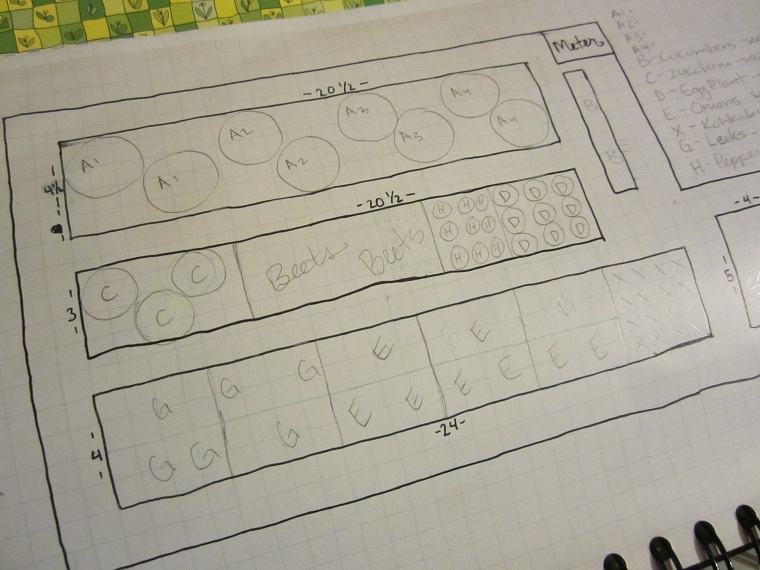
You can see from my garden plan that I made in 2009, I did just that:  Tall tomatoes in the back along the north border, middle size squash next, and short onions, kohlrabi and beets at the bottom on the south edge.  It worked great.
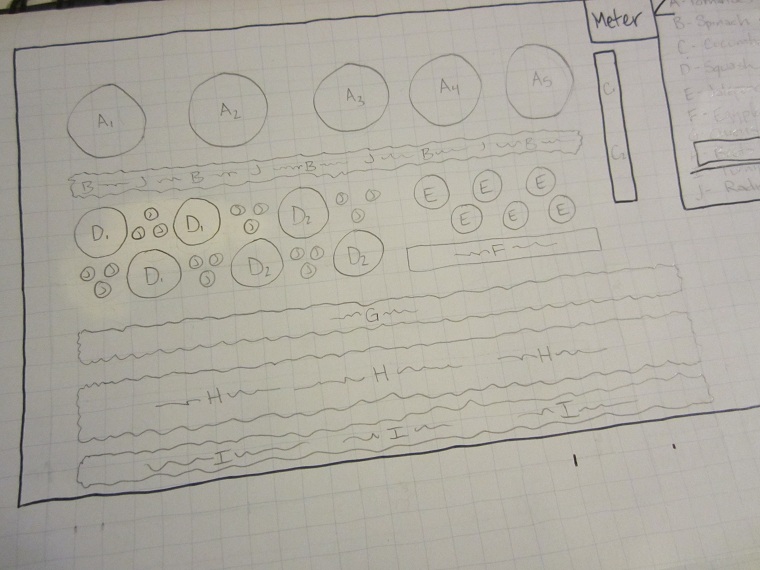
But I bet if you read my post in October on crop rotation, you spotted the problem with the layout.  If not, here was my 2010 garden plan:
See the problem yet?  Tomatoes up top, squash and peppers in the middle, and onions and kohlrabi along the bottom.  I did this also in 2006 and 2007.  Yeah.  Some people are thicker than others.  It took me a while on this one.

Finally, finally, I wised up.  I had to turn my beds 90 degrees.  You can see this year’s plan is much better for crop rotation.

Crop Rotation
So yes, it took me years and years to find a way to rotate our crops.  But why is it so important?  Most of the veggies we like to grow in our gardens come from certain plant families.  There are about nine families for the main crops most people like to plant.

  1. Tomatoes, potatoes, peppers and eggplant
  2. Peas and beans
  3. Cucumber, squash and melons
  4. Spinach, beets and chard
  5. Cabbages, kale, kohlrabi, turnips and broccoli (the brassicas – they only “real” family name I know)
  6. Onions, leeks and garlic (oh wait, I know two, these are alliums)
  7. Sunflowers, lettuce and other leafy greens
  8. Carrots, celery, parsley, parsnips
  9. Corn, rye, oats, wheat

The varieties in each family need similar nutrients to grow, and they are susceptible to the same diseases and pests.  So if you plant your tomatoes in the same place year after year, you can expect them to deplete their soil and/or die from a disease.  If you rotate things though, the nutrients that the tomatoes take from the soil in 2012 will get replaced by another plant, say beans, the next year.  And if a tomato disease came knocking at the end of 2012, the 2013 beans might not get it, since they aren’t necessarily open to the same sicknesses.  Make sense?

Clearly, it is pretty important to switch things up.  Your original layout needs to accommodate this, and you have to think a few years ahead.  Here is what I’ve done with our 2012 garden.

First I oriented the beds so the tall stuff didn’t always have to go in the same place (North is at the top of the page).  Then, the coup de grâce – sticky-notes.  Yep. Instead of writing in my plants, I put each thing we want in the garden on its own sticky-note.  You can tell, I love tomatoes.  The little circled letter corresponds to a plant family.  Now I can arrange and rearrange, and rotate. 

Yes, I know, I have more veggies than room in my garden for them.  Decisions are hard around here.  That’s why I’ve enlisted the neighbor’s yard.  😉

When playing with your layout and rotation, don’t forget about plant height.  In 2008, I tried rotating things in that old layout by switching the tomatoes to the bottom (the southern edge).  Guess what – nothing grew because the tall plants shaded out everything else.  Learn from my mistakes, grasshopper.

Here’s where I want to take a minute to mention square foot gardening.  Square foot gardening is a very good way to get a lot of plants into a small space.  It would probably be a great way to keep things rotating as well.  I am not very good at it, I’ll be honest.  I lack the self control.  😉  But if you have a very small space, you should consider it.  It looks like a great way to pack a lot into a small area.

So, to the planting.

Planting
First off, I’m totally skipping the starting seeds indoors thing.  I’m sorry if this is a big disappointment.  I only began gardening when Rick and I moved to this house 8 years ago, and we have no good place at all to start seeds indoors.  I’m thinking of getting some lights this year, but so far all my seed starts have failed.

Because of this, we buy seeds to sow directly in the ground for most things, but we buy already started tomato and pepper plants from the garden center.  The growing season in Colorado is a bit short to start these outside if you want much of a harvest.

To plant your seeds, read your seed packets.  Planting depth is important.  From the tip of your finger to your first knuckle is about one inch; the depth you would want to plant peas.  I am somewhat flexible with plant spacing, however.  If my packet says to plant seeds every six inches in rows 18 inches apart, I just go with six inches in any direction.  I know, I’m a rule breaker.  But it seems to work just the same for us, and I want to conserve space as much as possible.

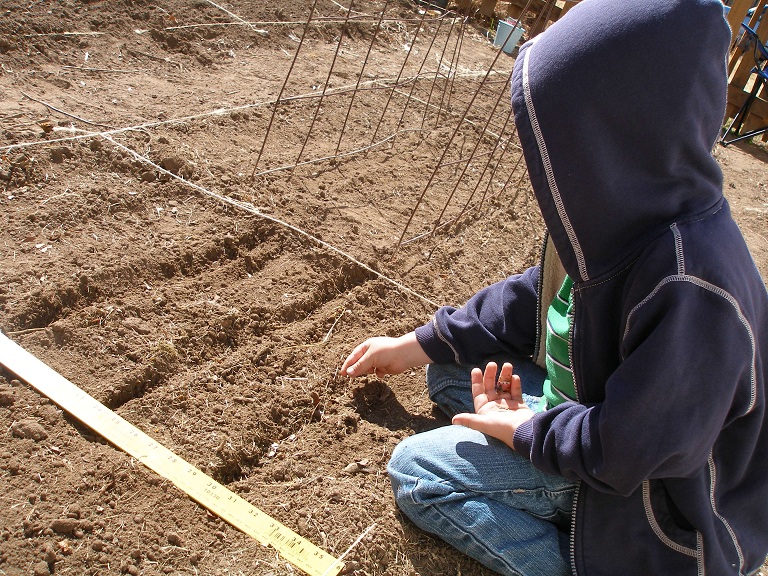
Some seed packets tell you to plant in hills.  Squash like hills.  Tomatoes do too.  So, for the first timers, this is what a row is (notice Henry, spacing rows with a yardstick – it’s ok to measure if it helps you):
And this is a hill:

I use my fingers or the side of my hand to make rows for most seeds, but I use a hoe to make a row for things that should be planted deeper than an inch.  I just drag one corner of  the hoe in a straightish line where I want the row to be.  The line is sort of a valley with the extra soil piled up along the sides.  Drop the seeds into the valley and use the soil next to the line to cover them.  Don’t use all the extra soil, especially if your seeds should be planted shallowly.  Some of that soil will be used to make the sides of your row so that it will hold water.  Tap the soil down well with your hands, making a long trench that will retain water to feed your seeds.

To make a hill, I use the back of a rake.  And by I, I mean Rick.  Not that it’s hard, it just seems to be Rick’s job.  Anyway.  Rick pulls the soil with the rake into a mound, and then we use our hands to sort of flatten the top, and move the dirt until it’s sort of a crater.  You plant inside the crater, not around the sides.  This is a nice bowl to hold water for your seeds or little baby plants.  We usually plant one tomato per hill and we plant three summer squash in a (larger) hill.

Then what?  You guessed it – water your seeds.  Water them well.  Give everything a good soaking.  Then wait a couple of minutes and soak everything again.  Don’t use hard jets of water – sprinkle or use a soaker or drip hose.  You don’t want to wash your seeds away.

Now is the time to set your tomato cages and trellises around your plants.  As the plants grow, thread them up through the cage, so they don’t break off any vines, or so the tomato doesn’t shoot off to one side.

Maintenance
After planting, there are three things left to do to keep your garden on track: watering, thinning, and weeding.

Your baby seedlings and newly planted seeds need to stay moist.  We like to use a drip system for our garden, which basically consists of a back-flow preventor at the spigot, and a bunch of tubing with little plastic drip heads on the ends where each plant is for the hills and lengths of pre-drilled drip-tube for the rows.  The heads release so much water per hour.  We love it because it conserves water and only puts water at the plants so it cuts down on weeds.  And, I just have to step out the door, turn on the spigot, and it waters everything for me.  I have three kids, people.

The drip system is not complicated, but explaining it thoroughly could be a post in it of its self.  (Perhaps in the near future?)

Anyway, that is one method for watering.  We have also watered by hand with the hose many a season, and last year our neighbor put his corn and potatoes on a timer connected to his sprinkler system.  Bottom line is during the summer you need to water.  Here in Colorado, we need to water everyday.  Technically, it’s an arid climate here.  If you live in the rainforest, gauge your water accordingly.

All that water will make your seeds sprout into seedlings.  And you will have to thin them.  That means, heartlessly grabbing those tender green shoots and ripping them from the ground (gently – don’t kill the ones you want to leave).  You have to give your plants room to grow.  If you leave every carrot seedling growing, you’ll get lots of tops and no carrots.  So leave one strong-looking seedling every few inches for your root crops.  And for heaven sakes, thin your zucchini.  It’s really, really hard the first time.  But just do it.  Now is the time to nut up or shut up.  😉

And weeding.  You have to rip ’em out too.  They will grow fast and steal your veggie’s water, sunlight and room.  Take ’em down.  Show no mercy, troops.  Defend your hills!  And your trenches!  If you do a little everyday, the enemy won’t gain any footing in your garden.

Questions?
Categories: Garden, Urban Homesteading | Tags: , , , , | 7 Comments

Vegetable Garden Basic Training Part I

Welcome to your first week of Urban Homestead Boot Camp.  Over the next few weeks I’ll be sharing the goods on what you need to get your own homestead up and running in 2012.  This is the quick and dirty version.  No holds barred, take no prisoners; these are the very basics.

This week, the vegetable garden.  Every homestead needs one.  Be it your whole back yard converted to raised beds or your balcony covered in pots, growing food is the cornerstone of any homestead. I’ve decided to divide this into two parts since we have a lot of ground to cover.  For the beginners out there, we’re going to keep it simple.  Part one covers site selection, soil prep, and deciding what to grow.

Site Selection:
You need a place that gets full sun.  For us here in North America that is somewhere that has Southern exposure.  Gone are the days of a backyard garden.  In the city, you take what you can get.  The side, the front, the roof, whatever.  It just can’t be in the shade of a tree or building.   At the Schell Urban Homestead, our gardens are in a side yard and along a strip of driveway.

One you’ve picked your spot, measure it up.  The size of your area is probably going to determine, to some extent, what you can grow.  It’ll be tough to grow corn if all you have is 32 square feet, unless that is all you want to grow.  It takes up a lot of room and is tall.  But if you are willing to buy your corn at  a farmers market instead, you can do a lot with a 4 x 8 bed.

Some considerations when selecting a site:

  • Will you grow in the dirt or buy soil for a raised bed or pots?
  • Can you get water easily to to area?
  • Is there anything nearby that will interfere with sun exposure?  Keep in mind that in summer, the sun is almost directly overhead.
  • What about site security?  Does the mailman usually walk there?  You might need a border or a mini fence.  If you are growing where the neighborhood kids can see, consider that you might lose a tomato or two (but that’s actually a good thing in my opinion).

Prepping the Site:
Once you’ve selected your garden site, you’re going to need to do some prep work before you can plant there. If you are planting in pots, you get off easy, labor wise, but will have to spend some money for the pots and the soil.  Check thrift store for pots if your funds are limited.  Or consider buckets.

So, what is at the site now?  Grass?  Other plants?  Rocks?  Or (please say it isn’t so) concrete?  If the site is concrete and you don’t want to bust it out, which we have done – it’s tough work, consider pots or very deep raised beds.  Keep in mind that concrete will hold heat in the summer though; you’ll need to water more frequently.

Otherwise, to plant in the ground or a raised bed, this is probably going to be the physically hardest part of getting your garden ready.  Start by clearing away any competing plants and rocks.  If you plan to plant in the ground, a soil test can be helpful, but is not be any means necessary unless you have concerns about lead or other toxins leaching into your soil (such as if you are in an industrial area).  If that is a concern, it may be simplest to build a raised bed and buy soil for it.

If the existing site has grass, that is easy enough to remove.  You have a couple of options, you can use a grub hoe or rototiller to remove or till under the grass.  Or you use a layering method of composting the grass into your garden space, like the method demonstrated in this video.

Mark the edges of your garden space.  If you want to spend a little or are concerned about aesthetics, you can buy timbers, railroad ties, fencing or many other materials to build your edging and borders to your heart’s content.  To do it on the cheap, use rocks, boards, brick, string and stakes, whatever you have.  Or check craigslist.  Basically – anyone can garden.  This doesn’t have to cost an arm and a leg, though it can, if you want.  But really, you just need to know where you are planting stuff.

Your beds should be about 4 feet wide, but not wider.  Longer is fine.  Four feet is about the farthest you can comfortably reach across; if you keep it within these limits, you can avoid stepping on your planting soil to keep it from compacting.

If you are doing raised beds, you are probably going to have to buy soil.  You’ll want soil for gardening, not fill dirt.  Fill dirt is hard, dry, grayish brown and has no organic matter in it – you’ll be hard pressed to get anything to grow in it.  Soil dark brown or black, moist, soft, and is rich in organic matter with lots of nutrients to feed your plants.  If you do the layering method, you’ll be using built-in compost, but you may want to add some soil to your layers as well.  If you are planting in the ground where only sod has been growing, you’ll definitely need to amend the soil.

You can certainly buy soil and compost at a garden center.  But you might also consider these sources: local farmers and ranchers for decomposed manure, tree trimming companies for mulch or wood chips, or check with your local Whole Foods around earth day for free finished compost.  If you are starting in the fall, you can get the ground prepped pretty well for the spring by digging into the area and layering dead leaves, grass clippings and dirt to decompose over the winter.

Deciding what to grow:
Keeping in mind how much room you have and how many people you are feeding, think about what you like to eat.  What are your gardening goals?  Do you want to get the kids excited?  Plant things that grow quickly (beans, sunflowers, radishes) or that they will be excited to eat (my boys love carrots).  Love cooking?  Plant lots of herbs.  Do you want to avoid mealy grocery store tomatoes?  Then you’ll want to make room for your star heirloom plants.  Want to avoid the grocery store all together?  Better convert the whole yard or enlist a neighbor.

Some things to keep in mind:

  • Plant what you like, but don’t be afraid to try something new.  If you know you hate broccoli, don’t plant any.  But try to remember that homegrown veggies taste about a million times better than what you can get at the grocery store.  My sister was forty before she learned that she did like tomatoes, as long as they came from the garden.  If you want to try everything, get a seed catalog.
  • How many people are you feeding?  Don’t plant four hills of summer squash for two people.  And vice-versa.
  • How much room do you have.  Corn and potatoes are notorious space hogs.  If you have limited space (most of us in the city do)  really consider what you want to grow vs. what you can get at a market.

Check out Erica’s post on How to Plan Your Harvest Based on What You Eat.

Next we’ll talk about layout and crop rotation, the planting, and garden maintenance.  Now drop and give me fifty…

Categories: Garden, Urban Homesteading | Tags: , , , | 9 Comments

20 Weeks: Kitchen Cabinets

So, back on the wagon, I promised to get that list of twenty problem areas in my home taken care of.  This week, I cleaned out the kitchen cabinets under my counters.

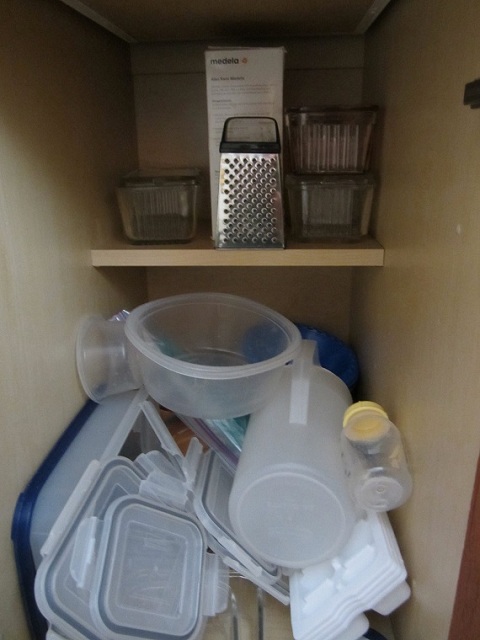
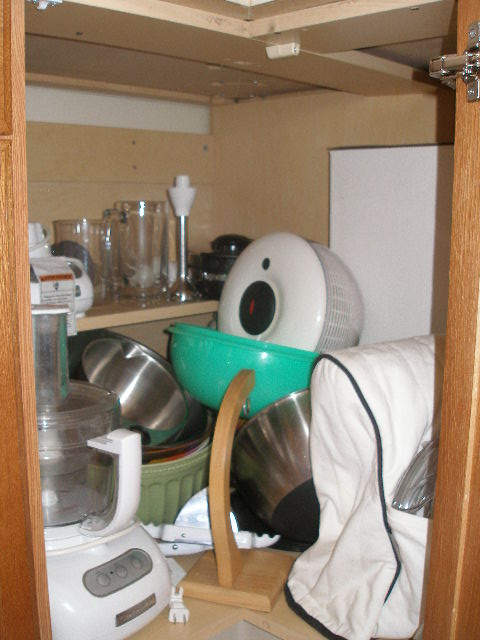
Here are the before pictures:


YIKES!!  These cabinets are particularly troublesome.  They always start nice and neat and then, after a few loads through the dishwasher, they end up a jumbled mess again.

To tackle them, first I took everything out.  Yep.

Things got sorted.  The thermos made it all the way to the top shelf cupboard next to the water bottles.  The potato ricer went into the roasting pan in another cabinet, since I usually only take the time to rice potatoes when I’m making a big fancy roast or turkey.  The ice cream attachment for my mixer got put away with the stuff in the basement that only gets used occasionally.  A few things got donated.  The rest I tried to put away in some way that would make it simple to keep nice.

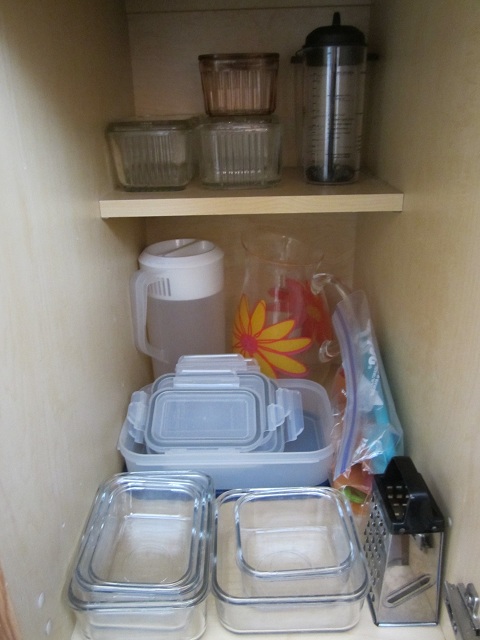
The mixer attachments are inside the bowl under its cover.  The pitchers and flower vases have been removed from this cabinet as well.  I got a nice drink container for Christmas that I’m storing in the buffet, so I could get rid of the lame old plastic pitchers I was hanging on to.

And speaking of plastic…

Besides that pitcher back there, one large Tupperware container and the popsicle molds, I finally chucked the rest.  Well donated.  But, I finally feel like I have enough glass containers and have slowly over the last two years weeded through most of our plastic to the point where I feel like I can be plastic free.  That should make things a lot simpler!

Looking at the before pictures on this project, it looked huge and daunting.  But really it took me less than half an hour to get the job done.  Looking forward to finishing this last few items of the list!

Be sure to check out the other projects I’ve completed: 20 Things.

Categories: 20 Weeks of Organizing | Tags: , , , | 2 Comments

2011 on the Bike

Happy birthday today to my Hard-working Husband, Rick!

I want to take a minute to say that nothing, and I mean nothing, would ever get accomplished around the homestead if it weren’t for him.  I’m really great at the ideas, but Rick is the hard worker that actually makes the ideas turn into something real.  He works hard all week at his job and then he comes home to work hard here on weekends, and I’m so grateful for him.

Last January, I asked Rick to set the odometer on his bike to track how many miles he rode for the entire year.  Then I promptly forgot all about this until last week when he gave me his final numbers.

In 2011 Rick rode 378.83 miles on his bike.  Most of these miles were commuter miles; riding to and from work.  Since I had a baby in July, we didn’t do much recreational riding as a family.  His office is 2.67 miles from our house and his average speed was 11.4 miles per hour.

Most days, due to traffic, he can get to his office or home faster on the bike than if he drove the car.  A fourteen minute commute, mostly on the bike path.

We estimate that he rode his bike to work about 70 days last year.  It’s not clear, because there have been days when he didn’t ride to work, but came home at lunch with his work van to get his bike and then rode home.  But that’s almost 20% of the year commuting on two wheels.    (!)

Rick saved about 20 gallons of gas, about a tank and a half in our car.  His total time spent on the bike:  31 hours, 47 minutes and 43 seconds.

He might argue that it’s actually not work to ride.  I think he likes it.  At least a lot more than driving in traffic.  He’s already had the bike out this year (yep, with snow and everything), and I think he’s going to try to get even more miles racked up for 2012.

Thanks, Rick for all you do.  Especially for supporting my habit of starting crazy projects…  and then finishing them for me.  You are the best!  Happy birthday!!

Categories: Simple Living, Sustainability | Tags: , , | 6 Comments

Urban Homesteading Basic Training

With 2012 upon us, many more people are looking to save money and live healthier.  Sustainability is on more minds lately, and more people are getting started with their first garden or flock of urban hens than ever before.  I don’t claim to be an expert, but I am completely willing to share my successes and failures with others.  The last five years have given me enough experience that I at least feel comfortable offering up a quick and dirty urban homesteading boot camp for others just getting started.

I plan to run a series of posts for at least eight weeks, possibly as many as ten.  Here are the topics I have planned for the next few weeks.  I also am completely open to discussing other topics if there is an interest in them.

Week 1:  Vegetable Gardening
Week 2:  CSA’s and Eating Sustainably on a Budget
Week 3:  Menu Planning in Season
Week 4:  Composting and Using Compost
Week 5:  Backyard Hens
Week 6:  Making Your Own Household Cleaners (by request)
Week 7:  Top Bar Beekeeping 101
Week 8:  Water Bath Canning

I’m hoping to also have a post about other kinds of urban livestock, and possibly cheese or yogurt making.  What else would you like add to your homestead skill arsenal?  What projects do you have this year?  Are you just getting started or going beyond the basics?

Categories: Urban Homesteading | Tags: , , , , , | 12 Comments

The ‘Sham’ in Shampoo

The other morning I stumbled into the bathroom well before the kids were awake.  “Yay!”  I thought, “I’ll get to take a shower today!”  But then I remembered.  I was all out of shampoo.  And I forgot to get more last time I went to the store.

My spirit, unwilling to be dampened, I decided I’d try that whole baking soda for shampoo/apple cider vinegar for conditioner, thing I’ve heard about.  I mean, really.  I use all natural soap, natural toothpaste, natural household cleaners, homemade laundry detergent.  I can do homemade shampoo!  Yay for less chemicals!  Yay for clean hair!

Except baking soda in your hair is gross.  Really, really gross.  I almost titled this post “The ‘Poo’ in Shampoo.”

I mean, I know it was the first time I tried it, and maybe I did it wrong.  Maybe I just need some guidance?  If you do the baking soda thing, let me know.  I did a quick Google search, and I mixed up baking soda and water according to the recipes I found.  Basically 1 Tablespoon soda and 1 cup water.  I also mixed up the apple cider vinegar and some water.

First, I tried what they all said to do.  I wet my hair and poured the baking soda mix into my hair at the roots.  I massaged it all around and rinsed.  I have really thick hair and by this time it felt all tangled and I was having doubts about the vinegar thing, but that part was actually uh.maze.ing!  I had put the vinegar mix in a squirt bottle and it completely detangled and smoothed my hair, pretty much instantly.  “Yay! This will make such a great blog post!”  I thought.

I got out of the shower, and went to dry my hair and it was all smooth and sleek and shiny!  WOW!  I blew it dry.  Gorgeous.  Well.  Almost.  It looked all greasy at the roots.  It felt all greasy at the roots too.  Super greasy.  Not oily, greasy.  Worse than before I got in.  Maybe I got carried away with the vinegar?  Hmm.  The kids were still asleep, so I decided I’d give it another go.

I decided to sprinkle in baking soda dry at the roots.  I worked it all around and it looked like the grease was all absorbed.  But also like I had grayed out my hair, since my hair is quite dark and there was now a fine white dust on it.  So I hopped back in the shower to give it a rinse.  And I could feel the greasiness about ten times worse than what it felt like before.  It was not the vinegar that caused this.  It was totally the baking soda.  I gave up.  I scrounged around the bathroom until I found some tiny, little bit of shampoo in a travel bottle.  I used it.

I will totally keep that apple-cinder vinegar thing.  It is awesome.  But the baking soda for cleaning your hair – a total sham.

Categories: Simple Living, Thrift | Tags: , , , | 12 Comments

20 Weeks: New Year Organizing Revival

Since I’ve been talking about goals lately, I thought I better address something that I left as a loose end last year.  Remember, back when I was half-way through my pregnancy with Cora,  my goal of organizing a list of 20 things in 20 weeks?

Well, I got all behind, and then I had my baby, and cleaning with a newborn, a toddler and a preschooler during the harvest season… forget it!

So the day before Christmas eve, I went on a frenzy in the bathroom.  And I redid the storage in there.  And then I remembered it was on the list of 20 things I wanted to get organized!  Woohoo!

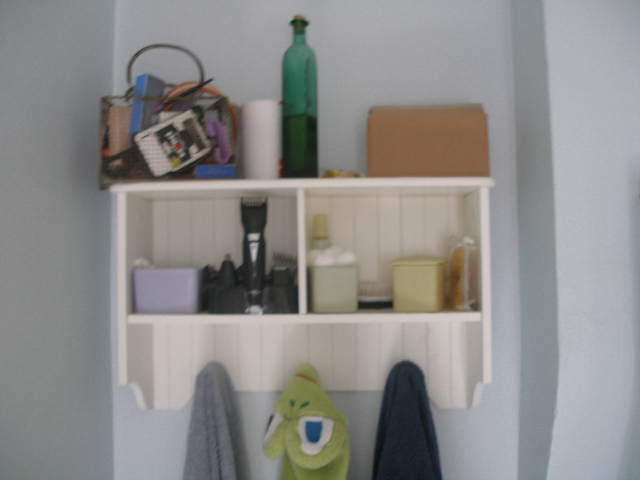
So here’s the before…

Ok, this cool shelf thing that hangs on the wall holds our towels and a bunch of other stuff.  Q-tips, nail clippers, Rick’s beard trimmer.  Extra soap is up there in a brown box, a ton of random things are in that basket, some bubble bath and a low-flow shower head that’s not going to be installed in the shower anytime soon is up there too.

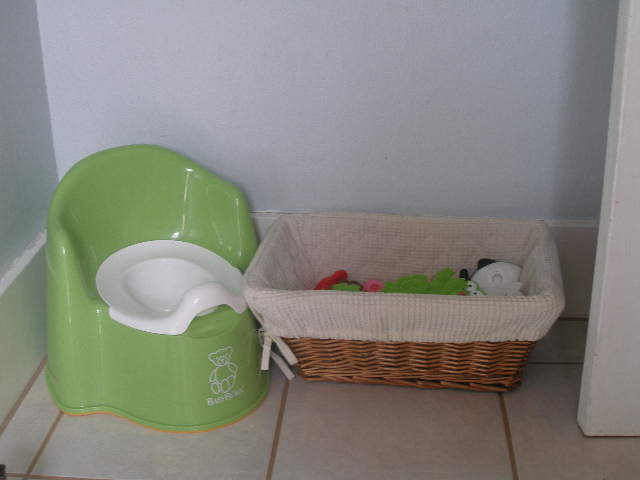
Under that shelf thing, we have the potty chair and a basket of bath toys.

Then, lastly, in front of the toilet we have a little storage bench full of our extra towels and wash cloths, and on top; my many, many magazine subscriptions (yes, I’m a magazine junkie).  Hey, everyone reads in the bathroom, I need variety.  And it’s my only place without the kids.  It’s peaceful.  Just like every mom.

And here’s the after…

First I moved the bench.  Lots more space here now in front of the toilet.

Then I emptied and reorganized the extra towels (got rid of a couple oldies that were worn out) and recycled or filed old magazines.  Now just the most current ones are out… and stacked nicely.  Went through the bath toys and tossed any that were too icky.  Cleaned any that needed cleaning and washed the basket liner.  The potty chair is used for emergency trips in the boys room – been saving E’s sheets this way.  Thinking of skipping the potty chair all together for C if we can, by the way.

And the biggie – the shelf.  Cleaned out that basket, tossing anything expired or irrelevant (yes, irrelevant).  That basket in the bedroom closet caught the extra soap and the shower head until we are ready to use them.  We used the bubble bath up and the bottle is now a soap dispenser in the kitchen.  Hair ties were corralled in the blue jar, and lotion is up high so it doesn’t end up in the two-year old’s hair again.  After all that, there was room for my apothecary jar of bath salts that used to live on the tank of the toilet.  Not like I ever have time for a bath, let alone many baths to necessitate an apothecary jar full of salts – HA!  But it’s pretty and the kids enjoy them, I guess.  😉

Anyway.  It looks much nicer in there and I’m really loving it.  We desperately need a remodel in there, but I’m holding off until C is potty trained.  Hopefully by then, the boys won’t be missing the toilet any more either.  😉  In the mean time, this is working great so far and it feels a lot more relaxing in there.

What about that list of 20 (which I later cut to only 18)?   I’m gonna finish it this year if it kills me.  Click this link to see what I’ve already done, and below is what’s left:

  1. Bathroom cabinet
  2. Boys closet shelf and clothing
  3. Boys toys and bedding storage
  4. Desktop/drawers and move desk out of office
  5. Office corners
  6. Office closet upper shelf
  7. Junk drawers
  8. Buffet
  9. Our bedroom closet
  10. Seed Storage
  11. Make a place for table linens
  12. Canned goods/canning and food storage supplies
  13. Find a place for Rick’s work clothes and my business supplies
  14. Kitchen glasses cupboard
  15. Bathroom linens/storage
  16. Scrapbooking table
  17. My sewing items
  18. Lower kitchen appliance cabinet

Not too bad, eh? So what if it’s late.  It’s still getting done!  Yippee!  This whole thing was inspired by Organizing Junkie’s 52 Weeks project.  Check it out to be inspired.

Is reorganizing anything on your list of resolutions this year?

Categories: 20 Weeks of Organizing | Tags: , | 4 Comments

The Top Ten Posts of 2011

If I hosted an awards show for my blog, the ten 2011 posts that I would give an award to would be pretty hard to pick.  My blogging grew a lot this year.  I went from barely writing in January to really getting committed in April.  We had a lot going on, from crazy experiments to having a baby and getting the house organized.  So in a miss-mash of ten categories, here are the results from 2011 on this here blog.

Best DIY postDIY Pallet Compost Bin – lots of hits on this one, all year.  I think I took great photos and I’m happy with the bins.

The most practical postHow to Peel an Acorn Squash – Who knew this was a universally tough squash for people to peel?

The most shared postOccupy Denver – I’m a little surprised at this one.

Post with the most comments20 Weeks: The Boys Closet – Cleaned! – Apparently, I’m not the only mom trying to keep their kids’ stuff organized!

Post that was hardest for me to push the “Publish” button onConquering Fears: Homeschooling, Josie and Postpartum Depression

Biggest epiphany of the year: Garden Layout and Crop Rotation – Duh!

The most popular post of all-timeHandmade Halloween – Garden Gnome Tutorial pulled ahead this year in October, beating out the former all-time most popular post since 2009, Thrifty Thursday: DIY Garden Gate.

The most overlooked post of 2011:  it’s a tie between Photo Friday: Putting in the Bees and Thursday Tip: Tomato Tags.  I got hardly any hits on either one.  The bee photos were just plain cool, and I thought the tip about zip-tying tags to tomato cages was brilliant.  It worked great this year, by the way.

The 2011 post I’m most proud of:  Unplugging the Fridge: Cost vs. Inconvenience and Project Review – Some of the math gets fuzzy before I suss it out properly in the comments.  But bottom line is, without a fridge, we’re saving about 30% on our electricity bill, give or take.

The most popular post of 2011Gardening and Culture: Are Food Gardens Just for the Poor?

Which posts did you like best?  Rick liked all the ones where I talked about cutting down the tree – but that saga was just too long to get an award from me.  😉

What are you hoping to see more of here in 2012?  Chickens?  Bees?  Canning?  Gardening?  The kids (Mom)?  Recipes?  Organizing?  Crazy Experiments?  Anything you want me to cut down on (I make no promises on the crazy)?

Have a safe and happy holiday ringing in 2012!

Categories: Recommended Reading, Top 5 | Tags: , , | 3 Comments

Blog at WordPress.com.