Author Archives: Anisa

Unknown's avatar

About Anisa

Bustin' sod in the city, I spend my free time blogging and getting dirt under my nails along side my hard-working husband, three kiddos and urban chickens.

April Independence Update

April seemed to fly by, didn’t it?  I’m really pleased with my spring garden so far.  There are a few things that didn’t come up as well as I had hoped (my beets had a lot of skips to replant, had some dud onions), but all in all, I managed to get everything in on time AND I’m on track for May.  A first!

If you’ve been following along with the Independence posts, you’ll know I keep a running total on my right sidebar over there. → →

Here is my summary for April.

Plant: onions, spinach, Boston lettuce, red romaine, Tom Thumb lettuce, Little Gem lettuce, lilac pom pom poppies, winter thyme, basil, oregano, radishes, sage, chives.  Not everything came up though.  I think some of my lettuce seeds were old and they didn’t germinate well.  Same story with some of the herbs.

Harvest:

Eggs: 125 in April.  It’s been fun keeping track of this everyday.  And I’m also surprised that we’re eating this much – it’s between two to two-and-a-half dozen eggs per week!
Spinach: 1.5 pounds plus whatever Emmett’s eaten next to the spinach patch.
Mint

Preserve: added 3 pints of peach-ginger preserves to the pantry from peaches that we froze last summer.

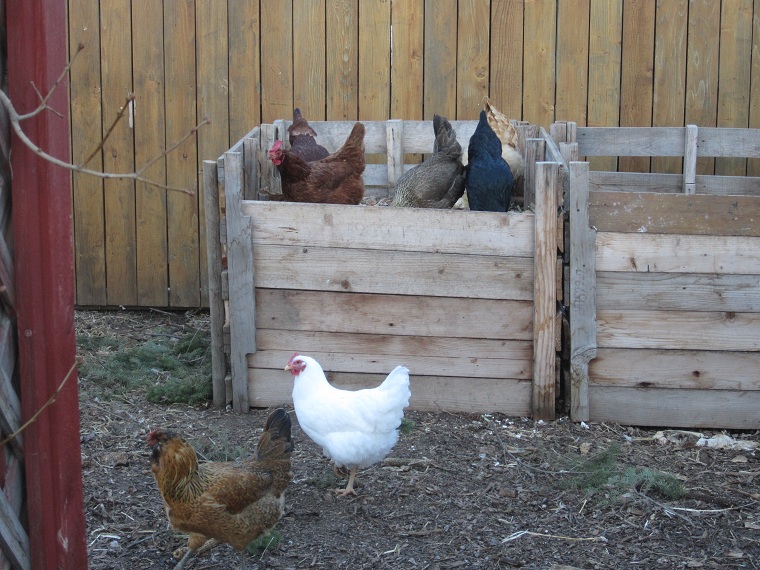
Waste Not: Scraps given to chickens and/or compost pile, gave the old chain link fencing to the neighbor’s friend who will use it for a baseball field.  Also, been hanging nearly all the laundry on the clothesline.  Donated old stuff to the Goodwill.  Used the push-reel mower to mow.

Want Not: bought a picnic table on CL (my Mother’s Day 2011 present), bought some books at a garage sale, added the 3 gallons of olive oil that we ordered in March to the pantry.

Eat the Food: mainly we’ve been emptying things out… from the pantry: peach preserves, peanut butter, pasta, nuts, pickles, etc..  The freezer: tomatoes, corn, bell peppers, peaches (many), elk meat (lots), chicken, berries (I still have berries?!?!), peas, green chiles.

Build Community: The April potluck was a huge success.  We had more people there than ever.  It kind of spurred us on to hurry up on that picnic table so we could have enough seating for everyone.  We built a raised bed in the neighbor’s yard and helped him plant it with lettuces, carrots and onions so far, and we introduced a friend to our CSA farm (they should pay me).
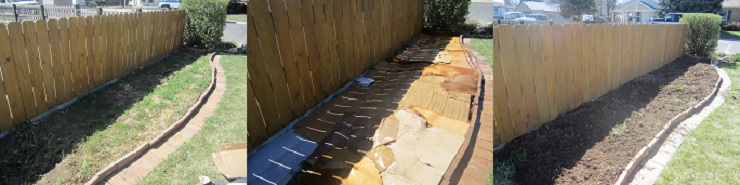
Skill Up: We replaced a chain-link fence with a cedar one, built our first lasagna bed, and divided and transplanted some day lilies that we along the old fence line.  Also learned that “nearly done” compost, is not “good enough.”  I hadn’t gotten the pile hot enough to kill weed seeds and now I’ve spread it in a lasagna bed and in my neighbors bed.  And grown lots of weeds.  😦

Also, I’ve been having a hard time remembering everything for the once a month updates, so I’m thinking I might do twice a month for a while to see how it goes.  I have things I want to talk about for May, and I’m afraid I’ll forget by the end of the month!

Have you been participating in the Independence Days Challenge?
Categories: Independence Days | Tags: | 2 Comments

Homestead Garden Tour – May 1, 2012

I wanted to post an update of how things are growing here at the homestead this spring.  I’m excited about our gardens this year, and we’ve worked pretty hard at getting the yard in shape after last year’s tree removal.  Last weekend, we finished the privacy fence along the driveway.  We are really excited about this, since now we’ll be able to explore planting some fruit trees or berry bushes or something permanent along the fence line (we’re not sure what yet). Now we just have a flagstone patio to install (and a pergola)!

We’ve had a lot of spinach so far this spring from plants that self-seeded last year.  And we’ve enjoyed bits of Swiss chard here and there from plants that we planted last year, overwintered and have just kept right on going.  Perpetual chard!

This slideshow requires JavaScript.

I’m very excited that our garlic is growing so well.  I think we planted enough for the coming year, plus enough for seed (I’m hoping anyway).  And our potatoes that we planted have grown so much that we’ve hilled up three times so far.  I’m hoping for a big harvest there as well.

The neighbor has already planted a row of corn, and we put the giant pumpkin seeds in the ground last week (along with a few sunflowers).  This week will be our main summer planting.  We are excited to get all those seedlings in – tomatoes, basil, peppers, chives, rhubarb, strawberries…

How is your garden shaping up so far?

Categories: Beekeeping, Chickens, Garden, Urban Homesteading | Tags: , , , , | 10 Comments

Spicy Hot Lava Cakes

Over the last few months, I’ve been on the quest for the perfect brownie recipe.  I love rich, fudge-y (not cake-y) brownies, with dark chocolate, that can be made in under half an hour prep time.  In other words, they need to be amazing at the spur of the moment for that night’s dessert.  This has been a delicious quest which my husband is truly appreciating.

During my search, a few weeks ago, I came across a molten chocolate cake recipe.  It was pretty good, quick and easy, but after tinkering with it a bit, and applying some of the techniques and twists I’ve acquired during my perfect brownie search, I think I came up with the best molten chocolate cake recipe ever.

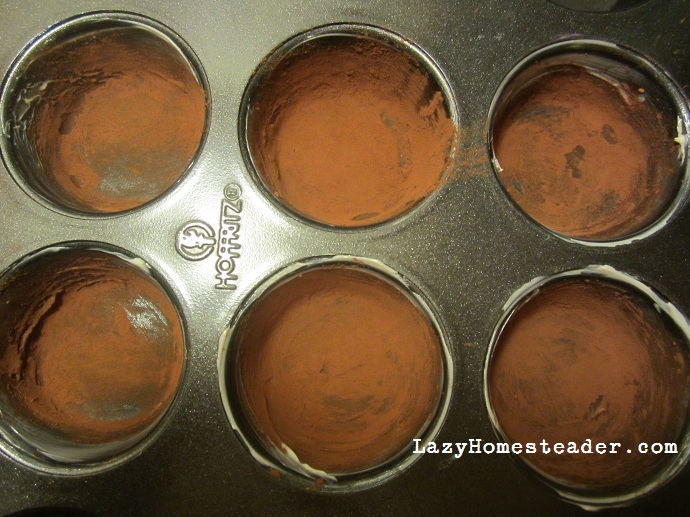
Step one:  preheat the oven to 400° and butter and dust your muffin tin with cocoa powder or granulated sugar.  My only muffin tin has 12 cups, but you need only six for this recipe.

Now, in a double boiler, melt butter and dark chocolate chips together.  Just so you know, with a double boiler, the boiling water should not be touching the bottom of the upper pan.

Also, I added chile powder, because I’m addicted to chocolate and chiles. And chiles in all their forms are just awesome.

If you don’t have a double boiler, you can use a heat proof bowl set over a pan of boiling water.  But the bowl should not be in the water – just over it.

After everything is all melted and mixed together, pour it into a mixing bowl with 1/3 cup brown sugar.  Whisk the chocolate mixture with the sugar, and then add three eggs, whisking well.

The chocolate mixture will get all gloopy and shiny looking.  At this point, mix in flour and a pinch of salt.

Then fill up your muffin cups.  Go ahead and fill them to the top, they don’t rise much.

Then set the muffin tin on a baking sheet and put them both in the oven.  This is actually kind of important.  It’s not to contain the mess or anything (there’s no mess), but I think it insulates the bottom of the muffin pan.  When I tried not using the baking sheet, the cakes came out too well done at the bottom.

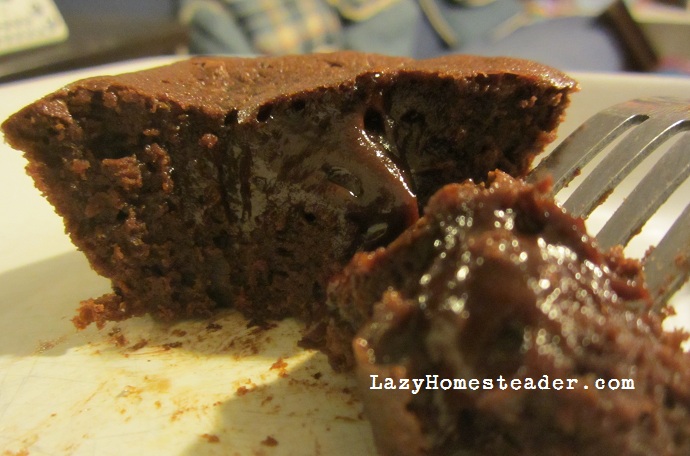
Anyway.  Bake them until the tops are set.  For me this is 12 minutes.  It might be more or less for you, keep an eye on them.  You only want them set, not cooked through.  Like this:

Let them rest in the pan for ten minutes.  Set your timer and read a blog post, answer some email, wash up your mixing bowl.  Whatever.

Then plate them up hot and enjoy…

Spicy Hot Lava Cakes

1/4 cup unsalted butter
1 cup bittersweet chocolate chips
1 TBS hot Chimayo chile powder (or other New Mexican chile powder)
1/3 cup brown sugar
3 eggs
1/3 cup flour
1/4 tsp salt

butter and cocoa powder or sugar for dusting muffin tins

Preheat oven to 400°.  Butter and dust 6  muffin tins.  In a double boiler or a heat proof bowl set over (not in) boiling water, melt together the butter, chocolate and chile powder.  When melted and combined, whisk chocolate mixture into brown sugar.  Beat in eggs.  Combine the flour and salt and fold into the chocolate mixture.  Divide batter between the prepared muffin cups.

Set muffin tin on a baking sheet, and bake for approx. 12 minutes, just until the top is set.  Remove from oven and let stand 10 more minutes before serving.  Enjoy hot (and spicy).

*Note: for my friends who like it on the milder side, you can use less chile powder or none at all, and they still turn out scrumptious.

Categories: Food, Recipes | Tags: , | 19 Comments

Pros and Cons of a Push-Reel Mower

Like many people around the country last week, we mowed our lawn for the first time this season.  The difference between us and our neighbors, however, is I talked on the phone while I did it.

We have a push-reel mower.

Last summer, I sold my husband’s shiny, red, super-charged, front-wheel-drive, 9 billion horsepower, mulching power mower for this little green machine powered by ye ole chevrolegs.

Now I love this thing, and truth be told, Rick hates it.  He teases me all the time about how I’m saving approximately 6 gallons of gas a year.  If that.  And, pretty much, he leaves the mowing to me now, where before it used to be solely his domain.  I think he’s embarrassed.  But I like it anyway.

In case you have been considering getting one yourself, here are the pros and cons (yes, there are some) of a push-reel mower…

The top five things I love about the push-reel mower:

  1. It’s quiet.  I really did talk on the phone while I was mowing the lawn last week.  My mom asked me, what that sound was, and I said, “Oh, I’m mowing the lawn.”  Then we both laughed.  I was talking on the phone while mowing the lawn.  Preposterous!  I could mow at six in the morning or ten at night and the neighbors would never know.  It’s the stealth mower.  I actually like the sound it makes.
  2. It uses no fuel or oil and takes little to no maintenance.  By the time my neighbor is done checking his oil and fuel and pumping and priming, reconnecting the spark plug and whatever else, I’m ¾ the way done mowing my lawn.  One time, no joke, with the old power mower I stood outside for like 15 minutes trying to start the thing before I realized the spark plug was disconnected (hubby did this for safety’s sake).  The neighbor had to come over and point it out. 
  3. It’s lightweight.  All the power it uses comes from your legs and arms pushing this machine; it’s easy to maneuver and I can easily lift it up the couple of steps to our front yard and takes up very little space in the garage.  With the old machine, I could barely get it up the steps, and had to go up all backwards and strategic.  It was super heavy and could chop off my arm – the little label on the side said so.
  4. There is NO string pulling to start it up.
  5. There is no exhaust.  No stinky fumes makes me feel all green and hip and environmentally conscious.  And also the lack of fumes keeps me from feeling sick.  I know six gallons (or whatever) of gas per year is not much, but I don’t mind mowing the lawn now, because I don’t get a headache from the noise/fume combo.

Five things I don’t love:

  1. You can’t mow over sticks.  The power mower mulched and could chop up a stick or a twig that had fallen from the tree in the front yard, but the push mower can’t.  I send the boys out in the yard before I mow with the mission to pick up all the sticks.  If I accidentally mow over a stick, I have to stop to get it out of the mower, because it will jam the blades.
  2. Sharpening the blades will be a challenge.  Not many places know how to sharpen the blades of a push-reel mower anymore, and those who do charge a lot for it – almost as much as the mower cost.  Since the blades will stay sharp a long time though, we at least have a while to learn how to do it ourselves.
  3. It doesn’t always get every piece of grass in one pass.  Because of this, it is really important to overlap or mow two ways.  Otherwise your lawn looks like it’s received a haircut from a barber half in the bag.
  4. The neighbors look at us funny.  When I first bought the mower, I thought people would think we were so cool – all hip and eco-friendly.  Turns out, they either think we are crazy or too poor for a “real” mower.  Hmm… this must be why Rick is embarrassed to use it.
  5. You can’t be a lazy lawn keeper.  If your grass gets too long, the push mower is a real bear to use.  In fact, there was a time last summer, when we first got the mower, that we had to borrow our neighbor’s power mower because we had waited a couple of weeks too long to mow and the push mower, literally, couldn’t cut it.  Lesson learned.

I feel like the push mower and the power mower take about the same amount of physical effort to use.  The push mower is all pushing, which isn’t that much work (hey if I can handle that giant cart thingy at Target I can handle the mower).  The power mower took more effort for me in the starting, holding down the lever thing, and then holding it back from running my flowers down (since it pulled itself).  I think the trade-off of putting the kids on stick patrol and enduring funny looks is a pretty good one.  Plus, I can catch up with my mom on the phone while I’m at it.  😉

Categories: Simple Living, Sustainability, Top 5 | Tags: , , , , , , | 42 Comments

March Independence Days Update

Wow – here it is the middle of April, and I’m just now getting to the March update.  Yikes!

March was a great month, garden speaking.  I actually got my spring garden in on time!  I planted a lot really, and am happy to report that potatoes, peas, beets, kale, spinach and arugula are all up already.  Some of my lettuce didn’t come up so I’m thinking I’ll have to replant it.

A switch must have flipped for the chickens, since March 1st, we’ve collected 99 eggs.  Ninety-nine!

Plant Something:  Potatoes, Alaskan sugar peas, blue curled kale and red Russian kale, yellow cylindrical beets, Ringmaster onions, spinach, arugula, Boston lettuce, red romaine, Tom Thumb lettuce, Little Gem lettuce, peas and oats cover crop blend in the chicken area.

Harvest Something: Eggs: 99!!  Enough spinach for a pizza and for Emmett to graze on.

Preserve Something:  Froze 1# pizza dough.


Waste Not: Scraps given to chickens and/or compost pile.

Want Not: At the beginning of March, we bought a case of pasta, and at the end of the month we ordered some olive oil in bulk.  Also, the neighbor gave us steel posts so we could get started on the last run of the fence, and two old rusty iron tractor seats that we plan to turn into a garden bench.

Eat the Food:  From the Pantry we’ve eaten peach preserves, peanut butter, strawberry jam, pasta, nuts, plum lavender jam, the last of the dried tomatoes and  pickles, pickles, pickles.  From the freezer: elk flat steak, bell peppers, tomatoes, corn, black bean burgers, peaches, elk back strap, turkey stock, and pizza dough.

Build Community:  In March, we hosted our second potluck and a seed swap.  It was great to get to know friends a bit better and I got some new seeds (peas, cilantro and hollyhocks).  We helped the neighbor get started on a new raised bed in his front yard.

Skill Up: Our neighbor showed Rick how to properly sand and paint steel posts.  

We are headed into one of the busiest times of the year for homesteaders.  The planting season is in full swing.  We had the warmest March I can remember, not one drop of precipitation in what is normally Colorado’s snowiest month, and it is being followed by a chilly April so far.  But everything seems to be growing well, and I’ve certainly gotten the planting itch!

How are things coming along at your homestead?

Categories: Independence Days, Sustainability, Urban Homesteading | Tags: , , | 5 Comments

Making the Most of Your CSA Share

CSA season is around the corner and I am very excited to start receiving a share again.  We have a month (plus or minus) until asparagus comes on!!  I would ideally love to grow everything we eat ourselves, but we just don’t have enough space.  And our CSA grows such beautiful, delicious food, I can’t resist signing up year after year. They take good care of their members, using a blog, Yahoo group and Facebook to help foster community.  They’ve even put together a cookbook full of recipes submitted by CSA members over the years.

All CSA’s are as different as the members and farmers who run them.  Since we are heading into our fifth year with Monroe Organic Farms, our CSA, I thought I’d offer up some of my best tips on making the most of your share.

1.  Open the bag and figure out what you have.  Most people get their share home after a long day at work.  It might be tempting to leave the bag sit until tomorrow, but it’s best to open your bag right away.  You will want to store some things right off the bat, and if there is anything delicate in there like lettuce or basil, you’ll want to get it in cool water or the fridge right away.  There’s nothing worse than waiting a day or two to get to your share and finding you let your green beans wither and die in the summer heat.

2.  Wait to plan your weekly menu until you get your share.  I pick up my share on Tuesdays, so I wait until Wednesday to go to the grocery store or market.  I spend a lot less this way, and I can plan meals around what we received in our share.

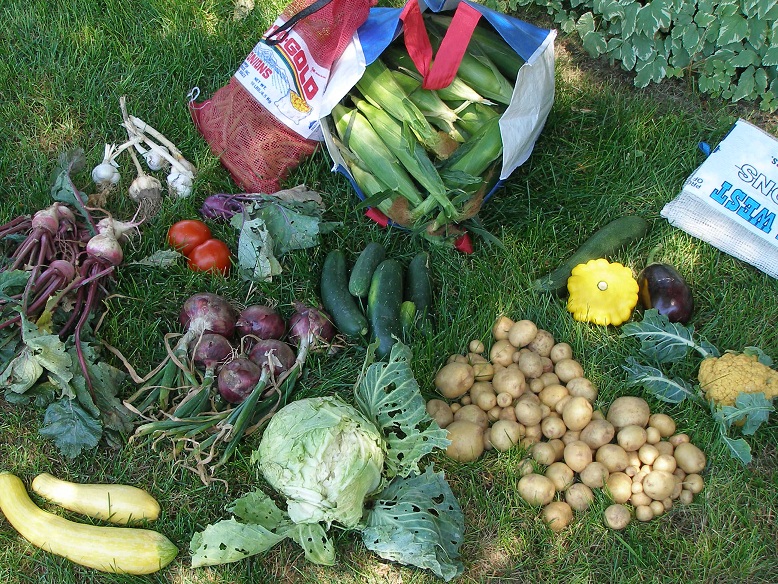
3.  Wash and store everything the day you get it.  I do my washing outside.  The potatoes, carrots, beets, turnips and onions all have a lot of dirt on them.  I used to do it in the kitchen, but then I had to sweep, mop and clean the sink too.  Instead, I dump my share on the lawn, hose it off and then sort it into what I want to eat right away this week and what I’m going to freeze for later.  Freeze what you’re going to save right away so it’s frozen at it’s peak.  It’ll be just as fresh when you go to use it this winter.

4.  Read the newsletter!  Every week you’ll get a run down of everything included in the share, plus important updates on upcoming distributions and events with the farm.  If you read it you’ll know just what that odd looking vegetable is, and you might even get a recipe on how to use it!

5.  Use the cookbook.  Don’t know what to do with a celeriac?  How should you freeze your extra beans?  It’s in the cookbook.  What to do with all those potatoes?  Not sure you like beets?  Try a new recipe.  All the recipes in the Monroe cookbook are from farm members.  They’ve all been tested by real people here in your community.  You might just get a new favorite dish.

6.  Get involved.  Read the farm’s blog and Facebook page.  Contribute to the yahoo group or the calls for recipes.  Come to the Harvest Festival.  This is the community in community supported agriculture.

7.  Understand that some things are out of our hands.  Some years will be bountiful pepper years, some will be tomatoes, some will be melons.  Usually never all three at once.  You might have been dreaming all winter of your strawberries only to have them hailed out (please no!!), or you might feel like you can’t shuck one more ear of corn.  But such is life when you are relying on the weather to bring you the freshest local food.  Enjoy your melon now, for in November it will be gone.

8.  Visit the farm.  See where things grow.  Check out the chickens, help load the shares onto the truck.  Connect with what you’ve invested in on every level.  Take advantage of the U-pick crops and the harvest festival.  It’s fun, you’ll learn a lot, and you’ll go home with even more delicious fresh food.

9.  Be gracious:  Be on time, return your bags, call ahead if you can’t make it.  Remember that your farmers and the volunteers at your distribution center are people too.

Do you participate in a CSA?  What are your best tips for making the most of your share?  If you’ve arrived here from the Monroe blog, share with us your experiences, favorite part of the CSA and what you are looking forward to most this year!

Categories: Community, CSA, Food, Sustainability | Tags: , , , , , | 14 Comments

Remedial Composting

When I did my composting boot camp posts we were under a few feet of snow here in Denver.  I was unable to get outside and get any useful pictures of the compost bin in progress for you.  But over the last two weekends, mother nature has been much more cooperative.  We were able to get out to the bins, and coupled with the spring garden cleaning we did, we had plenty of stuff to add to it.

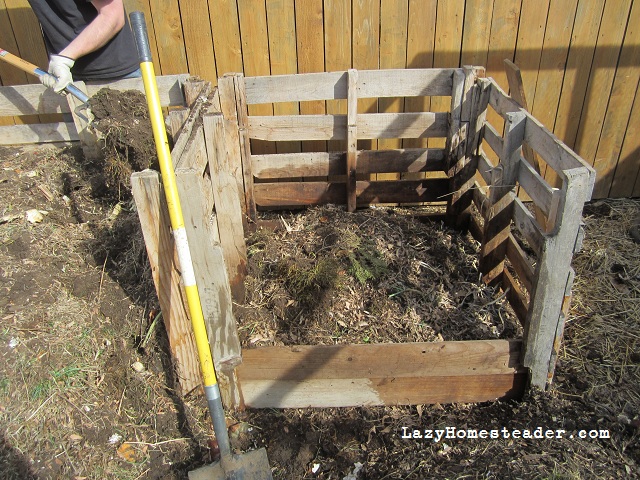
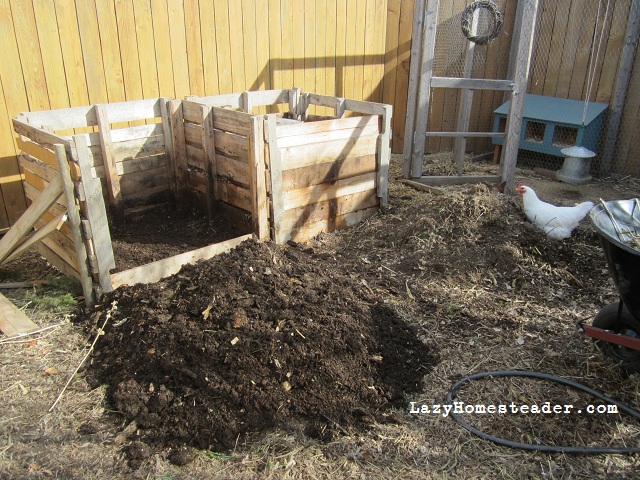
Both bins were pretty full.  The bin on the right had been covered, and I was hoping that it would be full of finished compost, ready to go.

Instead, it was nearly done.  But there were a lot of sticks and twigs in it from the tree last summer that hadn’t broken down yet.  Rick raked it all out of the bin, while Henry and I collected as many sticks as we could.  The plan is to power compost this stuff so it’ll be ready to go into beds by April or early May.

Here is a close up of that almost ready compost:

It looked pretty good, but there were still a lot of big pieces that I wanted to get broken down before we put it in the garden.

The left side of the bin is where we added our kitchen scraps all winter, fall garden materials and sod this spring that we removed from the edges of our flower and herb beds where it was encroaching.  We didn’t turn the pile over the winter at all, and it had many fabulous layers.

See all that beautiful finished compost at the bottom?  That is what I want!  But there is an awful lot of other stuff on top of it.  So we used the now empty bin on the right side to mix up the stuff on the left side all the way down to the finished stuff, which we will keep separate.

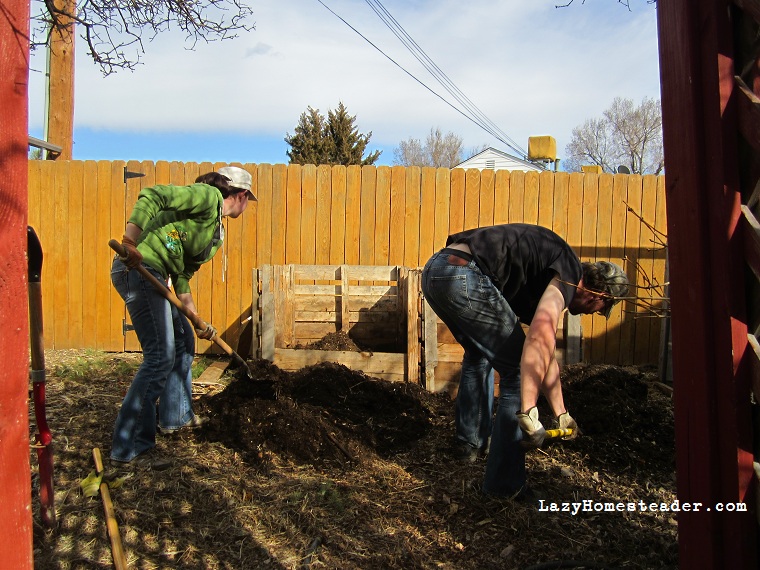
We started moving it over…

Not pictured is a bunch of dried grass and leaves and yard clippings that will get mixed in with the layers.  It’s off to the left of the frame.  We had more stuff than we could immediately fit into the bins without doing this process first.

So we tossed part of that top layer of grass and sod into the empty bin on the right, and part of it got tossed in front of the bin, so we could mix in other layers too.  As we moved layers over, we had H grab big armfuls of dry leaves and dry grass to mix in with the stuff coming from the left bin.

As the right-hand-side pile grew, we put the front boards back in to keep it contained.

We watered the pile with the hose as we went.  Remember, it takes water, air, carbon (browns) and nitrogen (greens) to make a great compost pile.  It was a hot day and the week was supposed to be plenty hot, so I wasn’t worried about making it too wet.

Where the layers were already very wet from the winter snows, we added lots of dry stuff.  If anything was too big, we tried to break it up as well.  The layer from last year’s garden was pretty wet, so it was good to mix in some dry brown material as we went. We were trying to balance it out. 

Also as we got to the middle layers we mixed in some of that first stuff that went over the side of the bin.  The idea it to get it somewhat uniform, so it all rots together, as opposed to the layers we originally had.

You never know what you’ll find in your compost bin.  I found this perfectly grown beet with a weird, crunchy, light-starved top.  It grew somewhere, way down in the pile.

We continued layering and watering and mixing and putting the boards of the compost bin back up until we had reached that finished compost down at the bottom of the left bin.  Then we pulled all that great, finished compost out of the bottom of the bin.

Now we had two piles.  Finished compost on the left, nearly finished compost on the right, and an empty bin.

We could use all that compost on the left, but I really didn’t have a place ready for it yet.  I decided to layer it back in with the nearly done stuff on the right with some of the top soil that we had from the bed edging.

Rick and I grabbed shovels and tossed both piles into the empty bin.

We watered it and then covered it with heavy black plastic. Over the next few weeks, it should cook down to great, useable compost ready to feed this springs’ gardens.

We did all of this work on the 11th.  I’ve checked the left-hand bin pretty regularly. Some days I uncover it and watered it; I’ve mixed it again once with a rake and my hands (so I could feel how wet and warm it was/wasn’t) since then already.  I want to keep it hot and damp, but not too wet.  Like a wrung out sponge or chocolate cake.  We’ve been adding our kitchen scraps and other yard waste to the bin on the right.

That is what composting looks like in action… the down and dirty work of spring cleaning.  😉

Categories: Compost, Sustainability, Urban Homesteading | Tags: , , , , , | 24 Comments

You’ve Got to be Chitting Me

This weekend the weather was amazing.  The sun was out, it was warm, and we all got sunburned.  It was the first really nice weekend of the year.  So nice in fact, that I was completely unmotivated to sit down at the computer inside and write a single line.  I had plenty of blog inspiration though.  I took no less than 76 photos this weekend.

Since the weather is so nice, we’re thinking we’ll be able to open the beehive in a couple of weeks and actually get some cool photos (and possibly harvest some honey), so I decided to put off the beekeeping 101 boot camp until then.  The bees were doing some housekeeping this weekend, and I saw of them coming back to the hive with pollen even, so I know it’ll be good news on the bee front.

We got started on some of the early spring to-dos.  We cleaned out the flower beds and checked on the garlic.  I have some kohlrabi that looks like it has made it over the winter, and we got a jump on removing the grass and from some new beds that we hope to plant this year.  And we hacked out a place for some potatoes since the neighbor is using his garden for other crops this year.

Once we got some of the prep work out of the way, Rick went downstairs and got our seed potatoes out of the cellar.

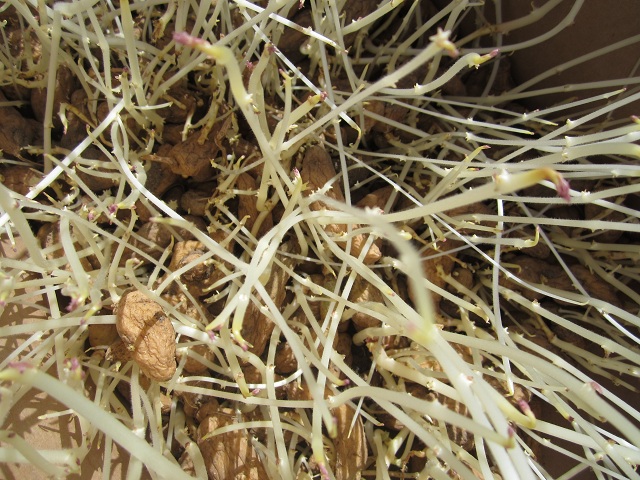
You might imagine that we were surprised to see the spuds with eight-inch long sprouts sticking their tips out of the top of their box.  From everything we’ve read, you are supposed to “chit” your potatoes around January, letting them begin to get sprouts, and then plant them out with one-inch long sprouts.

In case you’ve never heard of this before, chitting potatoes means you are encouraging the eyes of your seed potatoes to sprout before you plant them.

I don’t know if we left the lid open too early or what, but they were a-growin’.  The potatoes, fingerlings, were a little soft, spongy even.  We were feeling a bit panicky, unsure if our chits were ruined or if they had a head start.

We decided to go ahead and plant them.  What is the worst that can happen?  We’ll get a lousy yield?  If we didn’t plant them, we wouldn’t get any.  So in the ground they went.

This year, since our space is pretty limited, we decided to experiment with a tower.  Most of the potatoes are in rows, but we had room for one tower.  I’m excited to compare how they do.  From what I’ve read, fingerlings are good candidates for towers.

I stated by digging a round hole about eight inches deep.  I put some loose soil and finished compost in the bottom, and then spaced my super-chitted spuds in a circle around the hole, sprout side up. I lightly covered them with soil.

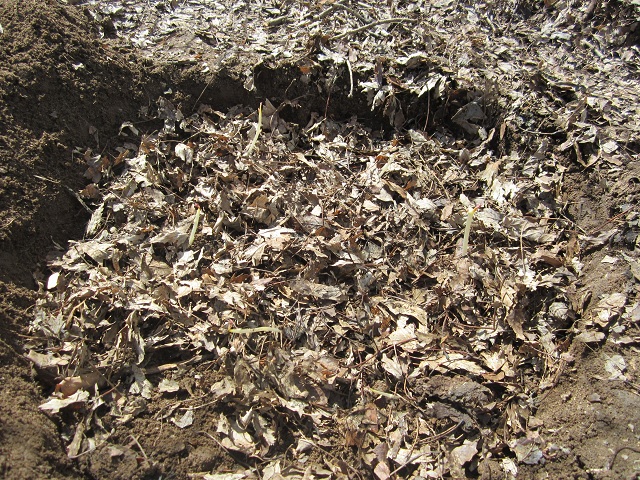
I had some half-decomposed leaves lying around, and since potatoes are heavy feeders and the tower is in a newer bed without the best soil ever, I layered in some leaves with the soil.

I alternated layers of soil and leaves until the sprouts were completely covered.  Then I put an old cage over the top.  Notice, there is still a pile of soil there on the left and some leaves on the right of the tower, so I can continue to hill-up as the sprouts poke through.

I’m very excited to see how this comes out.  I was completely surprised at the chits having such long sprouts, and so I’m looking forward to how they do.  And I’m excited to see how the potatoes in the tower do compared to those in the rows that we planted at the same time.

Have you planted potatoes in a tower?  What about our super long sprouts on the spuds; ever had something like that?  Do tell!

Categories: Garden | Tags: , , | 25 Comments

Create a free website or blog at WordPress.com.