Urban Homesteading

Green Cleaners in the Kitchen

The kitchen is the urban homestead’s work horse.  And boy do I ever give my old porcelain sink a workout.  It gets pretty stained and dingy and needs a good deep cleaning every week.  Like the bathroom, I basically use white vinegar and baking soda to get the job done.

I start by rinsing the sink, and then I sprinkle baking soda in (again, like many people use Comet).  I drink coffee and my sink gets easily stained.  I grab a sponge and start scrubbing.  Baking soda is actually pretty abrasive and it cuts odors.  Just a little water on your sponge makes this pretty effective.

After the scrub down, I rinse the sink again, plug it and pour in a little white vinegar to take care of any staining that I couldn’t get with the baking soda.  I leave it to soak there while I take care of the back of the sink.  I use a butter knife wrapped in a dishcloth with a little baking soda to get the edges and hard to reach places.

Or for areas that need more muscle, I use a knife/sponge combo.  Like the crack between the sink and the wall, under the window sill.  It’s impossible to get my hand back there – the butter knife does the trick.

By the time I’m done with all of that, the vinegar has done its job in the sink.  So I drain it and move on to the rest of the kitchen.

I use baking soda to scrub my stove top, and dish soap that cuts grease to clean the back of the stove and the toaster oven.  For the counters I have vinegar mixed with water in a spray bottle that I spray over all the counters, let sit for a bit and then wipe off.

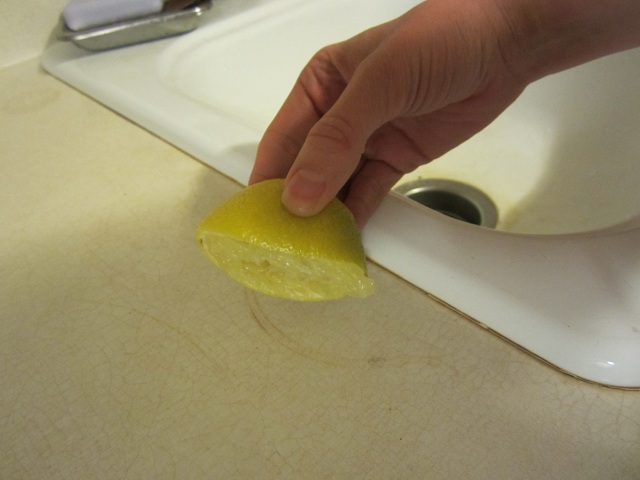
But recently, I had a stain on my counter that white vinegar couldn’t take care of.  Bleach didn’t cut it either.  It was rust from our cast iron griddle.  What got it finally was lemon juice.

Lemons are powerful.  They can cook shrimp or fish in their juice, they kill germs and bacteria, and the are amazing bleaching agents.  I have proof.  First I squeezed a bit of juice on the stain and rubbed it around.  Then I let it sit for a couple minutes.

I was afraid it wasn’t working.  I sprinkled on some baking soda.  Salt would have been better but I already had the soda out.  It made it all fizzy, and probably neutralized the acid a bit, but I wanted its scrubbing power and figured it had set there, full strength long enough.

So I scrubbed it, and scrubbed it.  And…. it worked.

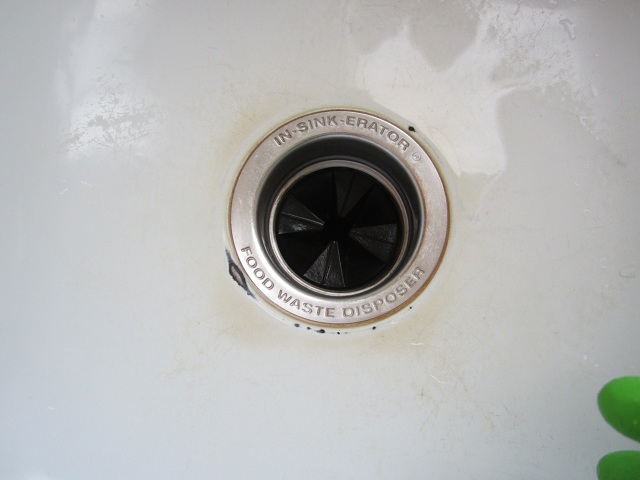
Then I threw the old, dead, juice-less lemon into the garbage disposal and ran it with water to make it smell nice.  Kitchen cleaned.

What do you use to clean your kitchen?

Categories: DIY, Simple Living, Thrift, Urban Homesteading | Tags: , , , , , , | 2 Comments

Green Cleaners in the Bathroom

This week’s boot camp is about green cleaners.  Lots of urban homesteaders are into doing things with less chemicals, more frugally, and more self-reliance.  Using or making some green cleaners around the house is a great skill to add to the homesteading arsenal.

The thing is, I don’t really use any cleaners in the house.  I use good old baking soda and white vinegar, and lemon juice.  And I think these have been talked about an awful lot on the internet already.  So while I can wax on about how effective these normal household items are to clean with, I am not sure I have much new information to offer as far as ingredients go.  Here it is, none the less.

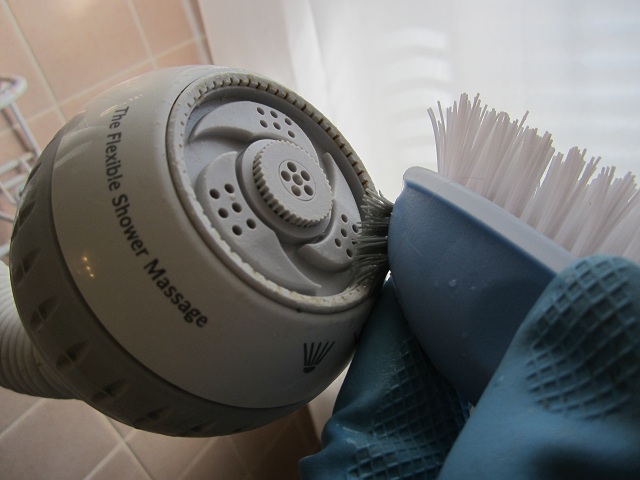
I can tell you that these things really do work in Colorado where the water is hard and full of minerals that build up on everything.  Like my shower head, all covered in calcium build-up (or is that lime scale? or…  ??):

To get that puppy clean, first I tried just straight up vinegar with a grout brush.  Which did a pretty good job.

But I kind of needed something that would stick a bit better so that the vinegar could sit and work at it for me.  I’m all for scrubbing if it means I don’t have to use CLR, but if I can not scrub, that’s even better.  So I mixed some vinegar with some corn starch.  And poured the gloopy paste all over the shower head.  And then, while I let that sit, I used some on the tub faucet that is always sticking and tough to pull the shower lever thingy on (wow – the technical terms in this post are astounding).  Then, after I got impatient, I rinsed the shower head off… pretty good, eh?

It’s not perfect or anything, and probably if I had been a little more patient, it would have been, but I think it was decent. What’s even better is the mix worked on the tub faucet puller thing.

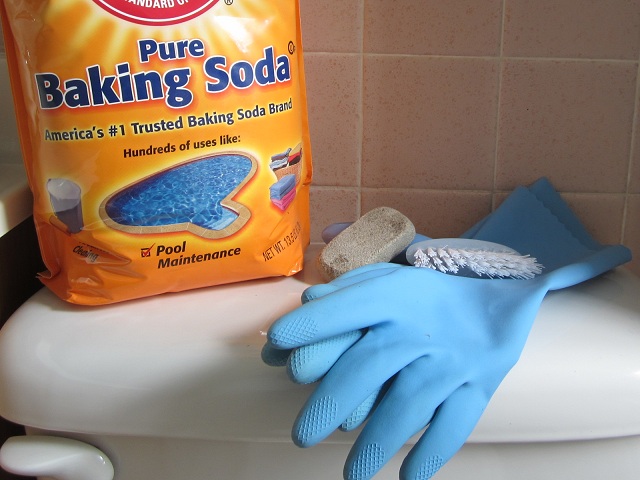
On to the rest of the bathroom!  Here is what I use:

Like the package says, there are hundreds of uses for baking soda.  That’s why I have a huge bag of it.  In the bathroom, I use it like most people use Comet.  I use it to scrub down the sink and tiles and tub.  And it works.

So what about the throne?  Well, lots of homesteaders are either into saving water or have male persons in the house.  Or both.  And so the toilet often gets stained from letting the yellow mellow.  And in our house, that hard water alone can leave a ring.  The best cleaning tool I have for cleaning a stained toilet is a pumice stone.

The first time I used it, I was scared to death.  I thought for sure I was going to scratch the porcelain and end up with a horrid looking toilet that I was going to end up replacing.  But that was needless worry.  It worked great.  And as far as I can tell, it didn’t scratch a thing.  First I don my rubber gloves and do a scrub with the toilet brush and a flush so the water in there is clean.  I don’t put any cleaners in there.  Then I grab the pumice stone.

I scrub around the water line, in the hole and under the rim.  It gets everything off.  You can see that the corners of my stone are getting rounded off.  The stone crumbles instead of scratching the bowl.  It works.  The toilet is sparkling.  After that, I will throw a splash of vinegar in the toilet and use the toilet brush again, for good measure.  Clean as a… well, not a whistle, but you get the idea.

I also use vinegar and water mixed in a spray bottle to clean the mirror with a lint-free cloth.  And to clean the floor. And to spray down the shower walls.

How do you clean your bathroom?

Categories: DIY, Simple Living, Thrift, Urban Homesteading | Tags: , , , , , , | 8 Comments

February Independence Update

I have to admit that my urban homestead boot camp has been a bit of a blogging boot camp for me as well.  I’ve written more in the last two months than I have pretty much ever, and it’s been a great outlet that I’ve really enjoyed.  And my readership is up as well, which is always fun for me and also amazing, since I am always surprised that people want to read what I’m saying.  So welcome to all of you new readers!  Also, I plan on doing a bit of blog maintenance this week, so if you see anything weird, mid change, please bear with me.

I wanted to do an update on my progress with the Independence Days challenge.  I’ve kept pretty good track on my sidebar, but sometimes I forget a few things here or there.  So for the last month, this is where we’re at:

Plant Something: Planting is on the horizon here for us.  We have seeds and I’m planning on starting some inside (perhaps this week?) but now we’re just waiting on the weather.

Harvest Something: One whole egg.  I’m pretty sure we have more than one egg eater, and I know one hen is in full molt right now.  And one is five years old.  So the lack of eggs, while not totally surprising, is completely frustrating.  I’ve heard from a few people on Facebook that we’re not the only ones in Colorado experiencing this, that it has something to do with our whacked out weather, but in five years of raising chickens, this is the first time we’ve been completely dry.  Especially this late in the winter.  So we have some culling to do in the near future and some replacements waiting in the wings:

Preserve Something: While we were all sick a couple weeks back, Rick dug the Thanksgiving turkey carcass out of the freezer and made up some stock (and some soup).  8 cups went into the freezer.  Other than that though, we’ve mainly been depleting it, and not adding to it.  😉

Waste Not:  Scraps given to the chickens and compost pile.  Also, a few months back I salvaged a small nightstand /dresser thingy and a book shelf that was going into the local preschool’s dumpster (why???).  Rick has been refinishing them.  The nightstand is solid wood and is cleaning up beautifully.  I wish I had done before/after pictures.  The book-case is both wood and wood-veneer.  It’ll probably end up getting painted.

Want Not: I bought a couple of pairs of pants from the thrift shop, as well as a hurricane for my oil lamp.  We have a case of pasta on order that I should be getting this week or next.  Also, some angel friends dropped by some clothes for C last night, unexpectedly.  I’m so grateful for gifts like that, out of thin air.  I’m glad we found out that other friends of ours are having a baby girl, so we can pay that blessing forward.

Eat the Food: Due to some payroll mix ups, we got to take full advantage of our freezer and pantry this month.  Rick got what we thought was some extra bonus money at the beginning of the month.  It turns out that payroll had made a mistake and then just took the difference out of his check two weeks later… after we had already used it to pay off some debt.  So we had two very lean weeks, income wise.  Thankfully we really didn’t feel much of a pinch, since we had the food stored.  We ate a bit more meat than we usually do, and a few less fresh vegetables.  But we by no means suffered through it.   From the pantry we had spaghetti squash, pickles, strawberry jam, peach-plum ginger jam, white pumpkin, dried tomatoes, peach preserves, plum noir jam, red beans and chick peas, rice, more pickles, pasta, popcorn, nuts….  and from the freezer, we enjoyed elk chili, elk steak, green chiles, elk stew meat, asparagus, the turkey bones for soup, elk for stir fry, green peppers, elk chili again, ground elk, elk steaks, more tomatoes, lots of peaches for tarts and cobblers and smoothies, frozen corn… and I’m sure more.

Build Community Food Systems: At the beginning of the month we hosted our first monthly potluck.  My hope in doing this monthly is to, number one, build community, and number two, share resources.  The first one had a small crowd, but we enjoyed it a lot and are looking forward to the next one on the 9th with, hopefully, more people.  😉

Skill Up: We’ve been chomping at the bit for spring to get here.  In the mean time, I’ve read up on fan training fruit trees, and I bought a grow light, since I’ve determined that the natural light we get in the house has been insufficient for starting seeds.  Now I have to figure out how to build some adjustable height stand thingy for the light.  Heh.  And, Rick has been doing the aforementioned refinishing, which is new to him.

So that is the summary for the month.  If you’ve been doing the Independence Days challenge this year, what have you been accomplishing?

Categories: Independence Days, Sustainability, Urban Homesteading | Tags: , , | 4 Comments

Five Things No One Tells You About Chickens

Over the last five years I’ve learned a few things about keeping chickens in the back yard.  And while, for the most part, chickens are really fun and the positives far outweigh the negatives, it’s not all roses.  No, they are not noisy.  No they don’t stink.  But there are a few lessons we have learned about the urban homestead’s favorite creature feature:

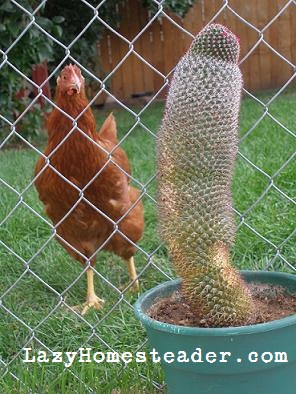
  1. cactus poppyDon’t name them.  Chickens are so far down on the food-chain that they are pretty much dinner for everything except insects.  Naming them is just setting yourself up for heart-break.  We named our first five chicks.  But the tears when Daisy was killed by a fox were enough to cure us of this.  The next two rounds of chicks were nameless.  While we still knew them as “the red one” or “the big one,” it kinda kept our feelings a bit more protected.  And we were able to eat the ones without names when the time came.
  2. Every one will ask if you need a rooster to get eggs.  I’m not really sure why this is a question?  If there is no rooster, the eggs will never become chicks.  Eggs are not baby chickens.  Eggs are just eggs.  At some point you will find yourself, once again, explaining that eggs are basically like a tasty chicken period that happens daily.  Yum, right?
  3. Baby chicks are messy.  Very, very messy.  Our first chicks were raised in a box in our office.  They were so cute.  When they finally moved outside, the office was completely covered in a very thick layer of dust.  It was awful.  The next chicks got the luxury of a heat lamp in the garage instead.
  4. Chickens dig deep holes.  Like, to China.  We used to let them free-range through the whole back yard.  Our yard is small, but they never ate all the grass.  They pooped everywhere, but we could hose off the patio.  The real bummer were these gigantic, deep holes.  They use them for dust baths.  Later, we moved the coop to one area of the yard.  The hens still free-range, within their area, and they’ve eaten all the grass back there and dig to their hearts’ content.  And we are no longer breaking ankles in the giant holes.  Bonus: the kids can now roll a ball in the remaining grass, poo-free.
  5. You will be spoiled by the eggs.  If, for some reason you need to buy eggs from the store, you will scowl at their sickly, yellow insides and scoff at their bland taste.  They literally pale in comparison to your awesome, dark-yolked, delicious, home-grown eggs.

So while others continue to extol the merits of the back yard flock, don’t come to me saying you weren’t warned.  😉

Categories: Chickens, Top 5, Urban Homesteading | Tags: , , , | 47 Comments

How I Do it All

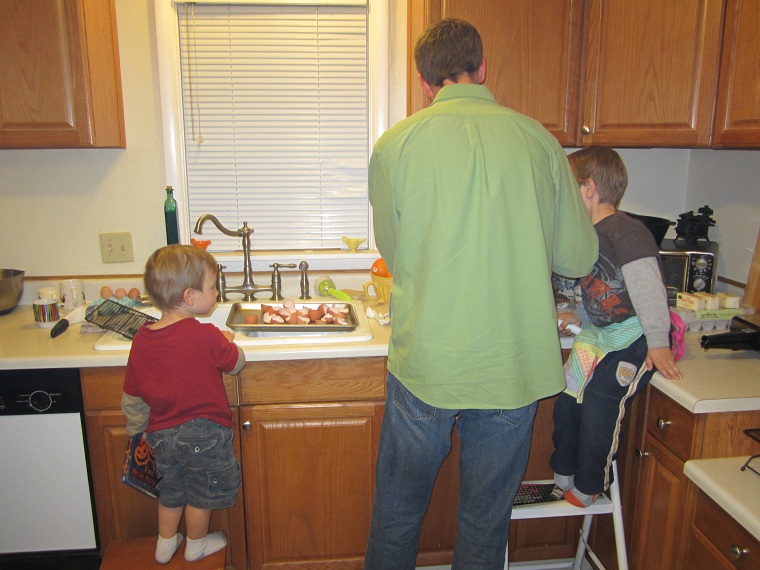
A lot of people ask me all kinds of questions about what we do around here on the Schell Urban Homestead.  The question I get asked the most though is, hands down, “With three kids, how in the world do you do it all?”  The answer is pretty simple… I have a strong partner:

Happy Anniversary, Rick.  Nine years seems like a great start.

Categories: Hunting | Tags: , , , , | 10 Comments

Deep Litter Method for the Lazy Chicken Keeper

When we first researched keeping chickens, my only hesitation was the idea of having to clean a coop weekly.  I used to have a parakeet, and I hated changing his newspaper tray, and I hated cleaning my hamster’s cage too.  I was dreading having to clean a coop.  I envisioned this, happening weekly (by the way, she was cleaning a coop inherited when she moved to the property for the first time).  Then, I ran across something describing the deep litter method, and I knew I had found the solution.

We clean our chicken coop (specifically the hen-house) twice a year.  And no more.

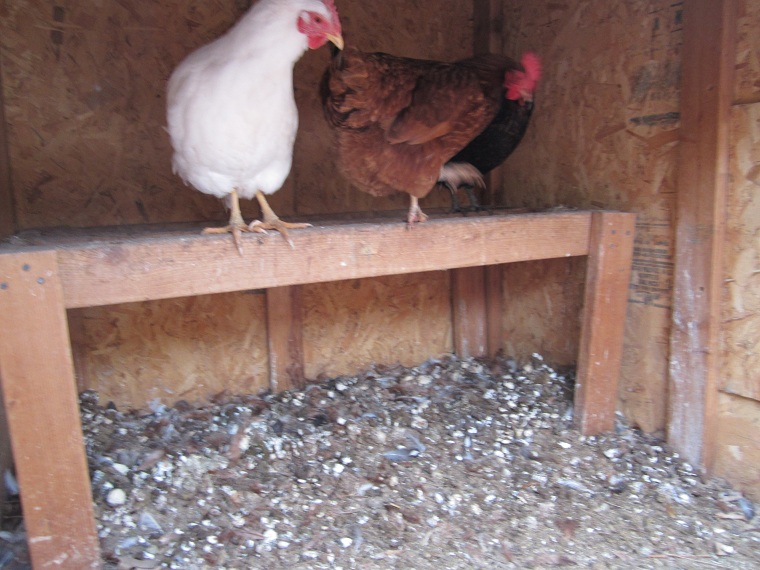
And the coop does not smell.  In fact, when we participated in the Denver Botanic Gardens/Denver Urban Homesteading Chicken Coop tour, everyone remarked on how our coop did not smell.  I didn’t clean it before the tour, because I wanted to show what the method off and let people see what it looked like to have chickens in real life.

What we learned was that we were, at that time, the only chicken keepers on the tour using this method.  Every other owner had told the tourists that they cleaned their coops weekly.  We were surprised by this and actually started making a joke of it, calling ourselves the lazy chicken owners on the tour.  People laughed and that’s how I actually came to the name, the Lazy Homesteader.  😉

Here is how the method works in case you are like me; allergic to hard work involving poop.

Clean your coop one fall day and then put down a layer of dried leaves or pine shavings or some other kind of litter (not straw – it’ll stink to high heaven).  Then you let the chickens poop on it.  Then when it’s thoroughly covered over in poop…

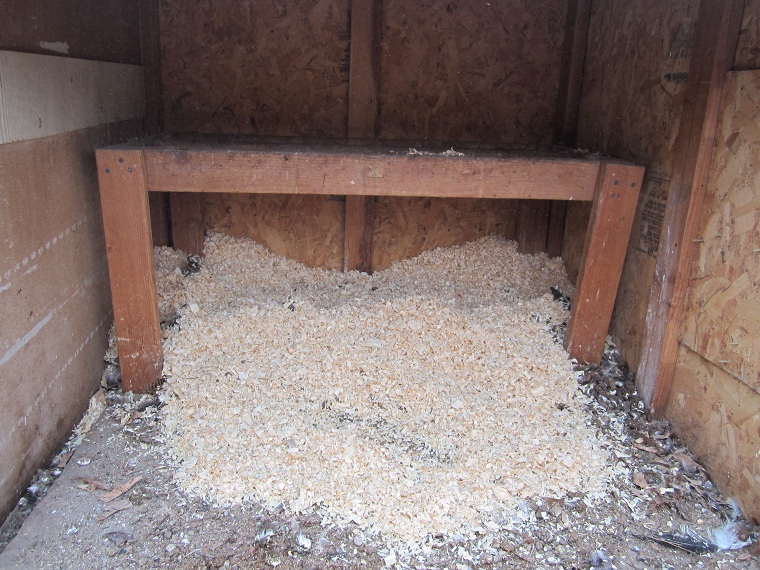
Put down more shavings or leaves. I just throw it in – I don’t spread it nicely or anything.  I’m not touching that crap.  😉  The chickens will dig through it and spread it around anyway.

Repeat until spring comes.  Note that I mainly just put litter down right under the roosts.  If it’s very rainy or snowy, we put their food and water inside the house (usually we keep them in the run) and we don’t want them to throw litter in the food and water.

Finally, on a nice day, when you feel like doing it, bring the wheel barrow over to the coop, scrape it all out, and dump the decomposed poop/leaves/shavings mixture into your compost bin.  It’ll be mostly all composted anyway.  Then clean out the coop and put down a fresh layer of shavings or leaves (if you have any more).

You are basically composting in the bottom of the hen-house.  And as you learned a couple weeks ago, compost generates heat, perfect for helping your flock stay warm during the winter.

And I can totally handle cleaning only twice a year.

Categories: Chickens, Compost, Urban Homesteading | Tags: , , , | 57 Comments

UH Basic Training: Chicken Keeping 101

Everyone in the household is seemingly well again, so urban homestead boot camp is back in session!

After a garden, when someone mentions “urban homestead” many people think of chickens.  To me, chickens are a bit of the country right here in the city.  They aren’t particularly noisy, they don’t take up much space, and it doesn’t cost much to feed them (ever heard the expression “chicken feed?”).

I have an awful lot to say about backyard chicken keeping.  Enough probably to fill a book.  It’s fun and the eggs are well worth the effort you put in.  In order to keep this post from becoming a novel, here are the down and dirty basics of urban chickens.  I am, of course, not an expert.  We’ve had chickens for five years now.  We’ve encountered a few problems and we’re continually learning as we go.  But if you’re looking at getting birds for the first time, here are some basic guidelines.

The Rules

First off, are chickens allowed where you live?  Check your city ordinances.  There are usually stipulations on the number of birds, the size of area required for them and in some municipalities, there may be a permitting process.  You can sometime skirt your HOA if they only stipulate the number of “pets” allowed and not what kinds.

Last month, The Crunchy Chicken had a guest post about what to do if your neighbors or HOA is not on board with your backyard flock.

Getting your neighbors on board is pretty important.  Luckily, it’s a pretty easy thing to do as well.  All of our neighbors love our hens.  The kids especially.  And the promise of fresh eggs are a great way to build some good will between neighbors.

You might be surprised where chickens actually are allowed.  Highlands Ranch, here in Colorado, for example is chock-full of HOAs, and they totally allow chickens.  So check it out.

This link has lots of city codes listed, but not every city.  A Google search will help if it doesn’t have your city.
The Birds

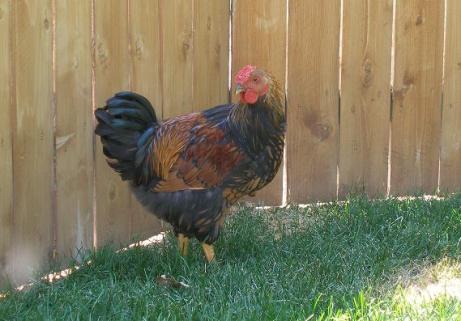
For most backyard flocks, you’ll want only female chickens.  Roosters are loud and crow all day, making it tough to stay on your neighbors’ good sides.  Plus they’re generally not very friendly.  Despite the fact that everyone wants to ask you how you plan to get eggs without a rooster, you don’t need one.  Without a rooster, all your eggs will be unfertilized and you’ll get to skip the 4:00 AM wake up calls (and at 11:33, and at 3:28, and at 6PM).

You can start your flock by getting chicks, started pullets, or hens.  Chicks are the least expensive, but you will need to raise them indoors under a heat lamp until they have grown all their feathers and can move outside, which will take a few months.  Pullets are female chickens that are less than a year old.  They will cost you more than chicks but you’ll get eggs sooner, since most chickens begin laying around six months old.  Or you can buy grown hens that are already laying.  They will be the most expensive since someone else has fed and housed them for a year with little benefit of getting eggs.  You probably don’t want to buy hens that over two years old if you want many eggs though.  Their peak laying years are the first two (from age 1-3 years).

You can order chicks in the mail or buy individuals at a feed store or from a local farmer.  There is only one site that I know of that will ship chicks in quantities less than 28.  We bought our chicks locally, so I can’t say how they do this.

Pullets and hens can also be bought from local farms, sometimes on craigslist, or at markets or poultry swaps.  Chickens are social, so you’ll probably want at least three or four.

There are lots of breeds of chickens.  If your climate is cold in the winter, you will want a heavy breed that can keep its self warm.  Bantams are miniature chickens and their eggs are about half the size of regular chicken eggs.

The Coop

Your birds need about two square feet apiece inside their hen-house.  It needs to have a roost and they’ll want a place to lay their eggs. The size, shape and style of your house and coop are limitless.  Check out some of these ideas for small backyard coops.

Coops are easy to build yourself if you are the handy type, or small ones can be bought locally or online for a few hundred dollars.  We built our coop ourselves and over the last five years have made only some minor modifications.  (Though I admit I have a few more in mind for this coming year).  I’ve seen people convert dog houses, old sheds and abandoned campers into chicken coops.

The original construction of our coop looked like this:  Coop Construction!

The main things to keep in mind are a place to rest, a place to nest, a place to get shelter and a way to keep predators out.  Many people advise using hardware cloth to keep raccoons out.  We have been successful with simply using chicken wire, which is much less expensive.  Although we’ve had chickens killed by foxes and raccoons, it was never due to a breach in the security of the coop, only due to the negligence of the chicken owners (we forgot to close the coop at night).

A chicken tractor is like a mini coop on wheels with a run attached that can be used to let your hens graze or catch bugs and then moved to a new spot so that they don’t eat the grass down to the dirt.  A great idea if you have the room for it.  Check out some neat ones here.

The Food

Chicken are omnivores.  I always sort of chuckle when I read “vegetarian fed hens” on a carton of eggs.  Now that’s good in commercial eggs, so that you know those poor birds weren’t fed other chickens.  But your chickens will certainly not be vegetarians.  They will eat bugs and worms, and I’ve heard they can catch and kill a mouse.

For the bulk of their diet, however, you’ll want to feed them something.  You can make your own food for them using a mix of grains and seeds.  A quick Google search will lend you many guides and recipes.  Depending on your resources this might be less expensive than buying pre-made food.  For some it is expensive if you’re in a big city far from where the grains are grown, and so it is easier to buy the bagged stuff.
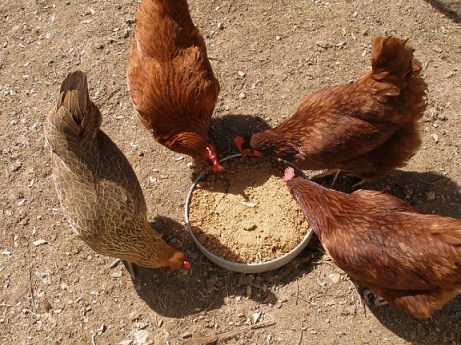
Pre-made choices include conventional, organic, medicated, pellets, crumbles, mash and if you’re lucky, whole grain.  Most backyard flocks don’t need medicated feed, even for chicks.  These feeds are made for large, commercial flocks, where chickens are kept in too-close quarters and make each other sick.  There is no need to dose your flock with antibiotics out of the gate with only three or four or twelve birds.

Pellets, crumbles and mash are different forms of the same feed.  The ingredients in the feed are ground up and then pressed into shape before being packaged.  The shapes are self descriptive.  These are a matter of personal preference since chickens will eat all three.  It comes down to what you prefer and how much the birds waste.  My birds have always flung feed out of the feeder, but if the feed is pellets, they still get eaten off of the ground.  All of these feeds are susceptible to moisture.  If they get wet, they will pretty much disintegrate.  So store it where it will stay dry, and keep a cover on your feeder if it is outdoors.

Conventional chicken feed is the least expensive but carries the risk of chemical pesticides, fertilizers and GMO ingredients.  Since here in the US, they don’t label those things on human food, they certainly won’t on chicken food.  If you want to avoid these (remember, your chicken is making eggs with that food, and you will eat the eggs), you should buy organic.  It can be more expensive than conventional feed, unless you can find a local source.  We have found a local farm co-op that offers us organic, whole grain layer feed for 43 cents/pound.

Your chickens are great garden disposals as well.  They love to eat greens, weeds, kitchen scraps.  I’ve often joked that they are like miniature pigs.  The only things I have not seen our hens devour are potato peels and mushrooms.  Otherwise, they will pick clean a ham bone as quickly as they will hork down mushy strawberries.  They stick their skinny necks through the fence to attack our Swiss chard on a regular basis, and they practically live in the compost pile during the winter.

They will eat eggs.  And if you cook them scrambled eggs, that’s fine.  They don’t identify an egg smashed flat on the ground as the same as an egg they just laid (they are not the brightest creatures).  But be cautious.  If they get a taste for raw eggs, soon they will be plundering their nests and eating more eggs than you.

Crushed eggshells are a good supplement for them to get calcium in their diet (to make strong shells).  You can also offer crushed oyster shell, whey, other dairy products and leafy greens.  They’ll chow down and thank you.

The Work

You know how my site is called The Lazy Homesteader?  Well, it’s because I really don’t like anything that is complicated, hard work, or lots of maintenance.  The main work in caring for chickens, I’ve found, is making sure they have fresh water everyday.  They need it replenished often in hot weather and they need the ice chipped off in the cold.  So every day, they need water.  That I can do, if Rick is helping me.  😉

Their feeder holds enough food for a few days, so I just check it when I’m giving them water to make sure it’s not empty yet.  And I collect eggs.

Your hens will eventually molt.  This is when  they lose and regrow feathers and take a break from laying, and typically happens in the winter.  The molt is dependent upon hours of daylight,  so if you want eggs year round, they need a light in their house to trick their bodies during the winter.  We’ve found that they don’t need it to keep warm (admittedly we don’t have ice storms here, so I can’t speak to that), but their feathers and group body heat seems to do the job.  We let them take a natural break from laying and don’t provide a light in the winter.

Cleaning the coop is the other main work of keeping chickens.  We use a deep litter method and only clean a couple of times a year.  We’ve found this doesn’t work that well with straw as the coop bedding.  It is great however with leaves or pine shavings.  During the first chicken coop tour, everyone remarked on how nice our coop was – that it didn’t smell at all.  But then one time we decided to try straw.  The coop stunk within the week.  It was a horrible stinky ammonia smell.  And messy.  They straw went everywhere.  A breeze blew it all over the yard.  It was slippery to walk on.  We switched back to dried leaves and pine shavings.  Later this week, I’ll explain the deep littler method in detail.    Others do use straw and change their hens bedding daily.  Still others use sand.  Find what works for you.

That is basically it.  This week, I’ll cover more chicken keeping things in detail.  This is a big topic, and I know this post is pretty general.  It may be elementary for old hands, but hopefully it answers some of the questions first timers might have.
Categories: Chickens, Urban Homesteading | Tags: , , | 13 Comments

Easy Roasted Asparagus Soup

Since spring is around the corner, we are making an effort to ensure we have room in the freezer for the coming crops.  The first thing in the freezer each year is asparagus.  When the asparagus comes on, we try to eat as much of it as we can, but we usually put some aside for the dark days of winter when we need a soup to warm us and remind us that yummy green things are just around the corner.

The other night, I used the last of the frozen asparagus in this simple soup.  It’s a variation on one I posted a couple of years ago.

First, cut three pounds of frozen asparagus into one to two-inch long pieces.  Peel and smash six to eight cloves of garlic.  Divide the asparagus and garlic between two baking sheets and toss with olive oil, salt, pepper and dried thyme.  Roast in the oven at 450° for about twenty minutes or so (keep an eye on it, I didn’t time it exactly), or until the asparagus starts getting nicely toasted.

The above picture isn’t quite done enough for me yet.  When you have roasted it long enough, transfer your roasted asparagus and garlic to a large pot.  Use a small amount of water in your baking sheets to get up all the brown bits from the roasting and pour that into the pot with your asparagus.

Add enough water to your pot to cover the asparagus and bring to a boil.  Make a slurry of 3 Tablespoons of flour and about half a cup of cold water.  Whisk into your soup.  Return it to a boil, reduce the heat and let it simmer for five or six minutes.  After it has thickened a bit, use an immersion blender to purée it smooth (or transfer to a regular blender in batches).

At this point you could actually cool and freeze the soup.  But if you are serving it right away (of course you are), ladle it into bowls and give each bowl a squeeze of lemon and a drizzle of heavy cream.  Serve with some cheesy toast and enjoy.

Categories: Recipes | Tags: , | 6 Comments

Create a free website or blog at WordPress.com.