Urban Homesteading

UH Budgeting Boot Camp: Building a (Food) Budget

Seeds, plants and soil all cost money, building a coop does too and those canning jars don’t come cheap.  But we urban homesteaders feel it’s worth it.  We are in it for the food.  So we have to find a way to make it work.  How do we eat well without breaking the bank?

This week we’re going to talk about budgeting, particularly budgeting for food and how to eat sustainably.  It’s not the funnest skill for me, but it is an essential one.  We could not do the things we do around our urban homestead without it.

When Rick and I started this journey, we had just had a baby and I decided to stay home with him, cutting our income in half.  We thought we’d be ok financially, but I had to get my appendix removed three weeks after H was born and medical bills ate through our savings.  Soon we were using a credit card to make ends meet.  And then one month we couldn’t pay off the balance.  And the debt racked up faster than we could have imagined.

Eventually, we cancelled the credit cards and started trying to get it under control.  But there were months where we were looking at choosing between gas and groceries.  Now, when I hear people talk about being “broke,” I think about those times.  The only way we made it through, all the while feeding ourselves, was budgeting.

Budget is a four letter word for many people (often those four letters are D-E-B-T).  But I have really come to understand that a workable budget is the only way to survive.  I’m not a natural budgeter.  I’m much more of an instant gratification person.  And people like me often have a hard time sticking to a budget.  I have a really hard time keeping the willpower up for an entire month (or few months), and tend to want to reward myself for being so good all month long by blowing my money on something silly.  I know I’m not alone.  It really helps me to trick my brain into doing some sort of project or challenge that is a budget in disguise.

One things that really helped me during that dark time of choosing between food and fuel was Crunchy Chicken’s Sustainable Food Budget Challenge in 2009.  The idea was to see if it was possible to eat sustainably on a food stamp budget.  I was successful at the challenge, but at the end of it I noted that,

I don’t know if this would actually be possible on food stamps because the majority of our savings came from food saved from the CSA last summer, the hog we bought whole last fall, things we saved our money up for so that we could have a year of sustainable eating on our tight budget. That and two years of practice at cutting the grocery bill each week a bit more, while still making fresh meals for my family.  Things like eating out, coffee shops, and convenience foods have not been in the budget for a long time.

That’s right I had already been at it for two years, and I had some secret weapons up my sleeve; a whole hog and a CSA membership.  So in talking about budgets, I’m also going to tout the benefits of joining a community supported agriculture farm.  I am not exaggerating when I say that this one thing saved us.  Seriously.

More on that in soon, but first, how do you make a budget?  There’s a lot of places online you can learn to do this.  Just find something that works for you without too much brain damage.

I am NOT an expert, this is just what we do.  I start by writing down on a piece of paper our income and all of our expenses.  My husband gets paid weekly, so I do the math and figure his income for the month.  Then I list out each bill we have.  I know financial experty people tell you to save money and pay yourself first.  That’s all good and fine, if you can do it;  if you can, you should, but for about five years, we couldn’t.  Anyway, I deduct the expenses from the income.  The rest of the money that is not going to a bill is what we have left to split between food, gas and whatever else you like to spend your money on.  Hopefully, you can save a bit too.

I try to be realistic about what we need to spend for each category.  Using a computer program for this really helps (like Quicken or Quick Books or whatever) that allows you to see how you’ve been spending in the past.  I might try to trim down certain things, like eating out, but I’ve learned that I need to leave us a little wiggle room.  A budget is not a diet.  You can’t go into it thinking about what you are depriving yourself from or you surely won’t stick to it.  Also, it is not permanent.  It can change month-to-month until you figure out what works for you and your family.  Lately, I’ve been using Erica’s Budget Fun Cards, because I like checking boxes.

The savings is key for us.  We don’t have much cushion built up yet as we’re fresh off of paying off those rotten credit cards and still are working on knocking out Rick’s student loans.  But we try to set aside a little every month to pay for some seemingly big-ticket items, which in reality save us lots of money.  Once we have a number for what we want to spend on food every month, we have a starting point.  I don’t follow all the experts that say your food should only be 5% of your budget.  Honestly, that is ridiculous.

Our food is easily our largest expenditure after our mortgage.  But we have ways of keeping the month-to-month food bill manageable.  Things like buying meat in bulk, the CSA membership and buying 300 pounds of peaches are financially tough to swallow all at once, but saves big time in the long run.  Those bulk items pay off in spades, particularly in lean financial times.

Tomorrow, I’m talking money savings in the food budget department.  In the mean time, do you budget?  Do you buy in bulk or have tips for saving on the food bill?  What questions do you have about eating well on a budget?
Categories: CSA, Food, Simple Living, Urban Homesteading | Tags: , , , | 6 Comments

What we are planting in 2012

A few of you were curious about what we are planting this year in the garden.  SO, here is the plan for 2012…

In the four main garden beds we are planting seeds of both grey and yellow zucchini, Mexican Sour Gherkins and Long Anglais cucumbers, pole beans (purple ones), Australian brown onions, golden beets, red Russian kale, and arugula.  I’m hoping the kolhrabi that we have been trying to overwinter are still going strong, so we can possibly get seeds from them this year.  We will buy started tomato plants as well; not sure what varieties until we see what they have at our garden center.

The boys will have some Cosmic Purple carrots in their hugelkultur as well as some cherry tomato plants and possibly a bean or pumpkin teepee for fun (stay tuned).

We have a couple of other planting areas around the yard, and in those areas we are going to put some lettuces, some lemon yellow Habanero peppers, and lots and lots of spinach.   Plus I’ve planned a couple of giant variety sunflowers to screen out some neighbors and later feed to the chickens.

In the neighbor’s yard, we’ll do potatoes again, and his corn.  Plus he’s made room for watermelons and the giant pumpkin.  We can’t wait!

Any locals have tips on herbs (basil, parsley, cilantro…)?  I’ve had mixed success with them, but want to add more, inter-spaced in the flower beds out front.

What are you planting this year?  Also, did I miss anything in last week’s veggie garden basics that you were hoping for?

Categories: Food, Garden, Hugelkultur | Tags: , , , | 1 Comment

Boot Camp Bonus: When to Harvest

This week’s boot camp focus was on vegetable gardens.  It turned out to be a bigger subject than I could cover in just one post.  Coincidentally, Erica at Northwest Edible also made a timely post covering some great tips on How to Plan Your Harvest Based on What You Eat.  Make sure to check it out.  I won’t repeat anything she posted here and I’m really grateful she put it up.

For me, one of the things that was hard to learn when we first started gardening was knowing when to harvest.  Some vegetables are easy to tell when they are ready to be picked; tomatoes turn red (or yellow or purple or what-have-you), but some things are a little harder to tell.  You can certainly count days, as implied on your seed packet: 60 days; 75 days; 53 days, two hours and thirteen minutes… where did I put those torn, empty paper envelopes again?  Right.

Here’s what I’ve learned for some of the trickier crops.

  1. Test green beans and peas early and often by picking one and eating it.  If it’s plump, sweet and good, they’re ready, if they are hard – too late.  When they are ready, pick them every day.
  2. Corn is ready when the silks turn brown and are dry.  If you want to check the kernels before picking, slice along the husk with your thumbnail about an inch instead of pulling it back.  Peek in and if it’s not ready yet, just close it back up.
  3. Watermelon is ready when the curly tendril nearest the melon shrivels up.
  4. Winter squashes (butternut, acorn, pumpkins, etc.) are ready when the vines fall to the ground.
  5. Pull your onions when the tops fall over.

What indicators do you use to know when your crops are ready?

Categories: Food, Garden, Top 5, Urban Homesteading | Tags: , , , | 6 Comments

Vegetable Gardening Basic Training Part II

Welcome to part two of your first week of Urban Homesteading Boot Camp.  Yesterday I talked about the basics of selecting and preparing a site for your vegetable garden.  Today, we’ll cover layout, crop rotation, and, the best parts: planting and maintaining.

If you are planting in pots, the scale on all of this will be much, much less.  😉

Garden Layout
Once you have decided what to grow in your garden, you need to decide where in the garden to grow it.  One of the first things to consider is the height of the plants, at their maturity, that you intend to grow.  This is more important than companion planting because, as some friends of mine learned the hard way, while carrots do love tomatoes, carrots also love sunlight.  So first think about what grows high up and what stays low.  Tomatoes can get very tall, so can pole beans, corn, and cucumbers if you trellis them.  Summer squash can also shade out neighbors with their big leaves.  Most of the root crops  stay low, as well as the peppers and lettuces; even peas can be kept pretty compact. You will want to plant low growing things to the south of high growing things (here in North America, obviously).

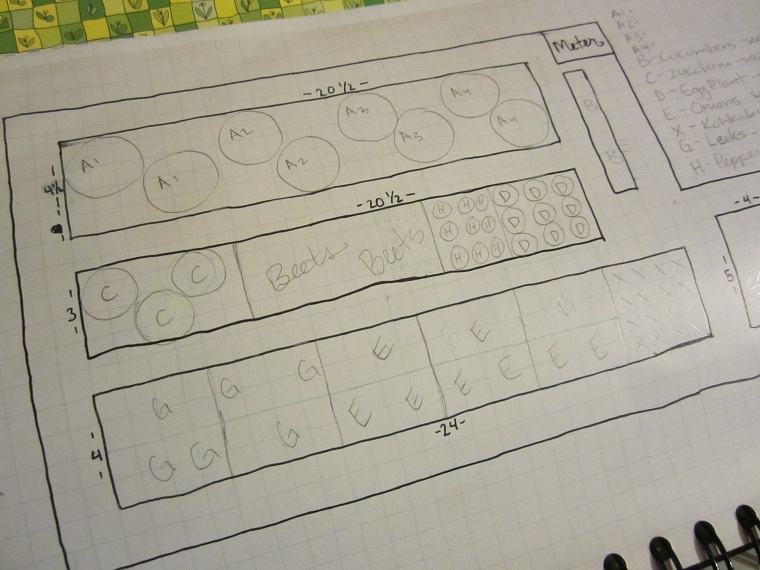
You can see from my garden plan that I made in 2009, I did just that:  Tall tomatoes in the back along the north border, middle size squash next, and short onions, kohlrabi and beets at the bottom on the south edge.  It worked great.

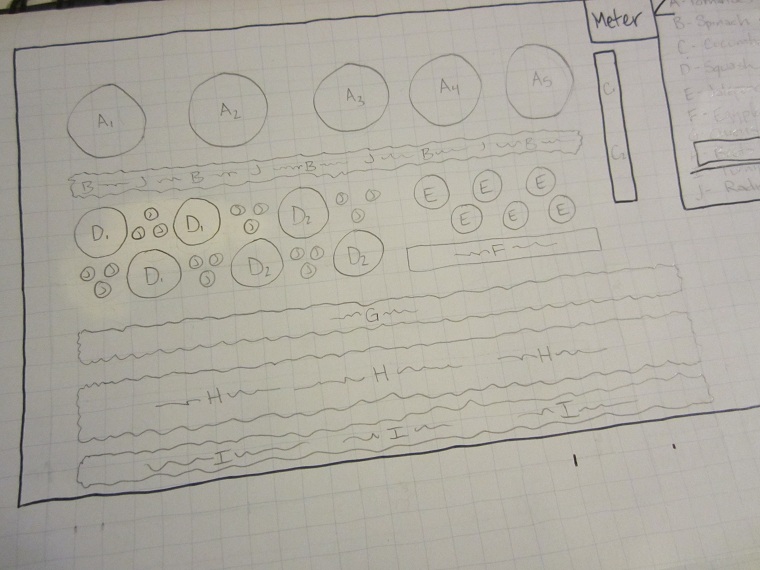
But I bet if you read my post in October on crop rotation, you spotted the problem with the layout.  If not, here was my 2010 garden plan:

See the problem yet?  Tomatoes up top, squash and peppers in the middle, and onions and kohlrabi along the bottom.  I did this also in 2006 and 2007.  Yeah.  Some people are thicker than others.  It took me a while on this one.

Finally, finally, I wised up.  I had to turn my beds 90 degrees.  You can see this year’s plan is much better for crop rotation.

Crop Rotation
So yes, it took me years and years to find a way to rotate our crops.  But why is it so important?  Most of the veggies we like to grow in our gardens come from certain plant families.  There are about nine families for the main crops most people like to plant.

  1. Tomatoes, potatoes, peppers and eggplant
  2. Peas and beans
  3. Cucumber, squash and melons
  4. Spinach, beets and chard
  5. Cabbages, kale, kohlrabi, turnips and broccoli (the brassicas – they only “real” family name I know)
  6. Onions, leeks and garlic (oh wait, I know two, these are alliums)
  7. Sunflowers, lettuce and other leafy greens
  8. Carrots, celery, parsley, parsnips
  9. Corn, rye, oats, wheat

The varieties in each family need similar nutrients to grow, and they are susceptible to the same diseases and pests.  So if you plant your tomatoes in the same place year after year, you can expect them to deplete their soil and/or die from a disease.  If you rotate things though, the nutrients that the tomatoes take from the soil in 2012 will get replaced by another plant, say beans, the next year.  And if a tomato disease came knocking at the end of 2012, the 2013 beans might not get it, since they aren’t necessarily open to the same sicknesses.  Make sense?

Clearly, it is pretty important to switch things up.  Your original layout needs to accommodate this, and you have to think a few years ahead.  Here is what I’ve done with our 2012 garden.

First I oriented the beds so the tall stuff didn’t always have to go in the same place (North is at the top of the page).  Then, the coup de grâce – sticky-notes.  Yep. Instead of writing in my plants, I put each thing we want in the garden on its own sticky-note.  You can tell, I love tomatoes.  The little circled letter corresponds to a plant family.  Now I can arrange and rearrange, and rotate. 

Yes, I know, I have more veggies than room in my garden for them.  Decisions are hard around here.  That’s why I’ve enlisted the neighbor’s yard.  😉

When playing with your layout and rotation, don’t forget about plant height.  In 2008, I tried rotating things in that old layout by switching the tomatoes to the bottom (the southern edge).  Guess what – nothing grew because the tall plants shaded out everything else.  Learn from my mistakes, grasshopper.

Here’s where I want to take a minute to mention square foot gardening.  Square foot gardening is a very good way to get a lot of plants into a small space.  It would probably be a great way to keep things rotating as well.  I am not very good at it, I’ll be honest.  I lack the self control.  😉  But if you have a very small space, you should consider it.  It looks like a great way to pack a lot into a small area.

So, to the planting.

Planting
First off, I’m totally skipping the starting seeds indoors thing.  I’m sorry if this is a big disappointment.  I only began gardening when Rick and I moved to this house 8 years ago, and we have no good place at all to start seeds indoors.  I’m thinking of getting some lights this year, but so far all my seed starts have failed.

Because of this, we buy seeds to sow directly in the ground for most things, but we buy already started tomato and pepper plants from the garden center.  The growing season in Colorado is a bit short to start these outside if you want much of a harvest.

To plant your seeds, read your seed packets.  Planting depth is important.  From the tip of your finger to your first knuckle is about one inch; the depth you would want to plant peas.  I am somewhat flexible with plant spacing, however.  If my packet says to plant seeds every six inches in rows 18 inches apart, I just go with six inches in any direction.  I know, I’m a rule breaker.  But it seems to work just the same for us, and I want to conserve space as much as possible.

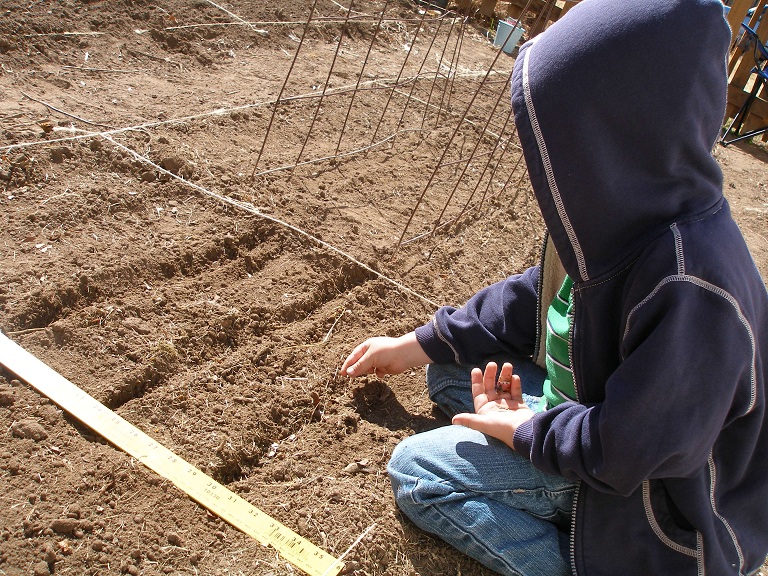
Some seed packets tell you to plant in hills.  Squash like hills.  Tomatoes do too.  So, for the first timers, this is what a row is (notice Henry, spacing rows with a yardstick – it’s ok to measure if it helps you):

And this is a hill:

I use my fingers or the side of my hand to make rows for most seeds, but I use a hoe to make a row for things that should be planted deeper than an inch.  I just drag one corner of  the hoe in a straightish line where I want the row to be.  The line is sort of a valley with the extra soil piled up along the sides.  Drop the seeds into the valley and use the soil next to the line to cover them.  Don’t use all the extra soil, especially if your seeds should be planted shallowly.  Some of that soil will be used to make the sides of your row so that it will hold water.  Tap the soil down well with your hands, making a long trench that will retain water to feed your seeds.

To make a hill, I use the back of a rake.  And by I, I mean Rick.  Not that it’s hard, it just seems to be Rick’s job.  Anyway.  Rick pulls the soil with the rake into a mound, and then we use our hands to sort of flatten the top, and move the dirt until it’s sort of a crater.  You plant inside the crater, not around the sides.  This is a nice bowl to hold water for your seeds or little baby plants.  We usually plant one tomato per hill and we plant three summer squash in a (larger) hill.

Then what?  You guessed it – water your seeds.  Water them well.  Give everything a good soaking.  Then wait a couple of minutes and soak everything again.  Don’t use hard jets of water – sprinkle or use a soaker or drip hose.  You don’t want to wash your seeds away.

Now is the time to set your tomato cages and trellises around your plants.  As the plants grow, thread them up through the cage, so they don’t break off any vines, or so the tomato doesn’t shoot off to one side.

Maintenance
After planting, there are three things left to do to keep your garden on track: watering, thinning, and weeding.

Your baby seedlings and newly planted seeds need to stay moist.  We like to use a drip system for our garden, which basically consists of a back-flow preventor at the spigot, and a bunch of tubing with little plastic drip heads on the ends where each plant is for the hills and lengths of pre-drilled drip-tube for the rows.  The heads release so much water per hour.  We love it because it conserves water and only puts water at the plants so it cuts down on weeds.  And, I just have to step out the door, turn on the spigot, and it waters everything for me.  I have three kids, people.

The drip system is not complicated, but explaining it thoroughly could be a post in it of its self.  (Perhaps in the near future?)

Anyway, that is one method for watering.  We have also watered by hand with the hose many a season, and last year our neighbor put his corn and potatoes on a timer connected to his sprinkler system.  Bottom line is during the summer you need to water.  Here in Colorado, we need to water everyday.  Technically, it’s an arid climate here.  If you live in the rainforest, gauge your water accordingly.

All that water will make your seeds sprout into seedlings.  And you will have to thin them.  That means, heartlessly grabbing those tender green shoots and ripping them from the ground (gently – don’t kill the ones you want to leave).  You have to give your plants room to grow.  If you leave every carrot seedling growing, you’ll get lots of tops and no carrots.  So leave one strong-looking seedling every few inches for your root crops.  And for heaven sakes, thin your zucchini.  It’s really, really hard the first time.  But just do it.  Now is the time to nut up or shut up.  😉

And weeding.  You have to rip ’em out too.  They will grow fast and steal your veggie’s water, sunlight and room.  Take ’em down.  Show no mercy, troops.  Defend your hills!  And your trenches!  If you do a little everyday, the enemy won’t gain any footing in your garden.

Questions?

Categories: Garden, Urban Homesteading | Tags: , , , , | 7 Comments

Vegetable Garden Basic Training Part I

Welcome to your first week of Urban Homestead Boot Camp.  Over the next few weeks I’ll be sharing the goods on what you need to get your own homestead up and running in 2012.  This is the quick and dirty version.  No holds barred, take no prisoners; these are the very basics.

This week, the vegetable garden.  Every homestead needs one.  Be it your whole back yard converted to raised beds or your balcony covered in pots, growing food is the cornerstone of any homestead. I’ve decided to divide this into two parts since we have a lot of ground to cover.  For the beginners out there, we’re going to keep it simple.  Part one covers site selection, soil prep, and deciding what to grow.

Site Selection:
You need a place that gets full sun.  For us here in North America that is somewhere that has Southern exposure.  Gone are the days of a backyard garden.  In the city, you take what you can get.  The side, the front, the roof, whatever.  It just can’t be in the shade of a tree or building.   At the Schell Urban Homestead, our gardens are in a side yard and along a strip of driveway.

One you’ve picked your spot, measure it up.  The size of your area is probably going to determine, to some extent, what you can grow.  It’ll be tough to grow corn if all you have is 32 square feet, unless that is all you want to grow.  It takes up a lot of room and is tall.  But if you are willing to buy your corn at  a farmers market instead, you can do a lot with a 4 x 8 bed.

Some considerations when selecting a site:

  • Will you grow in the dirt or buy soil for a raised bed or pots?
  • Can you get water easily to to area?
  • Is there anything nearby that will interfere with sun exposure?  Keep in mind that in summer, the sun is almost directly overhead.
  • What about site security?  Does the mailman usually walk there?  You might need a border or a mini fence.  If you are growing where the neighborhood kids can see, consider that you might lose a tomato or two (but that’s actually a good thing in my opinion).

Prepping the Site:
Once you’ve selected your garden site, you’re going to need to do some prep work before you can plant there. If you are planting in pots, you get off easy, labor wise, but will have to spend some money for the pots and the soil.  Check thrift store for pots if your funds are limited.  Or consider buckets.

So, what is at the site now?  Grass?  Other plants?  Rocks?  Or (please say it isn’t so) concrete?  If the site is concrete and you don’t want to bust it out, which we have done – it’s tough work, consider pots or very deep raised beds.  Keep in mind that concrete will hold heat in the summer though; you’ll need to water more frequently.

Otherwise, to plant in the ground or a raised bed, this is probably going to be the physically hardest part of getting your garden ready.  Start by clearing away any competing plants and rocks.  If you plan to plant in the ground, a soil test can be helpful, but is not be any means necessary unless you have concerns about lead or other toxins leaching into your soil (such as if you are in an industrial area).  If that is a concern, it may be simplest to build a raised bed and buy soil for it.

If the existing site has grass, that is easy enough to remove.  You have a couple of options, you can use a grub hoe or rototiller to remove or till under the grass.  Or you use a layering method of composting the grass into your garden space, like the method demonstrated in this video.

Mark the edges of your garden space.  If you want to spend a little or are concerned about aesthetics, you can buy timbers, railroad ties, fencing or many other materials to build your edging and borders to your heart’s content.  To do it on the cheap, use rocks, boards, brick, string and stakes, whatever you have.  Or check craigslist.  Basically – anyone can garden.  This doesn’t have to cost an arm and a leg, though it can, if you want.  But really, you just need to know where you are planting stuff.

Your beds should be about 4 feet wide, but not wider.  Longer is fine.  Four feet is about the farthest you can comfortably reach across; if you keep it within these limits, you can avoid stepping on your planting soil to keep it from compacting.

If you are doing raised beds, you are probably going to have to buy soil.  You’ll want soil for gardening, not fill dirt.  Fill dirt is hard, dry, grayish brown and has no organic matter in it – you’ll be hard pressed to get anything to grow in it.  Soil dark brown or black, moist, soft, and is rich in organic matter with lots of nutrients to feed your plants.  If you do the layering method, you’ll be using built-in compost, but you may want to add some soil to your layers as well.  If you are planting in the ground where only sod has been growing, you’ll definitely need to amend the soil.

You can certainly buy soil and compost at a garden center.  But you might also consider these sources: local farmers and ranchers for decomposed manure, tree trimming companies for mulch or wood chips, or check with your local Whole Foods around earth day for free finished compost.  If you are starting in the fall, you can get the ground prepped pretty well for the spring by digging into the area and layering dead leaves, grass clippings and dirt to decompose over the winter.

Deciding what to grow:
Keeping in mind how much room you have and how many people you are feeding, think about what you like to eat.  What are your gardening goals?  Do you want to get the kids excited?  Plant things that grow quickly (beans, sunflowers, radishes) or that they will be excited to eat (my boys love carrots).  Love cooking?  Plant lots of herbs.  Do you want to avoid mealy grocery store tomatoes?  Then you’ll want to make room for your star heirloom plants.  Want to avoid the grocery store all together?  Better convert the whole yard or enlist a neighbor.

Some things to keep in mind:

  • Plant what you like, but don’t be afraid to try something new.  If you know you hate broccoli, don’t plant any.  But try to remember that homegrown veggies taste about a million times better than what you can get at the grocery store.  My sister was forty before she learned that she did like tomatoes, as long as they came from the garden.  If you want to try everything, get a seed catalog.
  • How many people are you feeding?  Don’t plant four hills of summer squash for two people.  And vice-versa.
  • How much room do you have.  Corn and potatoes are notorious space hogs.  If you have limited space (most of us in the city do)  really consider what you want to grow vs. what you can get at a market.

Check out Erica’s post on How to Plan Your Harvest Based on What You Eat.

Next we’ll talk about layout and crop rotation, the planting, and garden maintenance.  Now drop and give me fifty…

Categories: Garden, Urban Homesteading | Tags: , , , | 9 Comments

2011 on the Bike

Happy birthday today to my Hard-working Husband, Rick!

I want to take a minute to say that nothing, and I mean nothing, would ever get accomplished around the homestead if it weren’t for him.  I’m really great at the ideas, but Rick is the hard worker that actually makes the ideas turn into something real.  He works hard all week at his job and then he comes home to work hard here on weekends, and I’m so grateful for him.

Last January, I asked Rick to set the odometer on his bike to track how many miles he rode for the entire year.  Then I promptly forgot all about this until last week when he gave me his final numbers.

In 2011 Rick rode 378.83 miles on his bike.  Most of these miles were commuter miles; riding to and from work.  Since I had a baby in July, we didn’t do much recreational riding as a family.  His office is 2.67 miles from our house and his average speed was 11.4 miles per hour.

Most days, due to traffic, he can get to his office or home faster on the bike than if he drove the car.  A fourteen minute commute, mostly on the bike path.

We estimate that he rode his bike to work about 70 days last year.  It’s not clear, because there have been days when he didn’t ride to work, but came home at lunch with his work van to get his bike and then rode home.  But that’s almost 20% of the year commuting on two wheels.    (!)

Rick saved about 20 gallons of gas, about a tank and a half in our car.  His total time spent on the bike:  31 hours, 47 minutes and 43 seconds.

He might argue that it’s actually not work to ride.  I think he likes it.  At least a lot more than driving in traffic.  He’s already had the bike out this year (yep, with snow and everything), and I think he’s going to try to get even more miles racked up for 2012.

Thanks, Rick for all you do.  Especially for supporting my habit of starting crazy projects…  and then finishing them for me.  You are the best!  Happy birthday!!

Categories: Simple Living, Sustainability | Tags: , , | 6 Comments

Urban Homesteading Basic Training

With 2012 upon us, many more people are looking to save money and live healthier.  Sustainability is on more minds lately, and more people are getting started with their first garden or flock of urban hens than ever before.  I don’t claim to be an expert, but I am completely willing to share my successes and failures with others.  The last five years have given me enough experience that I at least feel comfortable offering up a quick and dirty urban homesteading boot camp for others just getting started.

I plan to run a series of posts for at least eight weeks, possibly as many as ten.  Here are the topics I have planned for the next few weeks.  I also am completely open to discussing other topics if there is an interest in them.

Week 1:  Vegetable Gardening
Week 2:  CSA’s and Eating Sustainably on a Budget
Week 3:  Menu Planning in Season
Week 4:  Composting and Using Compost
Week 5:  Backyard Hens
Week 6:  Making Your Own Household Cleaners (by request)
Week 7:  Top Bar Beekeeping 101
Week 8:  Water Bath Canning

I’m hoping to also have a post about other kinds of urban livestock, and possibly cheese or yogurt making.  What else would you like add to your homestead skill arsenal?  What projects do you have this year?  Are you just getting started or going beyond the basics?

Categories: Urban Homesteading | Tags: , , , , , | 12 Comments

The ‘Sham’ in Shampoo

The other morning I stumbled into the bathroom well before the kids were awake.  “Yay!”  I thought, “I’ll get to take a shower today!”  But then I remembered.  I was all out of shampoo.  And I forgot to get more last time I went to the store.

My spirit, unwilling to be dampened, I decided I’d try that whole baking soda for shampoo/apple cider vinegar for conditioner, thing I’ve heard about.  I mean, really.  I use all natural soap, natural toothpaste, natural household cleaners, homemade laundry detergent.  I can do homemade shampoo!  Yay for less chemicals!  Yay for clean hair!

Except baking soda in your hair is gross.  Really, really gross.  I almost titled this post “The ‘Poo’ in Shampoo.”

I mean, I know it was the first time I tried it, and maybe I did it wrong.  Maybe I just need some guidance?  If you do the baking soda thing, let me know.  I did a quick Google search, and I mixed up baking soda and water according to the recipes I found.  Basically 1 Tablespoon soda and 1 cup water.  I also mixed up the apple cider vinegar and some water.

First, I tried what they all said to do.  I wet my hair and poured the baking soda mix into my hair at the roots.  I massaged it all around and rinsed.  I have really thick hair and by this time it felt all tangled and I was having doubts about the vinegar thing, but that part was actually uh.maze.ing!  I had put the vinegar mix in a squirt bottle and it completely detangled and smoothed my hair, pretty much instantly.  “Yay! This will make such a great blog post!”  I thought.

I got out of the shower, and went to dry my hair and it was all smooth and sleek and shiny!  WOW!  I blew it dry.  Gorgeous.  Well.  Almost.  It looked all greasy at the roots.  It felt all greasy at the roots too.  Super greasy.  Not oily, greasy.  Worse than before I got in.  Maybe I got carried away with the vinegar?  Hmm.  The kids were still asleep, so I decided I’d give it another go.

I decided to sprinkle in baking soda dry at the roots.  I worked it all around and it looked like the grease was all absorbed.  But also like I had grayed out my hair, since my hair is quite dark and there was now a fine white dust on it.  So I hopped back in the shower to give it a rinse.  And I could feel the greasiness about ten times worse than what it felt like before.  It was not the vinegar that caused this.  It was totally the baking soda.  I gave up.  I scrounged around the bathroom until I found some tiny, little bit of shampoo in a travel bottle.  I used it.

I will totally keep that apple-cinder vinegar thing.  It is awesome.  But the baking soda for cleaning your hair – a total sham.

Categories: Simple Living, Thrift | Tags: , , , | 12 Comments

Blog at WordPress.com.