Urban Homesteading

Composting Basics Part II: Hot, Cool, and Greens vs. Browns

If you read yesterday’s urban homestead boot camp post, Composting Basics Part I, you remember that I said I love compost.  Besides what it can do for you (you know turning “trash” into garden treasure, restoring and maintaining soil health, balance soil pH and neutralize chemicals, etc.), I love the way it does it.  I know it’s probably a little weird to love decomposition, but I do.

Yesterday, I told you that there are a lot of choices when it comes to bins, piles, and systems.  Worm bins and Bokashis are pretty specialized and self-contained systems.  I really don’t have much experience with either.   But I have used both a  pile and a bin.

A pile is best for “cool” composting.  It’s great if you aren’t in a rush for your finished compost, and if you don’t want to think much about it.  It doesn’t take a lot to build one.  And a pile probably won’t generate much heat, hence being “cool.”  Plan a year to two years for harvesting.  With this method, you basically just throw your kitchen scraps, yard waste and what-have-you into a big pile, and let it do its thing.  You can help it along by turning/stirring/forking it a couple of times a year, and by chopping up the browns you put into it.  Some people use a chipper or run over their browns with their lawn mowers before adding them to their piles.

You can cool compost in a bin too.  A bin will speed things up for you a bit more.  You will get more heat with a bin, and more heat means faster decomposition.

Right now, our family is “hot” composting.  A hot compost bin decomposes things very fast.  One pallet bin gave us over 80 gallons of finished compost in about 8 months last year.  For hot compost, you layer in your organic waste, give it a good soaking with the hose, and cover it (we use thick black plastic).  As it rots it generates heat, cooking the organic waste.  The heat actually comes from micro-organisms digesting everything. It can get hot enough to kill weed seeds.

The key here is you don’t want it to get too hot.  You want it to rot quickly and kill the bad stuff, but you don’t want to  kill off the good guys.  So you need to rotate it.  Or maybe aerate it is a good word.  Two bins make this nice as you can flip it from one bin to the other.  Sometimes, during the summer, we open it up, put out the half-finished compost, let the chickens scratch through it for a day or two and then scoop it all back in, water and cover again.  If you have a tumbler, there’s no need to use a pitch fork at all, just spin it.

So exactly what do you put in your compost bin?

“The greens” vs. “the browns.”  General advice is that for cool composting you need a 40/60 mix of the two, with more browns.  For hot composting, the ratio is even greater, closer to a 5 to 1 ratio or more of browns to greens. But what are they?

Greens include:

  • fruits and vegetables, whole, pieces, peelings and scraps 
  • moldy food
  • chicken, rabbit, goat poop and other manure from herbivores
  • alfalfa pellets
  • coffee grounds and used tea leaves
  • green leaves or grass clippings
  • hair
  • weeds (if they have mature seeds, make sure they are hot composted, otherwise not)
  • algae and water from fish tanks
  • urine

Browns include:

  • egg shells
  • dried leaves and grass clippings
  • straw
  • wood chips
  • saw dust
  • dryer lint
  • paper, including shredded paper, newspaper, tissue and paper towels
  • cardboard
  • coffee filters and tea bags
  • cotton fabric or string, wool
  • cotton balls and swabs (the kind with cardboard sticks)
  • any plant with woody stalks or stems, including corn cobs
  • nut shells
  • end of season plants

The greens provide nitrogen and the browns give carbon.  The only things I don’t compost are dog/cat poop, human feces, and bones.  All of them can be composted but they can make your pile smelly and attract animals to your pile.

The problem a lot of people have is that the ratios are talking about weight, not volume.  The browns are generally dry and weigh a lot less than the soggy wet greens, so you need a lot more of them.  I have to admit that I don’t really pay close attention to the exact ratios.  I tend to think of the greens as “wet” and the browns as “dry.”  Sort of like the browns are a sponge and the greens are the stuff I’m using to get the sponge wet with.  It’s totally simplistic, but it works somehow.  Even with the hot composting, I just think “Is there enough?  I better put more.”

There are all sorts of cute counter top containers for compost.  I keep a big stainless steel bowl on my counter to catch all of our kitchen scraps, our greens.  I used to use a porcelain one, but it got ruined, so stick with stainless steel.  When it is full or before bedtime, we take the bowl out to the pile.  I cover the bowl with a plate in the summer if fruit flies are a problem.

Most people don’t have a problem coming up with enough greens.  Browns can be tougher.  It helps to keep a source of browns nearby.  Yard waste is perfect.  We beg leaves off the neighbors in the fall.  In the summer, instead of putting grass clippings in as a green, we [have our neighbor who collects his] spread them around the chicken area.  The hens use them as littler and for a couple of weeks until they are completely dry.  Then we rake them up and toss them in the pile.  Dried leaves, straw, dead plants, wood shavings and shredded paper all work.  Usually, as long as you keep plastic out of it, the bathroom trash is all compost-able.

In addition to your greens and browns, you pile will need air and water.  Keep your pile moist – like a wrung out sponge, or chocolate cake.  We cover ours to keep the moisture in during the summer.  And we turn it and mix it.  It gets quite hot in the middle, so we move the middle to the outside edges and the edges in to the center to cook.  Then we water it some more and cover it back up.  Some people add soil or finished compost to their pile.  If your soil is healthy, it has all kinds of good micro organisms that help with decomposing your pile.  It’s sort of like adding yogurt to hot milk to make more yogurt.

What about the smell?  As long as you aren’t adding milk, meat or carnivore poop to your pile/bin, your compost should not smell foul at all.  If your pile has any odor other than a good soil smell, you probably need to turn it, add browns, or both.  Sometimes our bin gets an ammonia smell.  This usually happens after we’ve added the contents of the chicken coop to the pile and it’s had a chance to get going.  Chicken manure is very rich in nitrogen.  Adding in more browns and mixing it up, getting the inside to the outside and vice-versa, takes care of it.

When your compost is done, it should look like great soil.  No big bits or pieces of anything, light and fluffy, not soggy at all.  The compost shown above still has bits of egg shell and wood shavings (the browns take the longest to decompose) but I would put it in my garden like this anyway.

Happy composting!

Categories: Compost, Sustainability, Urban Homesteading | Tags: , , , , , , , | 9 Comments

Composting Basics Part I

Boot camp is back in session.  And I have a confession to make.  I love compost.  I mean I really, really love it.  I love the whole process of it.  I find it completely fascinating.  Compost is so awesome.  Completely dreamy, in fact. I might be obsessed.

The run down… you should compost.  Here’s why:

Compost builds up your soil.  There is a reason it is called “black gold.”  It provides good organisms, holds water, gives nutrients, improves clay soils, improves sandy soils, kills pollutants, fertilizes.  It is awesome.  Using compost reduces the amount of water, fertilizer, pesticides, and soil modification needed to grow a great garden.

Compost gets rid of your waste.  Basically, most things that can’t be recycled can be composted.  If it was alive or came from something that was alive, you can compost it.  Food waste, paper, yard waste, hair, wood, natural-fiber cloth, cardboard, even meat (but you’ll want to do it right).  We’ll call all these things “organic waste” for the purpose of this post.  The only things that can’t really be composted are  plastics, disposable diapers, and other synthetic materials.  Although bones can be composted, they will take a longer time than most gardeners want to put in, or are more likely to get stolen from your pile by some critter.

Seriously, what is cooler than something that turns all of a household’s non-recyclable waste into something that isn’t waste at all?  Something that gives back, that makes the gardens better?  Can you see why I’m infatuated?

How does it work?  Well, here’s the quick and dirty version (tomorrow, I promise a bit more detail):

Compost turns trash into treasure by rotting.  Yep.  Rot.  Experts talk about the greens and the browns, but the bottom line is that a compost bin uses water, heat and air to decompose all those vegetable peelings, coffee grounds, egg shells, grass clippings, leaves, straw, chicken poop, etc.  What you need is a place to put it and a way to turn it to get air into it.

Large bins are great if you have a family, a large garden or a large amount of organic waste to compost.  We don’t have the biggest yard, but we have two pallet bins in the chicken area that we use for composting.  You can make your own, or buy a variety of bins that range in size from pretty moderate to very large. Some even turn themselves.

*Note: Amazon links connect to Northwest Edible’s affiliate links – Help a garden blogger out! 

Or, skip a bin all together and just have a designated pile.

You’ll want to place your compost bin(s)/pile somewhere that gets some sun during the day and where you can get water to it.  A great place is in your garden so that you won’t have to go far with your finished compost.  Close to the kitchen is nice too, so it’s easy to fill, but you really don’t want it right up next to your house.  Trust me.  Our first bin was next to the house and we had a mouse invasion in the fall.  Now our bins are out in the chicken area.  Which is not close to the garden or the kitchen, but it is convenient for cleaning out the coop.  (Yep, broke all the rules I just mentioned.  That’s the way we roll).  It should also be free-standing; not up against a wall or a fence.

If you have a very small area, say only a patio or balcony, you might want to consider vermicomposting.  That is composting with worms.  They are a specific kind of worm, red wigglers, and they can live in a small box (or a big one) and they can eat through your kitchen waste pretty darn quickly.  Their bins can be really small and stacked, and I’ve even seen some that are topped with planters (double duty!).  They don’t need to be turned and they don’t need much “brown” material, but you do need to maintain them (you want the worms to stay alive).  Plus then you have little wiggly pets.  There are many different towers that you can buy or you can DIY with a plastic storage bin or wood.  Check YouTube for a bunch of tutorials.

Worms make excellent compost tea, which is a superb fertilizer that, once diluted, you can pour into your garden beds to help your plants.  Think of it as natural Miracle-Gro.  You can have a worm bin indoors as well.

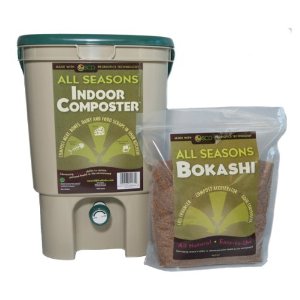
If the only place you have to compost is under your sink, or if you think you need a way to compost meat or dairy, you might want to consider a Bokashi.  I don’t have any hands on experience with one (we toss any extra dairy or meat scarps to the chickens… except chicken, of course), but they are pretty ingenious.  They are small and air tight, so there is no smell and they use probiotics (the good micro organisms) to decompose what you put in there.  They don’t hold a ton, but they are efficient and get you compost tea quickly.

Tomorrow, I’m going to cover what to put in your compost (you know, “greens” and “browns” and all that), plus the difference between cool and hot composting.

Since I do all of our composting outside, I’d love to hear your experiences and thoughts on vermicompost and the Bokashi methods.  Tell me, tell me!

Categories: Compost, Sustainability, Urban Homesteading | Tags: , , , , , , , | 8 Comments

2012 Independence Days Challenge

Last week, Sharon Astyk announced that she’d be bringing back her Independence Days Challenge.  Whew!  I was excited about it!  If you’ve read my blog for more than a year, you know, I’ve participated in her challenge since 2010.

The challenge is to make small steps, every week, every day if you can, towards food independence.  And then record them.  There is no lamenting what you haven’t done, and in contrast to challenges where doing as much as you can takes the stage, the Independence Days challenge shows that small things do add up and everyone can do something.

The steps are recorded in several categories…

Plant Something: Planting isn’t done just once a year when you are looking to be independent.  Sharon tries to plant everyday from February to October.  Think seed starting, cold frames, season extension if you can.  February is a bit early for us, but we already have potatoes chitting so we can be ready to go in just a few weeks.

Harvest Something: From your garden, your nest boxes, the finished compost, foraging.  It all counts.

Preserve Something: In lots of parts of the country you can’t plant and harvest year round, including here in Colorado.  So you better put up what you can for the dark days of winter!  Canning and jamming, yes, but also drying, smoking, freezing, etc.

Waste Not:  Scraps given to the animals and/or compost pile fit here.  Also mending things instead of throwing them out.  Creating less garbage, making sure things don’t go to waste.

Want Not: Building up your long and short-term food storage falls into this category.  We bought a case of peanut butter, for example, or buying bulk grains goes here.  Also, I’ve put things like cloth diapers or second-hand clothes in this category.  Things that last and will need our needs over time.

Eat the Food: It’s tough to break the habit of buying a full menu’s worth of meals at the grocery store.  You have to think and make an effort to use up the book you have stored.  Eating from your pantry and your freezer, making full use of what you have.  Trying new recipes falls here too.  Eat what you’ve worked hard to grow and save!

Build Community Food Systems: Sharon sums it up like this: “What have you done to help other people have better food access or to make your local food system more resilient?”  I include things here like gardening with the neighbors, giving talks about gardening, CSAs, farmer’s markets, sharing food with people in an effort to get them to take their own steps towards self-reliance.

And a new category (I’m so excited about this one)

Skill Up: from big things like building a beehive or cold frame, to smaller things like starting seeds or researching new ideas.  Record in this category what you’ve done to add to your own arsenal of skills.

Over the last two years, I have recorded our steps in a weekly blog post (see them all here).  But this year, I’m thinking of recording them a little differently.  Look to the right, over there in my side bar.  I’ve decided to keep a running total over there.  I’ll still post Independence Days updates, but probably less regularly than weekly.  We’ll see how it goes.  I’m flexible.  But I like the idea of watching it all add up in one place.

I’d love it if you decide to join the challenge too.  I really like seeing the small things add up.

For more info on the Independence Days Challenge, make sure to read Sharon’s post.

Categories: Food, Independence Days | Tags: , , | 10 Comments

Boot Camp Bonus: A Well Stocked Pantry

Yesterday I mentioned keeping a reasonably well stocked pantry in order to allow for some flexibility in my meal planning.  I got to thinking about what a well stocked pantry looks like.  It will probably different for every household, and it varies for us as well, depending on season, tastes, moods, how well we stocked up last year, etc.

In general, this is what I came up with for our version of a well stocked pantry (in no particular order).

  1. Oats – I keep a half gallon to gallon size container of oats on hand at all times.  Sometimes I switch between steel cut oats and rolled oats, but I have found that rolled oats are more versatile.   These whole grains make oatmeal, of course, but they can be added to desserts (cookies, crisps), muffins, breads, and are the base for home made granola.  They are insanely less expensive than boxed cereals, and better for you too.
  2. Rice – I use both white and brown rice, and at times I’ve kept quinoa on hand instead.  Rice is a great belly filler, another whole grain, and it keeps.  Good with stir-fries, in soups and stews, as a side dish, the star of risotto, and Rick even eats it for breakfast with butter and cinnamon.
  3. Canned beans – the hero of emergency meals.  Dried beans are far cheaper, and we keep them on hand too, but canned beans can be used instantly with no soaking or hours of cooking.  We add them to up the protein on pasta dishes and soups, sprinkle them over salads, as easy finger-food lunches for the kids, we let them star in vegetarian meals.  Keeping beans on hand saves the day if I forget to defrost meat for dinner.
  4. Olive oil & balsamic vinegar – Together, they make an easy, delicious and cheap salad dressing.  Separately, olive oil can be used for nearly everything we cook.  I do keep other oils on hand too, but if I had to keep only one, olive oil would be it.  The balsamic can be used in other ways too.  A friend brought over a dessert once of mascarpone cheese spread on sugar cookies, topped with sliced strawberries and drizzled with balsamic reduction (heaven).  I use balsamic as a secret ingredient in certain soups and other dishes.
  5. Broth – you can’t really make risotto without it and it makes soups super fast.  It’s a decent substitute for white wine in a pinch.  It’s a fast way to up your flavor without much effort.
  6. Canned tomatoes – if I’m crunched for time or feeling lazy, you can bet I’m reaching for a jar or can of tomatoes.  They can become anything.  I use them for enchilada sauce, pasta sauce, pizza sauce, soup, stew, chilli, roasted with other veggies, you name it.  This is a true staple for us.
  7. Onions and/or garlic – the other day I told Rick, “We’re out of onions.  I can’t make anything without an onion!”  I know, strictly speaking, onions and garlic are perishable, probably not really “pantry” food, but stored well, they last a long time and I really feel like I can make anything taste good if I have an onion or garlic.  This makes my mom laugh.  When I was a kid, I “hated” onions, I even gave my mom a homemade citation for using too many – her punishment was to not be allowed to use them for a whole week.  She was a good sport and went along.  I pray my children don’t ever punish me this way.  You can make rice and beans delicious with a little onion and garlic.  If times are tough, and your cupboard is nearly bare, you better have an onion.
  8. Dried herbs/spices – I love me some spices.  I can’t understand how people cook with nothing but salt and pepper.  An average spice rack should at least include thyme, rosemary, oregano, parsley, dill, red pepper flakes, bay leaves, savory, and cumin powder.  Mine better have extra red pepper flakes and Chimayo chili powder too.  You don’t have broth?  Make some with your meat, an onion, a bay leaf and some thyme, parsley, and savory.  Chili?  You need that cumin and those ground chilies.  Rosemary will make your plain ol’ rice and chicken amazing.  A bit of dried herbs go a long way, and they can make the most basic of meals delicious.
  9. Pasta – Another go-to for us.  It’s versatile, cheap, it keeps forever and I can buy it in bulk.  Sometimes I feel like the number of pasta dishes is limitless.
  10. Soy Sauce & rice vinegar – If you get tired of tomato based dishes, the cure is soy sauce and white vinegar.  The combo makes the best fried rice, and you can use them to make many Asian sauces.  Soup, Thai, stir fry, peanut sauce, marinade, jerky,  the list goes on.  Practice using the pair and you can impress anyone.

Obviously this list doesn’t cover baking basics like flour, which I almost added to the list.  But I’m curious how your pantry matches up to mine.  Is it similar?  Very different?  Did I miss something or surprise you?  Does your region or culture affect your list?  Tell me what is on your list of pantry staples.

Categories: Food, Simple Living, Top 5, Urban Homesteading | Tags: , , , , , , | 18 Comments

Tips to Make Menu Planning Manageable

To tell the truth making up a menu can be easy for a week or two, but then it can sometimes become a chore.  When it gets daunting, it helps me to remember a few things to make it a bit more manageable.

1.  Take turns.  At least two nights a week, my husband does the cooking, and plans what we eat those days.

2.  Make a routine.  During the summer especially, we have homemade pizza every Friday.  I make large batches of pizza dough and freeze it in one pound balls.  We use it as a way to clean up any left over veggies.  That means we have weird sounding, but delicious tasting pizza.  Steak, onion, and bell pepper;  tomato, basil and chard; potato and rosemary; eggplant, thyme and Swiss cheese; etc.  This makes every Friday a given on the menu.  Combine with whatever my husband has planned, now I only have to think of four more meals.

3.  Be flexible.  Keeping my pantry reasonably well stocked means that if I really don’t feel like fixing what I had planned on the day I planned it, I can usually go another direction without impacting the rest of the week’s meals.  Also, if your neighbor invites you over, feel free to delay you menu by a day.  It’s ok to plan take out once in a while.  Give yourself a night off.  The plan is more like a guideline, really.

4.  Use those bulk purchases.  The elk needs to get used up.  So I make sure to plan one or two meals a week using elk meat.  This removes still more brain damage in coming up with a plan, because I only have so many meals I can make out of red meat.  In the winter, there are lots of stews, chilli, steak.  The summer, we use less, mainly grilling, always with a big salad, sometimes stir fried or fajitas.  When I had to get us through a hog, we had pork a couple times a week too.

5.  Cook once, eat twice.  Plan for left overs.  Your pork roast on Monday becomes Wednesday’s pulled pork sandwich.  Tuesday’s left over pasta becomes Thursday’s frittata.  Cook a little extra early in the week to make it easier on yourself later, when your willpower starts wavering.

What tips do you have for making and sticking to a menu plan.

Categories: Menu Planning, Thrift, Top 5 | Tags: , , , , , | 4 Comments

UH Boot Camp: Menu Planning Made Easy

Menu planning may not sound like an urban homesteading skill, but I assure you it is.    It is something that, like a budget, takes thoughtful time and effort and doesn’t come naturally to many of us.  Our family would never stay within our food budget if we didn’t do it, however.  It saves us time, money and helps us waste less.

Menu planning saves time. When I sit down for fifteen or so minutes and make a plan for the week, I am gaining loads of time before dinner.  I can plan to eat something quick on the nights H has a violin lesson, and I can plan something that can keep cooking for a while on the nights that Rick could get home late or early.  I know the answer to, “What’s for dinner, Honey?”  There is no standing in front of the fridge trying to figure out what to throw together last-minute.

It saves time at the grocery store too.  If I know what we need for the week, and have a list, I don’t need to wander down every aisle.  I can just grab what’s on the list and get out of there.  And anyone with kids knows that the grocery store can be a time sink.  Trust me, a plan saves time.  😉

Menu planning saves money.  If you don’t know what you need for the week, you are going to spend a lot more money at the grocery store too.  You will need to wander around looking for what you think you might need or use, and you’ll probably buy more or less than is necessary.  Buying more isn’t tragic (unless what you bought will spoil), but not buying enough will kill your food bill, because then you’ll be heading back to the store for convenience trips.  Those convenience trip add a lot to your bill.  I don’t know how many times I’ve run into the store for one or two things and come out with my pocket fifty dollars lighter.  We always find a few extras that we “needed” during those quick trips.  For the most part though, sticking to the plan prevents those.

Menu planning also saves us from the days when we are exhausted before dinner time and too tired to think of what to make.  Somehow, just having it written down already makes it manageable enough to happen.  So instead of being tired and saying “I don’t know what’s for dinner.  Let just get take out,”  we have a plan and can throw together the dinner we have planned.  That mental energy seems to be a tipping point for us.  If there is no plan, we eat out a lot more.  And if our food budget ever gets blown, it’s due to one pizza order too many.

Menu planning keeps waste down.  When we know what to buy at the store and what we’re making each night for dinner, we rarely have any food waste.  I tend to remember the celery or kale and use it before it spoils, I don’t buy as many things that I don’t know if I’ll need or not, because I know what I need.  We eat more regularly from our stored food in the freezer and pantry, and things don’t go bad in the abyss of food storage any more.

I’ve written about menu planning in the past.  While that post is still valid, I have changed the way we plan our menus from monthly to weekly.  The main reasons I plan weekly instead of monthly now is we have gotten in the habit of eating from the freezer in the winter, there is no longer any mystery food in there; and in the summer, our CSA picks our vegetables for the week and I don’t want them going to waste.  Plus it is a lot less daunting to plan a week’s worth of food than a month’s worth.

So, how to plan.  Remember, this is boot camp – the very basics.  If you know how to plan already, make sure I haven’t missed anything.  If not, here is how we throw down a plan on our homestead.

  1. What do you have?
    This week, I planned our menu on Sunday night.  I sat and thought a moment about what we had in the icebox to use up, what was in the freezer and pantry, and how much money we had left in our budget for the month.  In the freezer, we have elk, green chiles, corn, asparagus and tomatoes.  In the pantry, there are still hard squashes, black beans, rice and pasta.  And it’s the end of the month, so we need to use what we have as much as we can, since I don’t want to blow the budget in the last week.
  2. What do you need to use first?
    Is there a little left over from last week that needs to get used up?  Did you get too much of something out of the freezer?  Use those things first.  If you are planning on eating greens, use them right away so they don’t go bad before the day you’re supposed to eat them.  Last night, Rick got eggplant down from the freezer, and then decided not to use it last-minute.  That means, tonight, eggplant is on the menu. 
  3. Look at your schedule.
    Do you need something quick on Tuesday? Are you having family over Friday?  What day are you going to the market?  Figure out what kinds of meals you need.  We are shopping on Wednesday this week.
  4. Make the plan.
    Monday:  Eggplant and tomato pasta bake with olives
    Tuesday: Ham and Egg Fried Rice
    Wednesday: Spinach and black bean enchiladas
    Thursday: Asparagus soup with cheesy bread
    Friday: Mexican elk steak with tomato, onion, chile sauce over rice
    Saturday: Pumpkin Coconut Curry
    Sunday: Bacon and tomato pasta with roasted asparagus
  5. Make the grocery list.
    While you are making your grocery list, keep in mind breakfast and lunch too.  This week, we need: milk, spinach, lemons, limes, avocado, onions, buttermilk, cheese, butter, nuts (for granola), fruit (for lunches), white wine and bread.

Simple enough, right?  In the summer time, the only difference is, I wait to plan our weekly menu until the day we pick up our CSA share, so I can see what produce we have for the week and plan around that.

Do you plan menus?  Does you method look similar or different from mine?

Categories: Menu Planning, Thrift, Urban Homesteading | 4 Comments

Modern Pioneer Quiz

Like many girls, when I was young I loved the Little House books.  I was enamored with the pioneer life and wished I could be Laura.  I used to tell my mom that I was born in the wrong time.  I should have been a pioneer!  I’m pretty sure this is what led us to getting chickens.  Needless to say, I was very excited to share these books with my own children.

Last summer, Henry and I started reading Little House in the Big Woods out loud because he was curious about maple sugar and I remembered that there was a great description of maple sugar being made in that book.  What I had forgotten, however was all the other great things that the Ingalls family did.

For example, the book begins with the harvest and putting things away for the winter.  In the first chapter Laura describes how the family smoked venison in a hollow tree.  It was Laura’s job to run and fill the smoker with green wood chips.  The method of smoking described is pretty similar to one that Rick and I have worked towards doing ourselves in our yard using an old oak barrel.

Next the family butchers a pig and Ma carefully makes the sausage balls and head cheese while Pa smokes the hams and the children roast the pig tail on a stick.  The girls play in the attic on the pumpkins among all their vegetables that are stored for the winter.  Pa goes on to hunt and make bullets (which Henry loved reading about) and Ma has her house keeping (every day with its own proper work) to keep the girls busy through the winter.

The more we read, the more I realized I have made my life very Little House.  I wonder, just how many other people out there are like us?  So I made this quiz…

The Modern Pioneer Quiz

How Little House is Your Life?

1. Has anyone in your house ever used an axe to cut a Hubbard squash or frozen meat?

a. What is a Hubbard squash?
b. No, but we do have winter squash stored in the attic.
c. Yes, it’s the easiest way.

2. Have you used a pig’s bladder as a balloon or roasted a pig tail on a stick?

a. Eew!
b. No, but I would if given the chance.
c. Yes! Bladders make the best toys.

3. Do you butcher your own meat?

a. No, but my grocery store has a butcher.
b. Yes, we even have our own smoker.
c. Yes, we butcher every fall after killing the meat we hunted and raised ourselves. Then we smoke it in a hallow log.

4. Do you store food for the winter?

a. Sure do, my freezer is packed with deals from Costco.
b. Yes, I can and pickle and use my dehydrator.
c. Yep, I hang my smoked hams next to the hard cheeses and salt pork.

5. Have you made maple sugar candies in the snow?

a. What?! You can make candy in the snow?
b. Yes, and the kids loved it.
c. Yes. We tapped the trees ourselves, boiled the sap, and afterwards we had the whole family over for a dance to celebrate.

6. Have you ever harvested honey?

a. No, but we get honey from a local farm.
b. Yes, our beehive is so interesting.
c. Yes, from wild bees living in a hollow tree.

7. Do you churn your own butter?

a. I think we did that in school once.
b. Yes, once in a while it’s a fun thing to do.
c. All the time; in the winter we cook carrot sin milk to color it yellow.

8. Has your neighbor ever delivered gifts on behalf of Santa Claus or loaned you some nails?

a. Neighbor? Oh, we don’t really see our neighbors.
b. No, but he’s helped me with some DIY projects.
c. Yes, he’s like family now.

Add up the number of A’s, B’s and C’s you answered.  Results are not scientific.  So, just how Pioneer are YOU?

Mostly A’s: More modern than pioneer, you might try a little DIY if you have the right tools, but you are more likely to hire someone.  Though you enjoy cooking at home, those foodie extremists will have to pry your microwave from your cold, dead fingers.  You’re not sure what head cheese is and you don’t even want to think about a pig bladder.  Baking bread is for artisans, you don’t really have time for that.  You’ll support the local bakery and farmer’s market instead.  We didn’t spend the last 100 years making advances so you could haul water from the creek.

Mostly B’s:  A modern pioneer and proud!  You use today’s technology to do yesterday’s work. Smoking, preserving, sewing and hunting are not lost skills thanks to the likes of you.  When you read about the Ingalls family, you are inspired to experiment in your own life.  But you don’t go overboard either.  You’re not about to give up indoor plumbing in favor of a weekly bath on Saturday, whether you need it or not.  Keep blazing the trail and those pioneer skills will be around for future generations too.

Mostly C’s:  Grab your fiddle and don your bonnet!  The pioneer spirits of Pa, Ma, Mary and Laure run strong through your veins!  The Little House books are not historical fiction, they are a guide!  Your friends are probably fascinated by your lifestyle, but you’d never know it, since you don’t have the internet.  In fact, you can’t even read this quiz.  You are too busy weaving straw hats, greasing bear traps and making bullets.  You really were born in the wrong century.  Good for you for making yourself a pioneer life in these modern times.

Categories: Urban Homesteading | Tags: , , , | 3 Comments

UH Boot Camp: Eating Well without Breaking the Bank

Yesterday I talked about the basics of making a budget.  For today’s urban homestead boot camp, I wanted to give you my best tips for saving money on your food bill while still eating well. Some things, to really save money, do take some investment up front, but the pay off in the long run is well worth it.  Other things are simpler, they can be started right away.  But first let me share what I think eating well means.

By “eating well” what I mean is eating real food.  Food that doesn’t come out of a box, that was raised and prepared with care.  Top Ramen is not eating well.  To me, sustainability is important, as is cost.  Eating sustainably means different things to different people.  To some, it means eating all organic, even if your bananas came half way around the world.  To others, local is most important.  And I know what it’s like when you have really limited funds.  Sometimes whatever is cheapest starts to look appealing.  For me, the most sustainable means locally grown without chemicals and pesticides.  An organic certification is optional.

So, how to get those things while not breaking the bank?

Things that take some investment upfront:

A freezer.  This is a tool that can save your bacon.  And beans.  And everything else.  You can freeze most things.  If you find a really great deal on some chicken, it makes sense to buy a little extra and put what you’re not going to use right away into the deep freeze for another day.  Freezers are pretty inexpensive and run more efficiently than most refrigerators.  Check craigslist or freecycle.  You can get a great deal.  Even our chest freezer from the 80’s runs more efficiently than our fridge did.  We have two.  Both were given to us; hand me downs from relatives.

Joining a CSA.  Community Supported Agriculture, where you buy a “share” of a farm’s predicted crop before it is even planted.  You and the other CSA members front money for a farmer to plant and then, along with the farmer, share in the risks and rewards of the weather.  In my experience, this is an incredible investment.  The farm we’ve been with for the last five years has never had a bad year.  Of course you are betting on nature, a crop might be totally wrecked by hail.  But you are also sharing in the reward when things are good.  Some are bumper years for bell peppers or corn, while the beans didn’t make it.  But we always get WAY more than we paid for.  Local and organic.  Our CSA also sells optional shares of fruit, honey, eggs and meat.

Oh, and when you are getting way more than you can eat in a week, you can put the surplus in your freezer for the winter.  January is the time to call CSA farms.  Farms are filling memberships as I type this, so check around.  Some farmers will even work out a payment schedule with you if the fee is too much for you to pay all at once.

Hunting or buying meat in bulk.  Both of these methods do the same thing; receiving a whole animal at one time.  You better have a freezer first.  When we bought a hog a couple years ago we paid about $400 for the whole animal.  This worked out to about $1.33 a pound for bacon, hams, pork chops, shoulder roasts, pork loin, lard, everything.

Hunting requires a skill set, equipment, time and licenses.  It’s not complicated, but you will need to attend a hunter’s safety course and get access to land (and a gun) in the fall.  The cost is slightly harder to figure, but not counting the gun my husband already owns to hunt with, we spent about $360 on licenses and gasoline for various hunting trips.  We have an entire elk in the freezer to show for it.  Roughly $1.44 per pound of lean red meat, said and done.  Some years, it’s much less expensive, depending on success rates.  And some years, we’ve gotten nothing.

For either meat option, now is a good time to look into it.  Local farmers and ranchers are taking orders, and you need to buy hunting licenses in advance (April here in Colorado).

While I’m talking about buying in bulk, I’d also like to mention that once a year we drive to an orchard to pick peaches.  It’s a far drive, to the western slope, so we make it count.  We spend about $400 on 300 pounds of peaches, including gas.  We race home with the A/C blasting and then spend the next week slicing and preserving peaches.  The majority of them get frozen, though we jam and can some too.  But these peaches last us a whole year.  So investigate local U-Pick farms.  We do the same on a smaller scale for berries and cherries.

Things that everyone can do now:

Make a meal plan for the week.  I used to plan a month’s worth of meals at a time, but that can be daunting, and over time I’ve realized that weekly works better for us.

Plan meals that are in season.  This is easy with a CSA.  Apples are least expensive in the fall, strawberries are cheapest in the spring.  If you want asparagus in August, you’re going to pay a lot for it at the market (and it won’t taste all that great).   This puts us eating things that are in season the majority of the time.  In season means relatively inexpensive.  We pretty much don’t eat bananas.

Use up what you have.  Until you get into the habit, it’s easy to keep ignoring the beans in the back of the pantry or the sausage in the bottom of the freezer.  Get into the habit of planning meals the use what you’ve already purchased.  You’ll spend less at the grocery if you aren’t buying what you already have.

Plan to eat less meat.  Meat costs more than other forms of protein.  Use meat more like a side dish.  Try adding one more vegetarian meal to your menu per week than you normally make.  Try making chili with black beans or stir fry with eggs.  Over the last few years we went from eating meat at dinner every night to eating meat only three – four times a week.

From your meal plan, make a grocery list.  And stick to it. This keeps me from impulse buying.  Also, it cuts down on incidental/emergency trips to the store which end up costing a lot more over time.

If the store that I’m going to has a double ad day, I’ll go on that day, but I don’t usually plan my meals around the ads.  I just figure if I go on that day I double my chances of finding things on sale.

I don’t use coupons at all.  There are never any coupons for bulk rice or apples or pork loin.  I can’t recall seeing one for milk.  Coupons usually make me feel compelled to buy things that I would not normally put on my list.  They are always for things in boxes or bags, things with weird ingredients.  Things that are processed and full of chemicals…

Buy whole foods. Processed foods are expensive.  Potato chips cost more than potatoes.  Rice-a-Roni costs more than rice.  Pasta and milk is cheaper than a package of noodles with a powdered sauce.  Not to mention a billion times better for you.

Buy foods from the bulk bins.  When you buy a pound of rice or oatmeal in a box or bag, guess what.  You care paying for that box.  And for the marketing of that box.  It’s much less expensive to buy oats from the bulk bin.  There is no packaging to pay for.  No labels, no marketing, and no weird ingredients.  And if you buy or make your own reusable bags, there is no waste either.

There you have it.  Those are my big tips for saving money on food.  Between the meat in the freezer, the vegetables from the garden and the CSA, and eggs from the chickens, there are times I can spend $30 at the store for the week.  All I’m buying at that point is dairy and grains.  But it takes time to get to that point.  And I’ve already invested money up front.

What does your family do?

Categories: CSA, Food, Hunting, Menu Planning, Thrift, Urban Homesteading | Tags: , , , | 9 Comments

Create a free website or blog at WordPress.com.