Food

Frugal Friday: Composting

YUCK!  What is that??
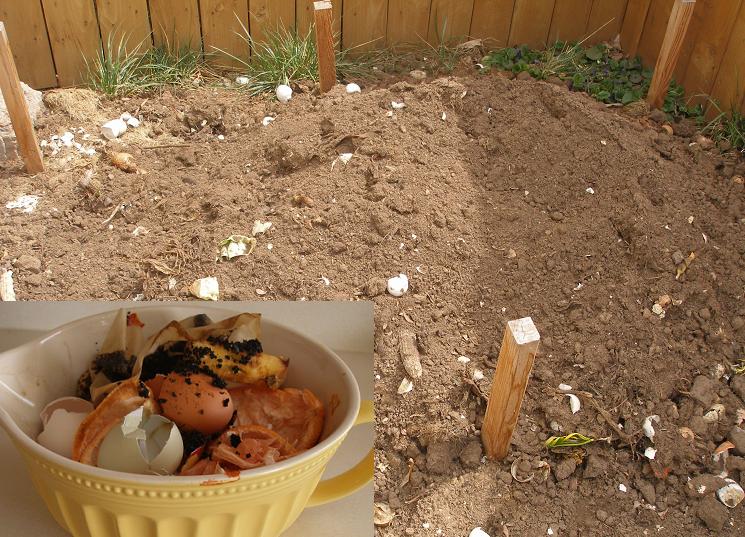
compost

It’s my compost.  That’s the bowl on my counter, super-imposed over the pile outside.  🙂

Week two of my Gardening  Thrifty Thursday Frugal Friday tips (sorry, I just didn’t feel like writing yesterday) is about composting.

I was actually lobbying for a compost pile for a long time before we got one.  A couple of years.  Rick grew up thinking that they were smelly heaps of rotting food that attracted neighborhood cats, and provided little benefit, except for those hippies.  He also grew up dusting baby tomato plants with pesticides and dousing them with chemical fertilizers.

I had to change his thinking!  I wanted to compost to reduce the need for those pesticides and fertilizers.  I wanted to foster a garden that could support and sustain it’s self!  And, my dad was a “worm grower” (throwing coffee grounds and eggs shells in the garden, to grow big, fat, night crawlers to use for fishing bait), so I knew the compost bin/pile needn’t be complicated or smelly.

In order to compost, you need only a few basic things:
– Green material (like veggie scraps, coffee grounds, etc.)
– Brown Material (dried leaves, straw, dried grass clippings, etc.)
– Water
– Somewhere to let it do it’s thing (a bin or pile)

After showing Rick some of the facts about composting, and pointing out to him that he had been doing it every fall all along (digging holes and filling then with layers of leaves, dirt and water, and then leaving the to rot through the winter to improve the soil in the veggie garden), he did a little research of his own and jumped in with both feet.

Rick  decided to save money by building his own bins, following a plan we found online, just by Googling it.  So far, he has the layout done, and we’ve been composting without walls for the last year or so.  He will eventually put in walls around the pile, where the steaks are, so we can transfer from one side to the other easily.

But why should you start composting?  I mean, who wants a pile of rotting organic matter sitting around the outside of their house?  Really?  Here are a few reasons why (from earth911.com)….

Benefits of Using Compost

  • Improves the soil structure, porosity, and density, thus creating a better plant root environment.
  • Increases moisture infiltration and permeability of heavy soils, thus reducing erosion and runoff.
  • Improves water-holding capacity, thus reducing water loss and leaching in sandy soils.
  • Supplies a variety of macro and micronutrients.
  • May control or suppress certain soil-borne plant pathogens.
  • Supplies significant quantities of organic matter.
  • Improves cation exchange capacity (CEC) of soils and growing media, thus improving their ability to hold nutrients for plant use.
  • Supplies beneficial micro-organisms to soils and growing media.
  • Improves and stabilizes soil pH.
  • Can bind and degrade specific pollutants.


In other words, it’s good for your garden, your plants, and the Earth!  This short list doesn’t even mention that the EPA estimates that 24% of what ends up in landfills is made up of yard trimmings and food residuals.  All of which can go into your home compost pile/bin and be used to enhance your own soil for your own veggie and flower gardens.

Wait… I thought this was supposed to be a tip about saving money.  How does composting do that?  Well those points up there basically equate to this:  Using compost reduces the amount of water, fertilizer, pesticides, and soil modification needed to grow a great garden.  It also reduces the amount of garbage you send off to the landfill, and combined with diligent recycling, that could even lead to eliminating the trash bill  completely!  So what, exactly, is the savings?  Well, I don’t have that broken down.  It all depends on what you grow, and what you need to make it grow.  But I can tell you this.  We don’t need to buy fertilizer, peat moss (for soil modification), manure, or pesticides any more.  We haven’t bought those things in a long time.  🙂

It’s easy to do.  We just keep a bowl on the kitchen counter to collect our food scraps, egg shells, coffee grounds & filters, veggie peeling, etc.  We dump that into the pile when ever we fill it up (once or twice a week).  This accounts for most of the “green matter” in the pile.  We add grass trimmings and dried leaves, the used pine shavings from the chicken house and paper from our shredder to account for the “brown materials.”  The only other things needed are water and time.

Be sure to check out these helpful sites for more reasons to compost, details on what should and should not be composted, compost uses, and methods of composting:
U.S. Environment Protection Agency
Earth911.com
Washington State University County Extension

Also, before I wrap this up I wanted to share a link to KGI’s post about the Obama’s first planting in their new garden!  Check it out! http://www.kitchengardeners.org/

Be sure to check around for other Thrifty Thursday tips this week. Katie Jean posted about the Value of Memberships! Check also with  Tracy, Crystal and Genny(though I know Genny is taking a break to prepare for the home birth of their baby!, and some of the others have been busy with other life things as well).  🙂

Categories: Compost, Food, Garden, Sustainability, Thrift, Urban Homesteading | 3 Comments

Thrifty Thursday: Joining a CSA Farm

main_logo2_600_221

Monroe's Logo, click to visit their blog!

One of the biggest money savers Rick and I did last year was joining a local CSA farm.  CSA stands for Community Supported Agriculture (see my March 2008 post,  “CSA – And it Tastes Good Too” for more info on how CSA’s work and where to find one in your area).  Like buying your meat in bulk or using cloth diapers, the upfront cost of a CSA membership is a lot to shell out at once, but the savings over time is incredible!

At Monroe’s farm (the CSA we belong to) the fee is split into two parts:  a Membership fee, which is set for all members, though it is reduced if you chose to be a working member; and a Produce fee, which is based on the size of share you are purchasing (single, half or full).

When we joined Monroe in 2008, we signed up for a working membership.  To figure out if this would be worth wile for us, we sat down with our grocery store receipts from the months past, and added up just what we spent on produce alone.  Then we figured out the mileage to drive to Monroe in Kersey, CO once a week, and what that would cost us in gas.  The fuel costs combined with the membership & produce fees from Monroe were still FAR, and I mean FAR, less than what we’d been paying at the grocery store for often times non-organic, shipped across the country, under ripe produce for the previous summer.

About a week after we signed up (before things were really started for members on the farm), I got a call from another member who also lived South of Denver and was interested in car-pooling to the farm each week.  That meant our fuel cost was cut in half from what we calculated it would be.

For the whole summer’s worth of produce, including fuel costs, this is what we spent in 2008 (when gas prices were through the roof, remember??).  And, it should be noted that we froze, stored and canned some of this produce and have been eating it all winter too (we still have onions, tomatoes, potatoes, green chiles and corn)!

Membership Fee (working member):  $100
Produce Fee (half share):  $135
Fuel (we got aprox. 20 miles/gallon):  $497.07/2 = $248.54
Total for the summer:  $483.54

That amount divided by the number of weeks we received produce from the farm (approx. 24) is $20.14/week on about 20-25lbs of local, fresh, organic produce.  This does not count the 2 flats of strawberries, asparagus, and 4 bushels of roasted green chiles which were “pick your own” that I brought home in addition to the share, or factor in all the stuff we stock-piled for the winter.

You have to remember that this number could change based on how far you drive to the farm (assuming you’re a working member), car pooling with more or less people, fuel costs, and how bountiful the harvest is.  Or, it could change if you are a non-working member as well.

The produce is so incredibly fresh.  As in, picked just that morning!  The half share was plenty for our family.  We ate most of it in a week, and were able to store what was left.  However, for 2009, we uped our share to a full size with plans to store/can/freeze much of the excess in order to ensure our grocery bills for winter produce are further reduced.

Check out Monroe’s website and their brand new blog to see what we do at the farm.  And make sure to check into a CSA in your area!  The saving is incredible!  And the food is out of this world!

It should also be said, that we got a lot more out of the CSA last year then produce as well.  We made new friends, Rick has a new hunting partner, Henry got to play in the dirt all summer, eat melons warm from the sun, pick strawberries… it was very very cool.

Categories: CSA, Food, Garden, Thrift, Urban Homesteading | 3 Comments

Sustainable Food Budget Challenge

susbudgetHow many times have you thought about eating organic and locally grown food, only to convince yourself it’s too expensive?  Or maybe you do eat locally and organically grown food, and try to convert your friends, but you can’t seem to get them to believe it’s something they can afford. 

For the month of April, The Crunchy Chicken is issuing the Sustainable Food Budget Challenge

I hear so many times, from many friends that “they just can’t afford to eat natural/organic.”  This way of thinking really discourages me.  Rick and I have a very tight grocery budget.  We do not spend our whole paycheck at Whole Foods, nor do we think anyone should.  Yes, our grocery shopping is supplemented with our garden and hunting, but those things aren’t free either, and take lots of work.  Not counting the garden, the CSA, and hunting, we spend between $60-100/week on groceries during the winter, and only $30-60/week during the summer.  I will calculate out the cost of meat, as well as garden & CSA veggies to add into that later, to give you an accurate reflection of what we truly spend per month to eat locally, organic, sustainable food. 

But first, the details on the challenge:  The idea here is to feed yourself and your family on sustainable food sources while staying within a set, tight budget (more on this below).   So what is “sustainable food?”   To me, it is food that has the least impact on the environment, while having the most impact on your health.  Locally grown organic veggies are at the very tip top of this list.  For example, a tomato from your garden, grown without fertilizers or pesticides, using grey water or a drip system, has a very low impact on the environment (no fossil fuels were used to get it to you!) and you get all the health benefits of an organic tomato.

So besides a garden, where do you find this stuff?  Start at the farmer’s market, food co-op, U-pick farm stands and local food stores.  Then move  on to the grocery chains and big-box last.  Local food store will often carry more locally grown food then the bigger chains and big-box stores.  And, usually at cheaper prices.  You will need to weigh the benefits of buying locally (but maybe not organic) versus buying organic produce flown half-way around the world to your local Wal-Mart.   Crunchy Chicken has a follow up post here about what sustainable means as well.  This is a helpful clarification since many of us live in areas where the farmer’s markets aren’t yet open. 

Crunchy Chicken raises the question: “is it possible…?” as well as lays out the rules for the challenge:

So, the question remains… is it possible to eat an organic or sustainably grown diet on a budget? A few years ago, there was the argument that those individuals who received food assistance from the government didn’t receive enough money to be able to afford healthy food. Some took it further and argued that poor Americans really were excluded from being able to eat sustainably strictly because of the higher costs. There are a number of factors at play here, the majority of which have to do with food availability such as the fact that not many supermarkets remain in some inner city areas and it’s difficult to travel out to the suburbs to shop at stores that sell the kinds of foods we are talking about here.

But, for the rest of us, can it be done? For those of us who live in areas where ample farmers markets, farms and grocery stores selling sustainably grown food exist, is it affordable?

I’d like to challenge us all to see if we can eat sustainably using the Food Stamp Allotment Program guidelines. It will take a lot of careful planning, but the end result is that we can save a lot of money on our food budget by trying to spend within this framework for a month.

Challenge Guidelines
So, here’s the skinny. Based on the following allotment chart, you are to stick to the corresponding amount for food for the month of April. The challenge is that you must buy according to the following guidelines (from Locavores). Do not include non-food items or home grown items into your budget, but do include seeds and plants which produce food for the household to eat. Make sure you include all the food costs from eating out, trips to coffee shops, etc.


These are fairly loose rules, but the goal is to buy sustainably grown food:

1. If not LOCALLY PRODUCED, then Organic.
2. If not ORGANIC, then Family farm.
3. If not FAMILY FARM, then Local business.
4. If not a LOCAL BUSINESS, then Terroir: purchase foods famous for the region they are grown in.
5. Hit the farmers market before the supermarket.


Household Maximum Monthly Allotment Chart:
1 person – $176
2 people – $323
3 people – $463
4 people – $588
5 people – $698
6 people – $838
7 people – $926
8 people – $1,058
Each additional person – $132
 

Here is the break down of where Rick and I are starting from, as well as a receipt info from today’s shopping trip on April 1st. 

Today I spent $84.51 at Sunflower Farmers Market (a local grocery chain) for food items for the week.  We plan on having Buttermilk Baked Chicken, Mediterranean Salad, Homemade pizzas, Elk chili, Chicken Satay, Mediterranean Chicken Packets, and Broccoli Tomato Stromboli’s this week.  The chicken I bought at the store was not organic or local (normally I buy organic chicken only once a month from Costco, where it is cheaper), but I refuse to pay $16.00 for one Rosie chicken (read the Omnivore’s Dilemma by Pollan and you will too!).  I bought salami from who-knows-where, and I’m certain it’s not organic either, but it was the only kind they had.  Nearly all the produce I bought, as well as the beans and flour were organic, though not local.  But the eggs and milk were Colorado proud, and hormone free.  The bread was both local and organic. 

The pizzas will have pork sausage, the cost of which is approx. $1.97.  We bought a whole local 4-H hog last fall for less than two bucks a pound.  The elk meat for the chili was given to us by a relative, harvested in Kremmling, CO.  Rick has not gotten an elk yet, but he’s applied for many a license, so the cost of that, to be fair would have been… well, whatever the heck $39 for a license plus the fuel cost to get to Kremmling, and the cost of one .306 bullet; divided by how ever many hundred pounds of meat an elk gives us… for one pound.  I’ll be extra  generous and say it was a $1.00.  Rick’s family processes their own meat, so that would have been free (just costs time, anyway).  We will also be using some frozen tomatoes left over from the farm last summer.  I am not going to figure out the cost of two or three tomatoes, but if we weren’t using those I would have bought a big can of Muier Glen Organic tomatoes for about $2.29, those in the freezer probably didn’t cost half that, but to be generous and fair again, we’ll say they were half: $1.15.

So, for this week:
-Grocery Store – mixed: $84.51
-Pork – local and sustainable: $1.97
-Elk – local and sustainable: $1.00
-Tomatoes – local and sustainable: $1.15
Total: $88.63

If we keep on track with this amount for the month, we’ll spend about $356 on groceries.  This is below the amount allotted for a family of three, and WAY below the amount allotted for a family of four (which we qualify as, since I’m pregnant) for Food Stamps.  Not too bad. Let’s see if we can pull it off! 

This month will bring a couple of exciting opportunities for us though as well.  Like the pick your own asparagus at the farm in a couple of weeks.  I can’t wait.  Look for more info on CSA’s in tomorrow’s Thrifty Thursday tip.  A lot of the produce we use (though, none planned for this week, besides those tomatoes) comes from there, and I will have cost breakdowns for that.

My goal for the challenge is to see just HOW sustainbly we can eat, for the least amount possible.  I have a feeling Rick will like this challenge.  He’s always complaining about the grocery bill! 

What about you?  Do you think you can do the challenge?  And if you’re already eating well on a budget, do you think you can stretch it further?  Will you join us???  Leave me a comment below with thoughts, questions, ideas, etc.!

Categories: CSA, Food, Garden, Recommended Reading, Sustainability, Thrift, Urban Homesteading | 3 Comments

The Red Heads

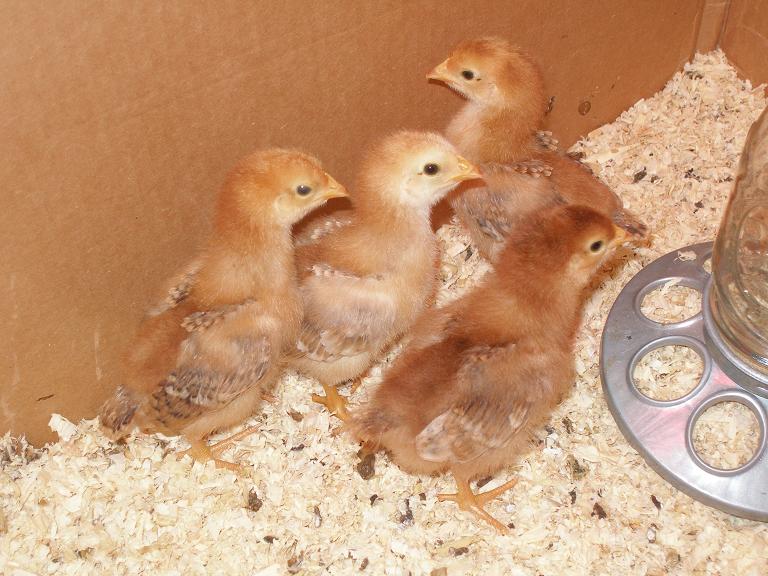
I wanted to share a picture of the chicks again… they are getting big fast!  Only one week old with wing and tail feathers!  I put them in the box we brought them home in (to clean the big box) and they barely fit!  Holy Schmokes! Check out our little red heads (and compare to last weeks post!):

one-week-old

Categories: Chickens | 3 Comments

New Kids in the Flock

There’s a new chick band around the Schell homestead.  They go by the names of Rose, Blossom, Petal and Petunia.  Debuting Sunday, we got these day-old beauties to add to the Schell flock and more than double our egg laying potential. 


baby-chicks

4-chicks


The Fab Four are all Rhode Island Reds (good egg layers!) and they will get to enjoy the warmth of our office and keep me company in here while I blog for the next 12-16 weeks.  Then the little chickadees will join their older counter parts, Mayzie, Lavender and Poppy in the backyard.

Rock on!

Categories: Chickens, Urban Homesteading | 4 Comments

Wordless Wendesday: Pizza Night

*Click pictures for best view*

pizza-dough-1

pizza-dough-5 pizza-dough-6 pizza-dough-8  pizza-dough-9  pizza-dough-101  pizza-dough-11  pizza-dough-12

Categories: Food | 2 Comments

A Little Love and Home Cookin’

Yesterday was Rick and my sixth anniversary!  Wow, how time flies!  We can’t believe it’s been six years already… that we have a two year old and another on the way, all the things that have happened over the last six years!  Wowie!

We decided to celebrate by taking the weekend in up in Kremmling, CO at Rick’s uncle’s cabin where we spent our honeymoon.  Our plan was to relax, get in a little snowshoeing, and play in the powder with H.

poor-sick-sleeper

Unfortunately, H had other plans.  Sick again.  We still got in plenty of relaxation, but we stayed inside the cabin by the fire.  Poor kiddo was burning up the whole weekend.

I feel like we’ve lived in a sick house for the last month or so.  H’s been sick and well three times now I think.  Rick’s still not over whatever’s been plaguing him for the last two weeks, and I even took a turn (something I hope I don’t repeat!).

Through all that I’ve made several pots of soup, including a few new recipes that I wanted to share. These first two are both from this month’s issue of Everyday Food magazine:

Tortilla Soup with Black Beans (this is a great way to use up items in your pantry).

p2230002

  • 1 TBS olive oil
  • 4 garlic cloves, minced
  • 1 tsp chili powder
  • 2 cans (14.5 oz each) diced tomatoes in juice
  • 2 cans (15 oz each) black beans, rinsed and drained
  • 1 can (14.5 oz) reduced-sodium chicken broth
  • 1 package (10 oz) frozen corn kernels
  • coarse salt and ground pepper
  • 1 cup crushed tortilla chips, plus more for serving (optional)
  • 1 TBS fresh lime juice, plus lime wedges for serving

1.  In a large saucepan, heat oil over medium.  Cook garlic and chili powder until fragrant, about 1 minute.  Add tomatoes (with juice), beans, broth, corn, and 1 cup water; season with salt and pepper.

2.  Bring soup to a boil; reduce to a simmer.  Add tortilla chips; cook until softened, about 2 minutes.  Remove from heat; stir in lime juice, and season with salt and pepper.  Serve soup with lime wedges and, if desired, more chips.

Serves 4.  Total time to table: 15 minutes.  (And for my readers counting protein, 12.8 grams per serving).

That’s it!  It was so simple and tasty, we ate the leftovers for three days in a row, with no complaints!  And it was just as good the third day as the first, making it great if you want to cook once and eat for a few days!

The next soup incorporates escarole… a leafy green, and since I’ve been really trying to get more greens in my diet, this soup get bonus points!  Also, as a side note, this month’s magazine had several escarole recipes.  We’ve tried a couple of them, and all  have been wonderful!  It’s my new favorite leafy green… move over kale and spinach!

Light Italian Wedding Soup

italian wedding soup

  • 1 lb ground dark-meat turkey (93% lean)
  • 2 garlic cloves, minced
  • 1 large egg, lightly beaten
  • 1/2 cup plain dried breadcrumbs
  • 1/4 cup grated Parmesan, plus more for serving
  • coarse salt and ground pepper
  • 1 TBS olive oil
  • 1 medium onion, halved and thinly sliced
  • 2 cans (14.5 oz each) reduced-sodium chicken broth
  • 2 cans (14.5 oz each) diced tomatoes in juice
  • 2 heads escarole (2 lbs total), cored, trimmed, and coarsely chopped

1.  In a bowl, combine turkey, garlic, egg, breadcrumbs, Parmesan, 1 tsp salt, and 1/4 tsp pepper.  Using 1 TBS for each, roll mixture into balls.

2.  In a large pot, heat oil over medium.  Cook onion, stirring occasionally, until softened, 3 to 4 minutes.  Add broth and tomatoes (with juice); bring to a simmer.  Add meatballs; cook without stirring, until meatballs float to surface, about 5 minutes.

3.  Add as much escarole to pot as will fit.  Cook, gradually adding remaining escarole, until wilted and meatballs are cooked through, about 5 minutes.  Thin soup with water if desired; season with salt and pepper.  Serve soup sprinkled with more Parmesan.

Serves 6.  Total time: 25 minutes.  Protein: 23.6 grams per serving.

This was also so easy and good.  Next time I will brown the meatballs before adding to the soup, just because I didn’t like the pale look of them.  Also, Rick and I agreed that one tablespoon per meatball was too big, and next time we will roll them smaller.  But it was still delicious!

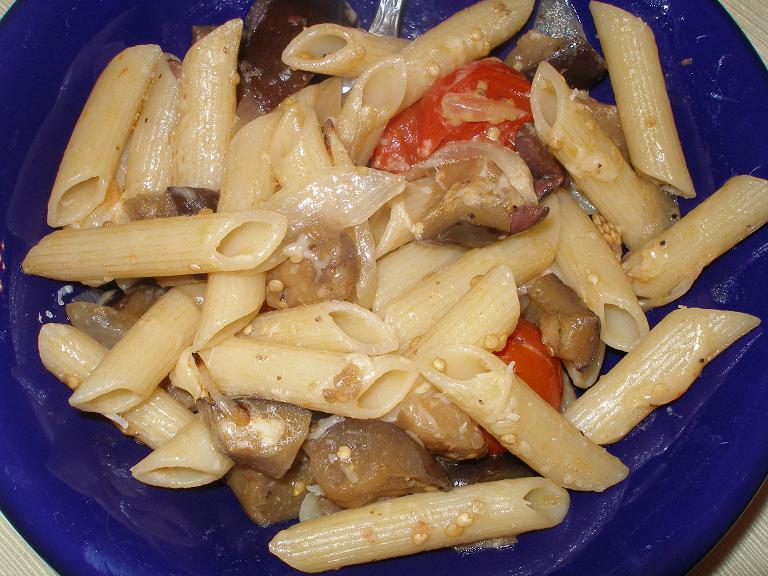
The last recipe I wanted to share, we made last night (it’s not a soup).  It uses eggplant.  I’m not a huge eggplant fan, and this summer we got quite a few from the CSA.  I didn’t want to waste them and I didn’t know what to do with them, so we sliced and froze them, hoping I’d come up with something before next summer.  I didn’t, but my Great Food Fast cookbook did:

Whole-Wheat Pasta with Roasted Eggplant and Tomatoes

eggplant

  • 1.5 lbs eggplant, peeled in alternating stripes and cut into 3/4-inch pieces
  • 1 large onion, halved and cut into 1/2-inch wedges
  • 2 pints (4 cups) cherry tomatoes
  • coarse salt and fresh ground pepper
  • 1/4 cup olive oil
  • 3/4 lb whole-wheat penne
  • 1/4 cup sliced pitted kalamata olives
  • 1/2 cup finely grated Parmesan cheese, plus more for serving

1. Preheat the oven to 450.  In a medium (11×15 inch) roasting pan, combine the eggplant, onion, tomatoes, 1.5 tsp salt, 1/4 tsp pepper, and oil; toss well to coat.  Roast until tender, tossing mixture halfway through, about 30 minutes.

2.  Meanwhile, cook the pasta in a large pot of boiling salted water until al dente according to the package instructions.  Reserve 1/2 cup of the pasta water; drain the pasta and return it to the pot.

3.  Add the roasted eggplant mixture, olives, and Parmesan.  toss to coat, adding 1/4 to 1/2 cup of the reserved pasta water, if desired.  Serve immediately, sprinkled with more cheese.

Serves 6.  Total time: 45 minutes.

We easily halved this recipe for last night.  And the eggplant was better than any I’ve ever had.  It was de-lish!  Rick said to add it to the regular menu, and to make it again.  So yay!  A success!  And a tasty way to make eggplant, finally!

So after all that home cooking, the perfect way to top it all off… Baskin Robbins’ February flavor of the month: Love Potion #31.  My favorite!  And my gift from Rick for Valentine’s Day!

icecream

Categories: Food, Recipes, Recommended Reading | 3 Comments

Sprouting Ideas!

I recently read this post on the Green & Clean Mom blog about Sprouting.  I have never heard of this before, but it’s something I can’t wait to try! 

I love the idea of quickly growing something edible in the kitchen during the winter months.  I know I would certainly eat more greens throughout the winter if I had them fresh and readily available in my kitchen every couple of days! 

Check out Green & Clean Mom’s blog for a basic overview of growing all kinds of bean sprouts in your own kitchen.  It’s very inexpensive (especially when compared with the cost of a little box of organic sprouts at the grocery store), and it looks very easy.  And for more info, just put ‘sprouting’ into Google and you’ll find tons of how-to and DIY sites that can lead you through, step-by-step as well. 

I’ll post a picture of my own sprouts in just a few days!

Categories: Food, Garden, Recommended Reading | Leave a comment

Blog at WordPress.com.