Monthly Archives: March 2009

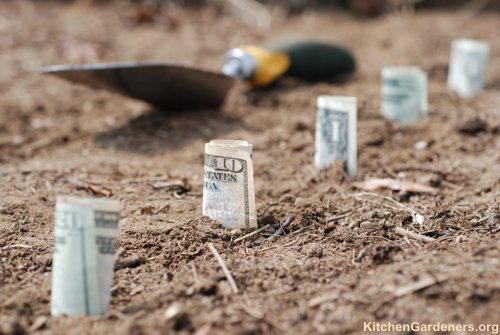
Thrifty Thursday: What is a Home Garden Worth?

garden-worth

This Thrifty Thursday marks the beginning of one of my favorite money saving techniques: GARDENING!  I received this awesome write up from my March 2009 Kitchen Gardeners International newsletter by Roger Doiron. 

KGI is a non-profit that “empower individuals, families, and communities to achieve greater levels of food self-reliance through the promotion of kitchen gardening, home-cooking, and sustainable local food systems.”  I got connected with them when I signed the Eat The View petition asking the Obama’s to plant a victory garden on the White House lawn (and our petition was as success!  The Obama’s are going to plant 55 varieties of organic veggies!  WooHoo!)!

What’s a home garden worth? With the global economy spiraling downward and Mother Nature preparing to reach upward, it’s a good question to ask and a good time to ask it.

There isn’t one right answer, of course, but I’ll give you mine: $2149.15. Last year, my wife Jacqueline suggested to me that we calculate the total value of the produce coming out of our garden over the course of the growing season. Initially, the thought of doing that was about as appealing to me as a recreational root canal. I remember replying something like: “OK, so let me get this right: in addition to raising three busy boys, managing two careers, volunteering in a school garden, and growing most of our own produce, you’re proposing that we weigh every item that comes out of our garden, write it down in a log book, and spend a few leisurely evenings doing math?” Jacqueline, an economics major in college and a native French speaker, answered with a simple “oui” and so the project began.

There was a lot of work involved, mostly for Jacqueline, but as with gardening itself, it was work with a purpose. It didn’t take long for our log book to start filling up with dates and figures. Although we started eating our first garden salads in late April, we only began recording our harvests as of May 10th, starting first with greens and asparagus. Our last weighable harvest was two weeks ago in the form of a final cutting of Belgian endives forced from roots in our basement.

By the time we had finished weighing it all, we had grown 834 pounds and over six months worth of organic food (we’re still eating our own winter squash, onions, garlic, and frozen items like strawberries, green beans, and pesto cubes). Once we had the weights of the 35 main crops we grew, we then calculated what it would have cost us to buy the same items using three different sets of prices: conventional grocery store, farmers’ market and organic grocery store (Whole Foods, in our case). The total value came to $2196.50, $2431.15, and $2548.93 respectively. For the other economics majors and number crunchers among you, you can see our crunchy, raw data here.

There are things we didn’t include like the wild dandelion greens which we reaped but did not sow, the six or so carving pumpkins which we ultimately fed to our compost pile, and the countless snacks of strawberries, beans, peas, and tomatoes that never made it as far as our kitchen scale. There were also things we forgot to weigh like several pounds of grapes which turned into about 12 jars of jam. As with any growing season, there were hits and misses. The heaviest and most valuable crop was our tomatoes (158 lb/72 kg for a total value of $524). In terms of misses, our apple tree decided to take the year off and very few of our onions started from seed made it requiring me to buy some onion plants.

On the cost side, we had $130 for seeds and supplies, $12 for a soil test, and exceptional costs of $100 for some locally-made organic compost we bought for our “This Lawn is Your Lawn” frontyard garden (normally, we meet most of our soil fertility needs through our own composting). I don’t have a scientific calculation for water costs, but we don’t need to water much and, when we do, water is relatively cheap in Maine. Also, I mulch my beds pretty heavily to keep moisture in and weeds down.  Let’s say $40 in water.  So, if we consider that our out-of-pocket costs were $282 and the total value generated was $2431, that means we had a return on investment of 862%. The cost of our labor is not included because we enjoy gardening and the physical work involved. If I am to include my labor costs, I feel I should also include the gym membership fees, country club dues, or doctors’ bills I didn’t have.

If you really want to play around with the data, you can calculate how much a home garden like ours produces on a per acre basis. If you use the $2400 figure and consider that our garden is roughly 1/25th of an acre, it means that home gardens like ours can gross $60,000/acre. You can also calculate it on a square foot basis which in our case works out to be roughly $1.50/ft2. That would mean that a smaller garden of say 400ft2 would produce $600 of produce. Keep in mind that these are averages and that certain crops are more profitable and space efficient than others. A small garden planted primarily with salad greens and trellised tomatoes, for example, is going to produce more economic value per square foot more than one planted with potatoes and squash. We plant a bit of everything because that’s the way we like to garden and eat.

Clearly, this data is just for one family (of five), one yard (.3 acre), one garden (roughly 1600 square feet), and one climate (Maine, zone 5b/6), but it gives you some sense of what’s possible. If you consider that there are about 90 million households in the US that have some sort of yard, factor in the thousands of new community and school gardens we could be planting, this really could add up. Our savings allowed us to do different things including investing in some weatherization work for our house last fall that is making us a greener household in another way. Some might ask what this would mean for farmers to have more people growing their own food. The local farmers I know welcome it because they correctly believe that the more people discover what fresh, real food tastes like, the more they’ll want to taste. In our case, part of our savings helped us to buy better quality, sustainably-raised meat from a local CSA farmer.

The economics of home gardening may not be enough to convince President Obama or UK Prime Minister Gordon Brown to plant new gardens at the White House or 10 Downing Street, but the healthy savings their citizens could be making and then reinvesting in their local economies could.

In the end, it might come down to the language we use. Instead of saying “Honey, I’m going out to the garden to turn the compost pile”, perhaps we should say “Honey, I’m going outside to do a ‘green job’ and work on our ‘organic stimulus package.’”  I bet that would get the attention of a few economists, not mention a few psychologists.

Happy, healthy March
Roger Doiron

PS: Garden writers and bloggers: feel free to republish the text and photo above with a link back to KGI.  Thanks.

I loved the idea of seeing what a home garden is actually worth.  I think Rick and I may track our garden’s value this year!  Our garden is  around 560-600 square feet, not counting the strip along the driveway (maybe another 160-200 sf?).  And we use all that space pretty efficiently, though there’s always room for improvement.  We manage to squeeze more and more in each year, and this year should be no exception. 

If you’re thinking of planting your own garden, but not sure how to do it, there are some good websites with free garden planning out there.  Check out BHG.com and almanac.com, two of my favorites. 

Can’t wait to get into the “dirt” of gardening in this month’s Thrifty Thursdays!

See what ideas are growing with Tracy, Crystal & Katie Jean this week too!

Categories: Garden, Thrift | 4 Comments

Thrifty Thursday: Green Cleaners/Kitchen Staples Part 2

Cleaning toolsThis week’s Thrifty Thursday tip is focused on another kitchen staple:  Baking Soda.

I can clean almost everything in my home with baking soda, vinegar or lemon juice.  Baking soda is a great thing to add to laundry, clean the oven or scrub the sink with.  Here are a few of the many uses:

In laundry:

  • Use to clean and deorderize laundry.  I use about 1/4 to 1/2 cup in the washing machine to give my detergent a boost, or to get the stink out of my cloth diapers.   I’ve also washed lightly soiled clothes with just baking soda when I’ve run out of detergent.
  • For really stinky stuff, use it as a presoak.  Usually I do this in hot water with 1/2 cup or more, depending on the load size.
  • Apply a paste of equal amounts baking soda & water to stains to help break down grease. 
  • Use in the rinse cycle as a fabric softener.

Other cleaning tasks:

  • Deodorizing the refrigerator and freezer.
  • Cleaning the stove top, range or oven:  make a paste of 3 parts warm water to one part baking soda.  It will not scratch surfaces.  Other places to use it: counter tops, sinks, inside the refrigerator…. the list goes on.
  • Mix it with a mild dish washing liquid (like Ivory) until you have a thick paste to make a good bathroom cleaner. 

My laundry cupboardBaking soda can be bought in bulk at a store like Costco or Sam’s.  It’s so inexpensive!  Just don’t use it to with vinegar at the same time or they will cancel each other out.  The exception to this is to clean your kitchen sink drain:  put baking soda down the drain, followed by some white vinegar.  Quickly plug the sink and let sit.  This is like the volcano you made in grade school science class.  🙂  It will help remove any built up gunk in there. 

Another handy kitchen staple to have on hand is that mild dish washing liquid.  It can be used in a variety of ways as well, and combined with other things to make effective cleaners.  Eliminating the need for all the chemicals.  🙂

A great book on how to clean anything and every thing in your home is Martha Stewart’s Homekeeping Handbook.  She has lots of green and mild alternatives and always recommends starting witht the mildest before moving on to the harsher methods of cleaning.

What are some of your favorite ways to clean green?  Do you love a specific brand or tool?  Is there a kitchen staple that you use to clean with?

Categories: Recommended Reading, Thrift | 2 Comments

Thrifty Thursday: Green Cleaners/Kitchen Staples

A lot of people think that your home is not truly clean unless you can smell the Lysol (or what have you).  Unfortunately, those pine-fresh fumes are harmful not just to you, your family and your pets, but to the environment as well.  Fortunately there are a lot more “green” alternatives on the market now a-days.  And they are more effective now then they have been in the past.  But I wanted to talk about some great, safe, effective cleaners you probably already have in your home. 

Cleaning with kitchen staples is not only affordable and green, it is very effective.  And it keeps your home from smelling like a hospital or hotel (or a mop bucket).  Lemon juice and distilled white vinegar are two very effective, totally safe alternatives to bleach (and dozens of other cleaners). 

I mix equal parts white vinegar and water to clean glass and mirrors.  I use it in the rinse cycle of my washing machine (it cuts grease, whitens fabric and softens water, making it rinse cleaner).  It cleans floors and eliminates soap scum. 

Lemon juice removes stains and whitens fabric as well.  It disinfects counter tops and removes odors, and can even remove mineral deposits on your faucets or the stains in your coffee pot.

Here are a few recipes for general house hold use:

  • For glass & mirror cleaner, mix equal parts distilled white vinegar and water in a spray bottle.  Clean with a lint free (or microfiber) cloth.  This solution can also be used to clean wood floors finished with polyurethane (not water-based finishes) and, of course, tile. 
  • To remove soap scum, use that same sprayer bottle and simply spray on and wipe off.  It may be helpful to leave the vinegar solution to set for a few minutes and/or use a plastic brislte brush to remove stubborn spots. 
  • I also use this mixture to clean my counter tops in the kitchen.  Even after cooking chicken.
  • For mineral deposits, apply a paper towel soaked in either white vinegar or lemon juice to the area and let sit for at least an hour.  Wipe away residue. 
  • Run a pot of clear water mixed with either lemon juice or white vinegar through your coffee pot.  Rinse well, and run with just water (so your next pot of coffee doesn’t have a vinegar/lemon taste).
  • To disinfect used toys (or, say if your son poops in the tub and then you have to clean all his bath toys), mix 1/4 – 1/2 cup white vinegar with hot water in the tub (enough water to cover the toys).  Let soak, and the scrub with a cloth or a brush.  Rinse and let dry. 

For laundry:

  • To whiten with lemon on the stove top, fill a pot with water and a few slices of fresh lemon.  Bring to a boil.  Turn off heat, add linens, and let soak for up to an hour.  Launder as usual.  This is great for socks and “pit-stained” white shirts.  As well as for linens, white napkins, etc. 
  • For tough stains on whites (I used this to whiten my Fuzzi Bunz inserts before I sold them), apply lemon juice to the stain and let sit for a few minutes before washing.
  • Add 1/8 to 1/2 cup of white vinegar to the first rinse cycle.  You will be surprised at it’s whitening power.  Note:  Do NOT use this with bleach!
  • For extra brightening, dry your whites out in the sunlight to take advantage of nature’s own bleaching agent.  Also this conserves energy and is free!

When you look at all the different cleaning products these two kitchen staples replace, you really are saving a lot of money.  Window/glass cleaner, tub & tile cleaner, counter top cleaner, bleach, stain remover, tile floor cleaner, wood floor cleaner….  the list goes on.  Once you start using these safe alternatives, you will find more and more uses for them. 

Next week, the many many uses of baking soda.  As the saying goes, everything old is new again.  Our great grandmothers cleaned this way.  🙂

Read what Tracy, Katie Jean, Crystal & Genny are blogging about today.

Categories: Thrift, Urban Homesteading | 3 Comments

The Red Heads

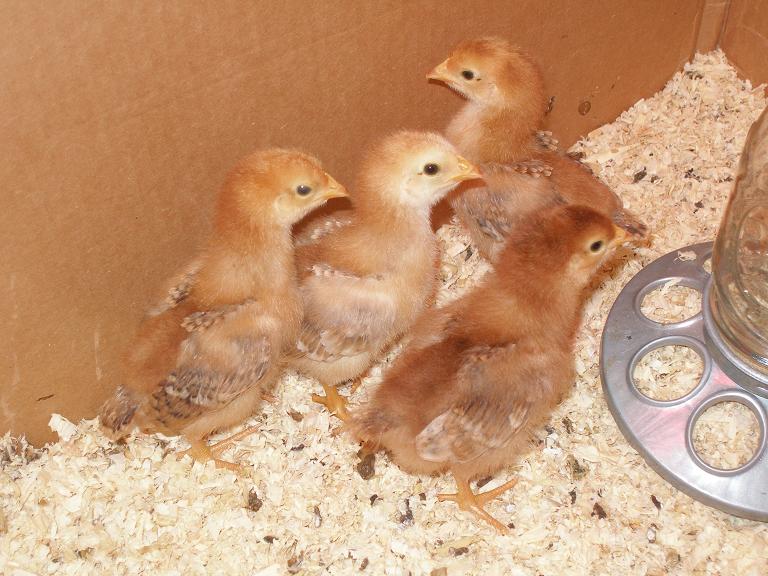
I wanted to share a picture of the chicks again… they are getting big fast!  Only one week old with wing and tail feathers!  I put them in the box we brought them home in (to clean the big box) and they barely fit!  Holy Schmokes! Check out our little red heads (and compare to last weeks post!):

one-week-old

Categories: Chickens | 3 Comments

Thrifty Thursday: “Optional” Coverage & Microfiber Miracle

Pic from Google Image searchThis Thursday tip is actually a double, since last week’s post was “donated” to the Romp.  So first up is the last of my Bills & Budgets tips: “Optional” Car Insurance Coverage.

If you live in Colorado, back in November or December you might have received a letter from your insurance company regarding the new car insurance law requiring a minimum of $5000 in medical payments coverage (MPC).  The way the law was written, this coverage was automatically added to all insurance policies on January 1, 2009 unless you signed and returned a rejection form to prevent this coverage from being added to your policy.  What does it cover?  Do you need it? 

The MPC covers medical bills in case of an accident regardless of who is at fault.  It’s relatively inexpensive (talk to your insurance agent), but you you might have the same coverage in your health insurance policy.  This means you should weigh carefully whether to accept or reject this coverage.  It takes some investigating if you don’t have your policy paperwork handy, but once you review your health insurance policy and what the MPC covers, you might find you don’t need the new MPC after all. 

Keep in mind that this was added automatically to your policy unless you rejected it in writing (and why I put “optional” in quotation marks).  If you didn’t do it before, you might want to check and see if you really need it or not.  If you are adequately insured through your healthcare company (lol), you could save yourself some dough on your car insurance. 

On the other hand, if you don’t have health insurance, this could be a relatively inexpensive way of insuring the health/safety of yourself and those in your car.  It even covers pedestrians and bicyclists if they are hit by a car.  A little food for thought, I guess.

My microfiber cloths and my swifferSecond for this Thrifty Thursday is the Microfiber Miracle!  This is not the first TT tip I’ve written involving microfiber, but it is one of my favorite cleaning tools. 

Microfiber is great.  It’s super absorbent (it’s in my kids’ diapers for goodness sake), reusable, machine washable, and leaves windows & mirrors streak free (see my TT post in December).  But my favorite use for it is cleaning my floors. 

I swiffer with it.  I have several microfiber cloths and a couple are just the right size to fit on my Swiffer. Our house has all hard surface flooring.  Wood in the living/dining room and bedrooms, and tile in the kitchen and bath.  I didn’t own a Swiffer for a long time because it seemed like a big waste to me.  I mean, I loved the concept of picking up dust and hair on my hard floors (which is very important in a house with a 60 pound lab/velociraptor mix), but the cloths were so expensive! 

Then one day I realized microfiber does an excellent job of collecting hair and dust.  And I can wash it and reuse it! 

A 16 count box of dry Swiffer cloths at CVS Pharmacy is $5.39.  On Amazon.com, you can get three boxes of them (32 count each) for $22.49 plus $5.90 shipping.  That’s 30-34 cents a cloth.  All one time use.  The wet cloths are $8.79 for 24 at CVS and $22.49 + 5.90 for shipping at Amazon for three 24 packs.  That’s 37-39 cents for each one time use cloth. 

And who knows how many cloths I’d need to cover all the floor space in my house?? 

The bright green cloths I use were a gift and came from The Pampered Chef.  I don’t think they have this set anymore, but they sell a cranberry colored cloth for $8.50 plus tax and shipping.  On Amazon, there is a set of two cloths that would fit perfectly on the head of a Swiffer for only $5.99 plus $5.14 for shipping, and they look pretty similar to the smaller of the two green cloths I have (even the same color!).  Amazon says these cloths can be washed and reused up to 300 times each. 

So that price break down is: $5.99+$5.14=$11.13, $11.13/600 (since there are two cloths)=  $0.019  –LESS than two cents per use!  AND, I shake my cloth out after I do one room and then put it back on and move to the next room.  So one cloth can do my whole house (sometimes more than once) before I need to wash it.  And if I want them wet, well, that’s easy to make happen with little to no cost.  Plus, you can probably find similar cloths at a local store and save yourself the shipping, making it even more thrifty. 

This doesn’t even take into account the fact that you are not throwing hundreds of one time use Swiffer cloths needlessly into the landfill.  So, using microfiber instead, you are making a “green” choice when you clean your floors!

There are probably thousands of uses for the microfiber miracle.  I just wanted to share my favorite!  For the majority of March, I wanted to give a few Green Cleaning tips since I think we can all feel spring coming on!

See what Tracy, Katie Jean and Genny are saving on this week.

Categories: Thrift | 2 Comments

New Kids in the Flock

There’s a new chick band around the Schell homestead.  They go by the names of Rose, Blossom, Petal and Petunia.  Debuting Sunday, we got these day-old beauties to add to the Schell flock and more than double our egg laying potential. 


baby-chicks

4-chicks


The Fab Four are all Rhode Island Reds (good egg layers!) and they will get to enjoy the warmth of our office and keep me company in here while I blog for the next 12-16 weeks.  Then the little chickadees will join their older counter parts, Mayzie, Lavender and Poppy in the backyard.

Rock on!

Categories: Chickens, Urban Homesteading | 4 Comments

Create a free website or blog at WordPress.com.