When chicken food gets wet it disintegrates. H dumped the chicken water into the chicken food, making sort of a “mash” in the bottom of their round food pan. When I asked what he was doing, he said, “They’re having cake today.”
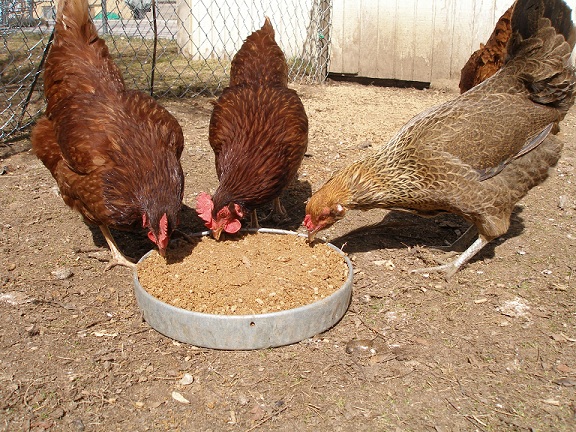

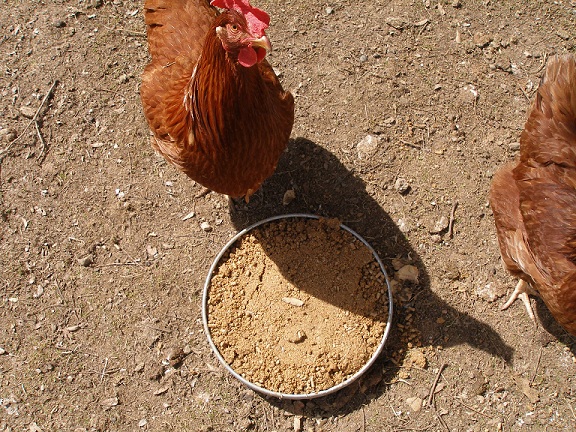
When chicken food gets wet it disintegrates. H dumped the chicken water into the chicken food, making sort of a “mash” in the bottom of their round food pan. When I asked what he was doing, he said, “They’re having cake today.”
Ok – the Spring Cleaning has officially begun around here. It started out slow: an hour in the garden last week, a little extra sweeping. But it’s on the upswing now. Sunday, after Rick installed the new washer, I spent a good chunk of the afternoon hand scrubbing the kitchen/laundry floor and baseboard. I washed the lower cabinet doors and washed all the rugs. I’ve been chipping away at the office piles and did load after load of laundry for twos days straight.
Over the last three or so years I use these checklists from Woman’s Day magazine to get me through my Spring Cleaning. I also use a checklist from the Martha Stewart Homekeeping Handbook which now lives on a shelf above my laundry area (since I was most often referring to the laundry section in the book).
Yesterday would have been a perfect day to wash the windows – nice and cloudy, but I really like to do this chore on a weekend when Rick is home. The inside windows are no problem, but it’s the outside of the windows that I need someone else to keep an eye on the kiddos for. I actually like doing this chore. It’s kind of methodical and I love the way the house seems to sparkle when it’s done.
Today we are going to the garden center! The To-Do list for this weekend seems to be getting longer and longer. Garden chores, yard chores, and cleaning chores keep getting added to the list.
What about you, have you started your spring cleaning? Do you have a routine? What do you do?
Plant something – so nothing yet. 😦 BUT that will not be the case next week!
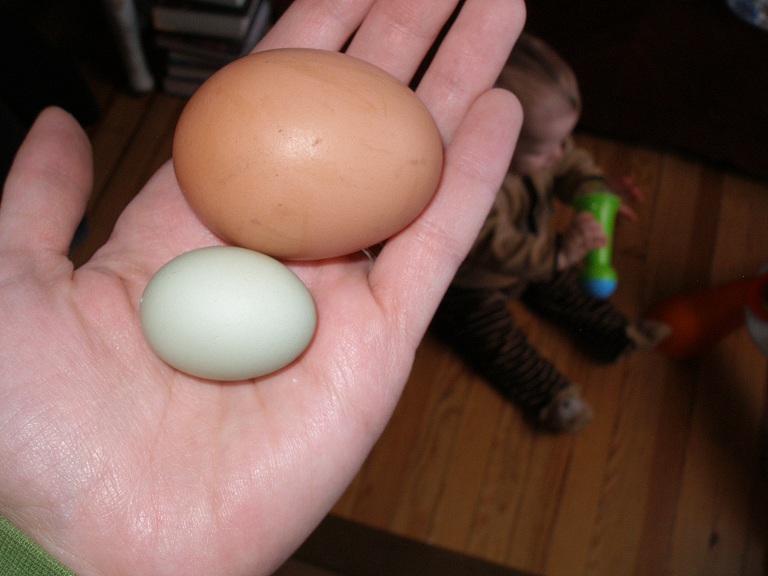 Harvest something – eggs: Mayzie laid a tiny egg this week. She hadn’t laid all winter, so we’re grateful for something at least, no matter how small…
Thankfully, we got a couple full size ones from her later in the week.
Preserve something – froze half a batch of the soup below for later.
Waste Not – compost and recycling. We are also now reducing the energy we use to wash and dry our clothes… see below!!! We’ve been brainstorming ways to store all those empty jars (since we’ve been eating our preserves, beets, pickles, jellies, etc.).
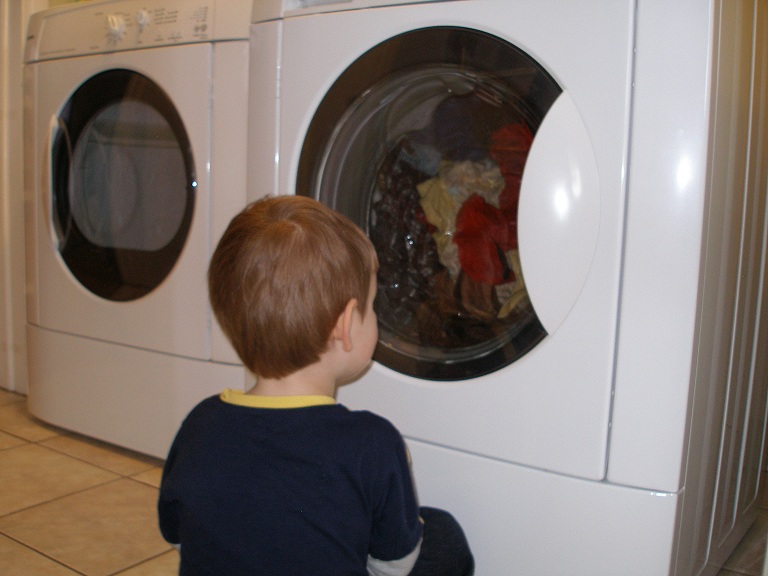
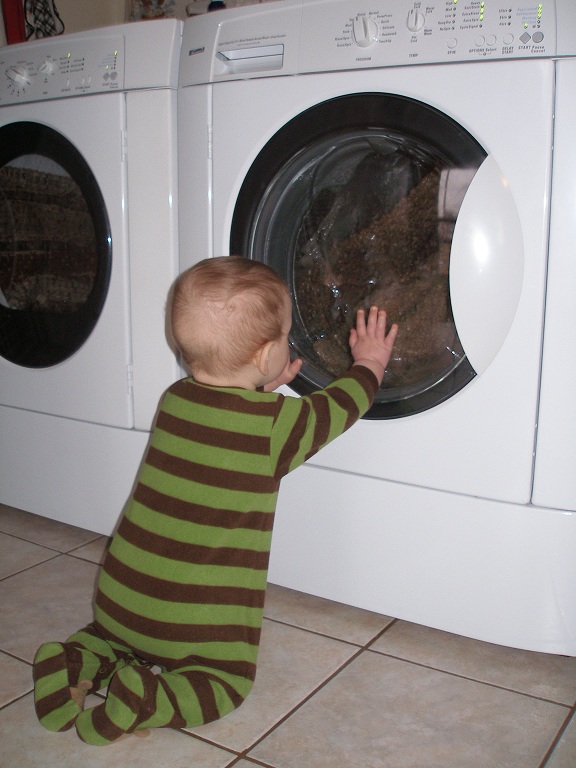
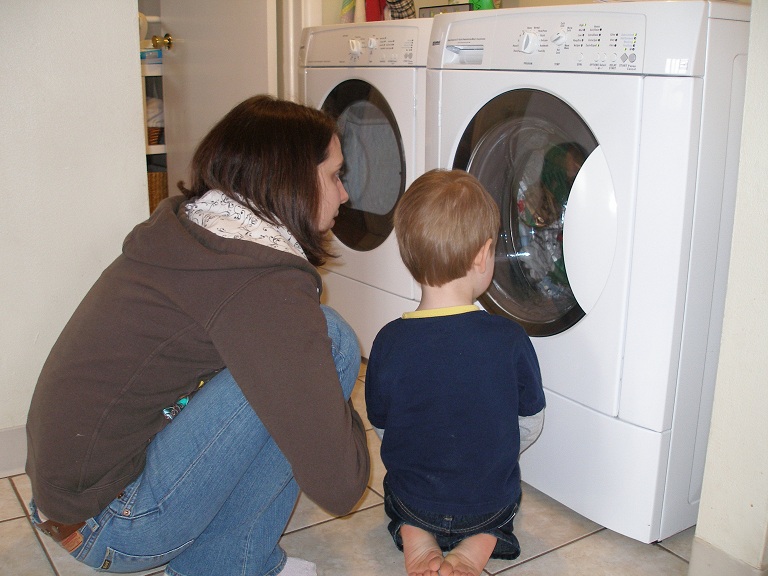
Want Not – OK, get ready, this is HUGE! Our neighbor (the amazing Mr. Mitchell) GAVE us a practically new front loading, energy-efficient washer and dryer! His friend had to move quickly, and sold the washer and dryer to our neighbor for $200. So we are going to pay our neighbor the $200. But these machines are less than two years old, and the same models are still sold at Sears for over $650 each. So to me, $200 for over $1300 worth of appliances is the same as giving it away. (!!SQUEAL!!!) – Yes, that’s right, I’m squealing like a little girl over a washer and dryer. (Bonus – crossing item #36 off of my 101 in 1001 list!)
Got the garden plan drawn up and ready. Forgot to mention last week that I borrowed my friend Jen’s copy of Carrots Love Tomatoes, and read through it pretty quick. Great little book – very handy and quick to read.
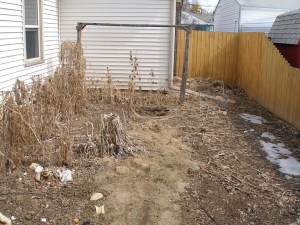
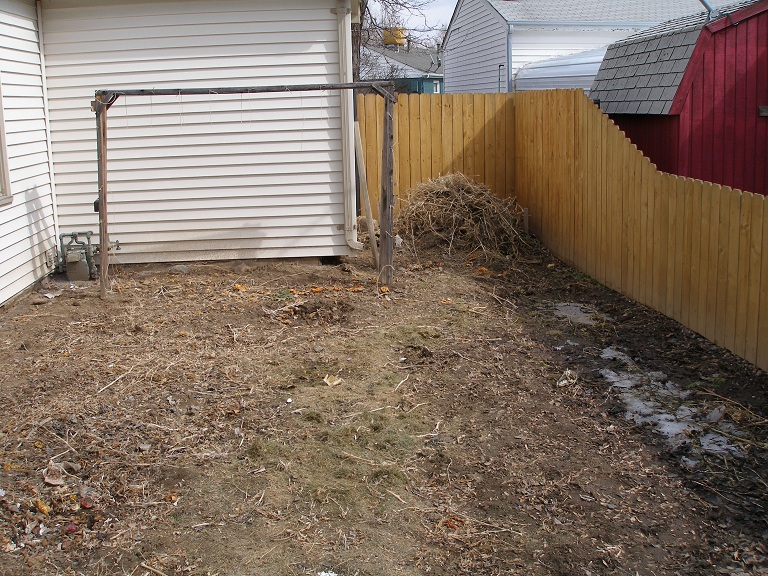
Henry and I spent some time cleaning up the garden on Wednesday… moved out the drip system (that was left out all winter – oops!), put the limp remains of plants we did not pull out in the winter into the compost pile. Basically, we got it ready to be roto-tilled. None of the above is planting, but we are preparing and I didn’t know what other category to put it in. 🙂
Build Community Food Systems – Total revamp of the CSA blog this week. Been working with a few other farm members to make it great. Check out the new digs: http://monroeorganicfarms.wordpress.com. Took green chili to a party to share.
Eat the Food – venison, bacon, butternut squash, beans and asparagus, a big pot of green chili using pork and chiles from the freezer. We’re trying to use up all the frozen asparagus before the new crop is in at the farm! Yum Yum – I can’t wait to go harvest the good stuff this year! Usually we use a soup recipe that is mainly asparagus and shallots, but this week I had some extra bacon lying around, and no shallots. This is what I came up with, and we really liked the smoky flavor the toasted garlic and the bacon gave the soup.
Toasted Garlic and Asparagus Soup
4 slices bacon, chopped into 1/2 inch pieces
1 small onion, chopped
1 head of garlic, chopped
1/2 tsp red pepper flakes
1 tsp dried thyme
3 Tbs flour
3 lbs asparagus, cut into 2-3″ long pieces
2 cups chicken broth
4 cups water
1 1/2-2 tsp salt or to taste
1/3 cup heavy cream
In a 4 quart pot, cook bacon over medium-high heat until crispy. Remove some of the bacon pieces and reserve to garnish the finished soup. To the remaining bacon, add the chopped onion. Saute until the onion softens, about 3 minutes. Add the garlic, thyme and red pepper flakes. Continue to cook until the garlic begins to toast, but do not let it burn. Stir in the flour.
Add the asparagus, chicken broth and water. Stir and season with salt to taste. Bring to a boil, then reduce the heat and simmer for 4-6 minutes, until the asparagus turns bright green. Remove from heat. Using an immersion blender (or working in batches using a regular blender), blend soup until smooth. Stir in cream just before serving, and garnish with reserves bacon pieces.
So – the first week has passed and I am excited that we have a few things accomplished, though not many.
Plant something – nothing yet, but we are getting a plan together.
Harvest something – eggs – we’ve been lucky that our hens have laid through most of the winter with no heat lamp or anything.
Preserve something – nothing – would have done the tamales, but they were too good and had to be eaten straight away!
Waste Not – compost and recycling. We had to find a new place to take the recycling, since the local place moved away.
Want Not – Rick started cleaning up in the yard a bit this weekend. A bit more of this to do until the garden is ready to plant.
Build Community Food Systems – Made a big batch of tamales with my friend Jen last Sunday. I brought home about 25. We were going to freeze them, but they were SOOOOOO tasty. So we kept them in the fridge for quick lunches. That’s good too though, since I often skip lunch if there’s nothing easy to eat.
Also, joined the Advisory Group for the CSA. I’ll be working on the web communications with a few other members.
Eat the Food – We’ve enjoyed the pickled beets, canned and frozen peaches, elk sausage, bacon, basil pesto, and pablanos from the freezer this week. Here’s the recipe for the delish tamales (from epicurious.com): Grilled Tamales with Pablanos and Fresh Corn – Yum Yum! Oh – and Jen rendered the lard for us! She went to buy lard, and the butcher at the store did not have enough, so he gave her some pork fat and we rendered it ourselves. Easy and interesting. No – we did not eat the chicharróns however. 😉
 So, March 1st (TODAY) marks the beginning of a new year for the Independence Day Challenge. It has not been a full year for me, since I started in 2009, but since Sharon Astyk, the leader of this challenge, is starting her year a little early, I am too. I like to follow along, and her record keeping encourages me with mine.
So what is the Challenge? Well, in Sharon’s own words,
“…most of us would like to grow a garden with our kids, or make sure that we know where our food comes from. We’d like to live in communities with a greater measure of food security, we’d like to know more about what we’re eating. We’d like to have more contact with nature, we’d like to be more self-sufficient. We’d like to have better food at lower cost, we’d like to have a reserve for an emergency or to share. We’d like to do more in our community and to eat with one another. We’d like to sit down to a home cooked meal more often.
We want these things but we don’t know how to get them, in large part because when we think about growing a garden or preserving food, or working in our community, we imagine we must allot large chunks of our time. We imagine it is impossible – because we know we can’t pull hours every day out of our frantic schedules.
But what if we didn’t have to? That’s what the Independence Days Challenge encourages all of us – busy working families and farmers, city dwellers and suburbanites and country folk – to remember. That is, it isn’t all or nothing, we don’t have to wait until we have a whole afternoon free or are on vacation. What if we could do it gradually, just a little bit every day or week – what if we only had to plant our few seeds today, and tomorrow, pull a couple of weeds and harvest two salads, and the next day make three jars of jam?
What’s amazing about this is how fast it adds up – a few minutes here and there turn into a much greater degree of self-sufficiency.”
Sharon has written a book, Independence Days: A Guide to Sustainable Food Storage and Preservation, and I think her work with her family is quite inspiring. She says,
“That’s why I think food preservation and storage matter so much. Ultimately, we are talking not only about the fairly manageable question of what to have for dinner, but also about about transforming our society, our use of energy, our food culture, and, of course our culture as a whole.”
The challenge works like this: Every week commit to writing down what you’ve accomplished in seven categories (listed below). The only rule is don’t list what you didn’t do. Because it is so easy to get blinded by what we haven’t done, that we don’t see our accomplishments. This is about your successes.
The seven categories are (and I mostly quoting Sharon’s descriptions here):
1. Plant something – In Sharon’s words, “it should be a reminder that gardening isn’t “put in the garden on memorial day and that’s it” – most of us can grow over a longer season than we do, and enjoy fresh foods grown through spring, summer and fall, and even into or through winter in many places. Even if you live in an apartment, you can sprout seeds. So keep on planting!”
2. Harvest something – “as soon as you pick the first dandelion from your yard, it counts if you ate it or preserved it. Don’t forget to include food you forage – whether from wild marginal areas, or even just from the neighbor’s trees that he never harvests (ask, obviously).”
3. Preserve something – Canning, dehydrating, natural cool storage, and for me, freezing (though Sharon’s not big on freezing). “It doesn’t have to be overwhelming – and it is a way to preserve what is plentiful, inexpensive, delicious and healthy for a time when there is less of it.”
4. Waste Not– “Once you’ve got food, whether purchased or home preserved, you have to keep an eye on it – we waste nearly half of all food, much of it in our homes. In this category goes making sure you use what you buy or grow, cutting down on garbage production by minimizing packaging and purchasing, composting, reducing community waste by composting or feeding scraps to your animals, and taking care of your food storage – everything from keeping records and writing dates on jars to checking the apples and making sauce when they start getting soft. BTW, reduce waste also refers to money and energy – stretching out your trips to the store and not “spending” gas on your food, cutting your grocery budget and reducing cooking energy. These are things that are good for the planet and good for all of us.” – Couldn’t have said it better.
5. Want Not – The stuff you’ve done that isn’t growing/storing/preserving food goes into this category. “That means the food you buy for storage, the things you build, scavenge, rescue and repair that get you further down the path. Did you get a good deal at goodwill? Scavenge some cinder blocks for your raised bed building project? Share with a neighbor? Find a grain mill on Craigslist? Buy some more rice and put it away? Inventory the medicine cabinet? Pick up a new book that will be helpful?” This category is about preparing and helping yourself.
6. Build Community Food Systems – “Great, we’re all doing this stuff at home. But what did you do to help spread the message, because that may even be more important.” Things like donating to a food pantry, teaching neighbor kids how to make yogurt, talking about your food storage plans, bringing a casserole to a new neighbor. As Sharon says, “The first line of security for all of us is each other – we are all enriched by a more food-secure community.”
7. Eat the Food – “Ultimately, eaters have more power over our agricultural future than they know – farmers can’t necessarily lead the way – they have to sell what eaters want. So cooking and eating are the way we will change the food system. This is where you tell us about the new recipes you tried, or the old ones you adapted to new ingredients, about how you are actually eating what you store and store what you eat, or getting your kids to try the kale.”
So here’s to 2010 – wish me luck, and join along if you like!
Here’s a quickie this week. I know I’ve mentioned FreeCycle.org and Craigslist before, plenty of times. But here are a couple more swapping sites to add to your thrifty lists:
and
Trade a Favor is a Facebook application. Just add it to your Facebook page, list what favors you are willing to trade for (services, skills, items, etc.) and find a match. This is a high-tech version of bartering people!
Swap Thing is very similar. Sign up is free through the site, and you can trade your things for someone elses things (or services), and you can use cash to offset the differences if your services is more or less valuable than theirs.

Just thought I’d share! Happy Valentine’s Day!

From gardens, bees and backyard chickens in the heart of Denver to starting from scratch in San Antonio. Our family of five is striving to find the simple life - the easy way.





 The Lazy Homesteader