Urban Homesteading

So You Want to be a Farmer

hoeing the fields closeupOf course it’s no secret that I want to be a farmer.  Rick and I joke about it almost daily, and, very un-jokingly, we work hard putting up produce from the CSA, growing our own in the garden, raising the chickens and generally learning all we can about living on the land.

Getting chickens was a baby step.  We started with four and moved up to seven.  They eat a lot.  And they poop a lot.  And for the first year, we didn’t get a lot of eggs, but spent a lot of money on building them a coop.  Now we know more, and we’re getting lots of eggs, and though they’re messy and dig holes, we are glad to have them, and thinking of better ways to do things with them.

Part of the reason why we decided to be working members on Monroe’s farm, was so that I could get a taste of what went into this pipe dream.  Every week last year, Rick sent me off to Kersey with the admonition to pay close attention to what Jerry said, and to ask him about ______.  He wanted me to pick Jerry’s brain weekly.  Did he grow Brussels sprouts?  When did he plant potatoes?  How do you know corn is ready to harvest?

A week or so ago, a working member friend, Tracy, posted an article about taking A Farm Vacation on her Facebook page.  At the moment I first saw it, I was tired from processing food and working, and thought, “Vacation!  What?  Farming’s hard work!”  And it is.  But after the trip to Palisade last weekend, I’ve changed my mind.  I want to take this vacation myself.

Palisade was so beautiful.  The Western slope of Colorado is sunny and warm and the towns charming.  Rick and I saw an orchard for sale and picked up a flyer.  Ah – we could live here, and we could grow this.  If only we had more [money, and] time to sit here and pick Buck’s (the owner of the orchard where we harvested peaches) brain on how to do it all.  If only we could stay here and give it a try for a while before investing in property.

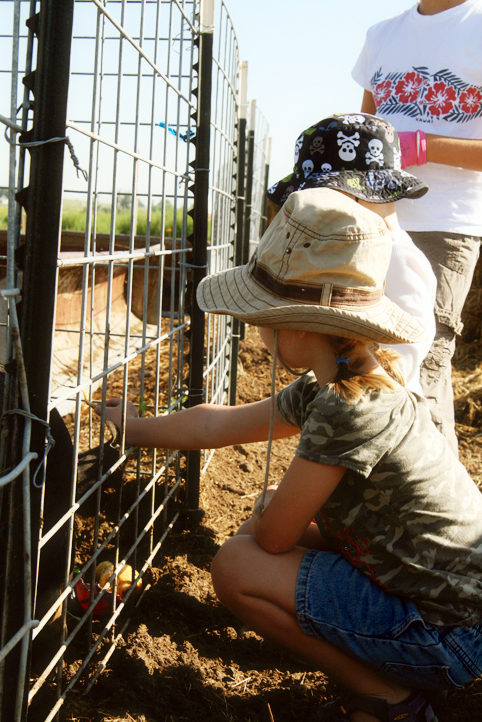
Monroe piggies by Rachel Carlson PhotographyI really love having H (and now E too) out there on the CSA farm every week.  While his biggest thrill is playing with the other kids, catching toads and feeding the pigs, I have the opportunity to remind him that those pigs will become pork chops, and those toads eat the bugs that destroy crops.  He gets excited when we move from the barn to the fields, and he plays behind us in the rows, eating melons, catching “buggies” and pulling weeds.  He is gaining an understanding of where food comes from.  And this means so much to me.

A few months ago, I read a blog post called This Place We Know by Sharon Astyk.  Sharon is a beautiful writer, and the post is quite long, but it really captures something. I want my children to understand where their food comes from and what happens on a farm.  That a farm is more then a cutesy place where cows say moo and pigs say oink.

And I know, now days, I’m not the only one who feels this way.  Here are a couple of articles that have appeared recently on people dreaming of the simple life: one from Utne Reader: The Organic Farm Fantasy Meets Reality and on Mother Earth News: Skills for Farming.

I envision my boys growing up in an agrarian life style.  Being connected to the earth and to our food connects us with God.  The Maker made this and made us.  The grocery store has broken the connection for most of us.

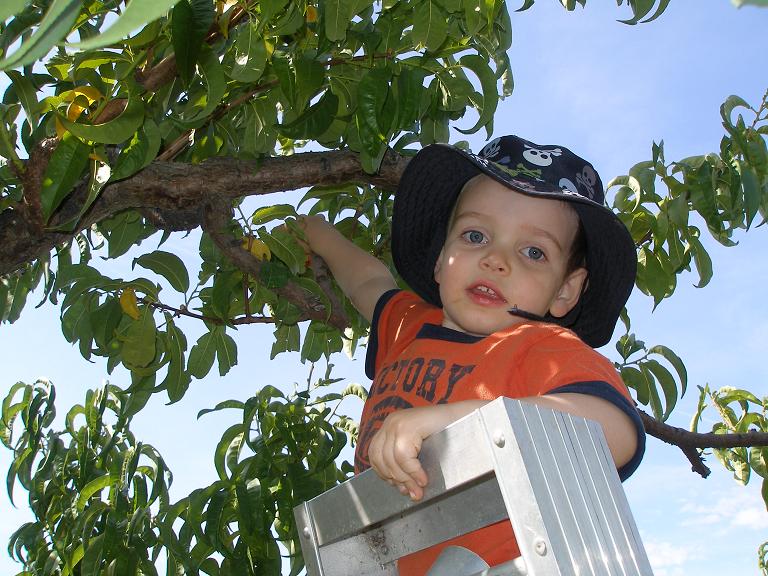
Seeing my boy pick a peach or nectarine and delighting in that sweet first bite before he’s even taken a step away from the tree is amazing.  There’s no lesson about fruit coming from tree needed when he picks it himself.

In our home, we don’t have many conversations about limiting candy.  You’re more likely to hear, “No, you’ve had enough carrots,” or “Ok, but this is the last tomato before dinner.”  And these statements don’t make me sad.  Last night as Rick prepped green beans for going into the freezer, we worried about Henry eating so many beans that he’d spoil his dinner cooking in the oven.  And he did!  This is a good problem to have, we’ve decided. For Henry, going to the garden to pick (and graze) tomatoes brings joy.  The fruit of  spring’s labor is wonderful.

Henry in the orchard 2When he sees us tilling the garden, he knows it’s to get it ready for the plants.  When he plants a seed, and then gets to see it grow into a plant and then the plant grows a flower, and the flower grows a zucchini, he gets it.  There’s not a lot of explaining to do.  And compost is an opportunity to show him how we give back to the ground to keep the circle going.  The eggs are a reason to be kind to the chickens.  Sharing scraps with pigs makes the pigs happy and helps them get ready to be a delicious meal in the fall.  Happy animals make better food.  Happy chickens lay tastier eggs.

It’s funny to think that just a few years ago, I had never gardened before.  Rick was the one who wanted a place for a garden when we bought our home.  He had grown up with it.  I think he may have thought twice about that first garden if he had know what it would spiral into.  🙂

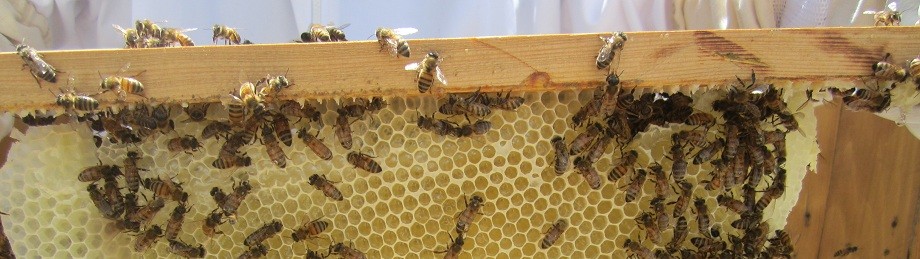
I’ve always wanted to be in the country, to be on land.  I grew up doing 4-H, wishing I had a horse.  I even made Rick promise that I could have a horse after we got married.  But I had never thought about farming or growing things until that first garden.  Now I’ve gotten carried away.  I want my own beehive, my own milking cow.  Steers for beef, chickens and ducks for meat and eggs, a turkey to raise for Thanksgiving.  And fields full of veggies and fruit, melons and squash.  Fruit trees.  Grain. I want it all!

I don’t think Rick was prepared for the fallout of that first little veggie patch.  Certainly not for the chickens.  Sharon Astyk wrote another post to this effect.  Rick and I could relate to her guide, “So You (Don’t Particularly) Want to be a Farmer” on more than one account.  It’s a guide for the spouse/partner/family member of a person who has been bit (hard) by the farming bug.  The post had us both laughing out loud, for it was so very true.  Despite planting the seed with that first little garden patch, Rick got dragged into this wanna-be farming thing against his better judgement.

For example, the chicken thing was all my idea.  I used phrases like “think of all the money we’ll save on eggs!” to convince him.  Our very first egg from our very first chicken had to be (ever so gently) pried from the vent of that hen… she was egg bound.  And who did it?  Not me… HIM!  I was afraid of hurting her.  He saved the day.  And I’m sure he resentfully thought me a madwoman!

But most especially one line at the end of Sharon’s post hit home for Rick and I and this crazy pipe-dream of owning a farm together:

Sweet FruitSometimes there’s nothing more to dream of than being yoked together in the same harness, on the same land and doing the same good work for all the days of your life.”

Rick and I continue to be members of the CSA because we are still learning things, and because we have become addicted to the beautiful food that comes from Jerry’s land.  We still ask questions, pick brains, read book after book.

We’ve so much to learn, although I feel we’ve also learned so much.  Winter squash is harvested after the vines fall,  melons are sweeter if you limit their water.  This is how you store potatoes and canning isn’t quite as hard if you’re doing it with a friend.

But the best thing we’ve learned from growing things together: Seeds sown in love produce sweeter fruit.


Excerpts cross posted at BlogHer.com and monroefarms.blogspot.com
Categories: Chickens, CSA, Food, Garden, Recommended Reading, Urban Homesteading | 6 Comments

Wordless Wednesday: Peach Picking

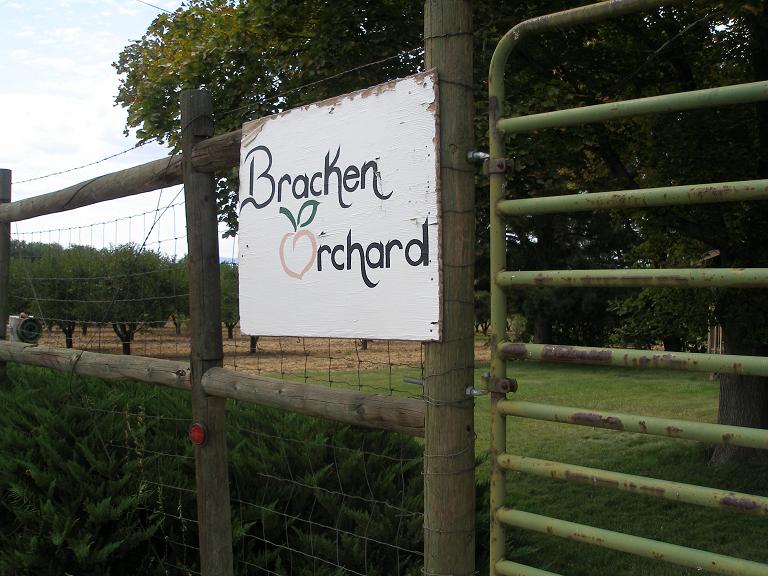
Bracken Orchard  U Pick

H Ladder 1 


Categories: Food | 2 Comments

Community and Independence Days – Week 16

PreservesSo this week was very productive as well.  My friend, Julie, came over and I showed her how to can (with my limited experience this year).  We made a batch of pickled beets (which smelled amazing!) and a batch of cucumber dills, all in two and a half hours while our kids played.  Oh – and we made lunch and all sat down together to eat it as well.  We were both amazed at how much we got done when doing it together, and how we weren’t even exhausted!  Wow!  I wish we had a community! 

Heirloom Romas, the mail & Health Kick hybrids under neath a Black Krim, two Cherokee Purples and three Lemon BoysWe talked about how long ago, women didn’t have the option to send kiddos off to preschool or day care – but they didn’t need that option… they had friends and family close by to help them.  And getting those chores done was fun and easy (or at least easier) with someone else there.  And the kids were entertained and had extra eyes and hands to watch them.  *sigh*  I want community!  Hippie commune, here I come!  😉  Ok, maybe not, but it wouldn’t be all bad.

So this week’s accomplishments:

Plant Something –  none

Harvest Something–  picked 180+ pounds of peaches on Saturday with our friends, plus a box of tomatoes.

Preserve Something –  It’s the ‘P’ week.  Monday I made pickles, pepper jelly pesto and pickled peppers, and Sunday we of course processed peaches… froze most, but plan to can/jam more this week.  Also froze those Roma tomatoes… I wanted to make a sauce and/or can them, but they were ready on Friday, and I didn’t have time before we left for Palisade.  So they were simply frozen instead. 

Waste Not – nothing to add this week.

Want Not/Prep & Storage – made some gifts for Christmas time

Build Community Food Systems – Signed up for a composting class in September, made pickled beets with my friend Julie,  bartered a melon for some jalapenos.

Eat the Food – Fire & Ice Salsa!Fire & Ice Salsa

3 cups chopped watermelon
1/2 cup chopped green bell pepper
2 tablespoons lime juice (about 1 lime)
1 tablespoons chopped fresh cilantro
1 tablespoon chopped green onion
1-2 tablespoons chopped jalapeno pepper
1/2 teaspoon garlic salt

After chopping, drain excess juice from watermelon in a colander.  Combine melon in a large bowl with green pepper, lime juice, cilantro, green onion, jalapeno and garlic salt; mix well.  Refridgerate 3 hours. Serve with corn or potato chips, or, like Rick, add it with shredded roasted chicken, avacado, and extra onions to warmed corn tortillas for Fire & Ice Chicken Tacos!  Thanks Mom, for the recipe!

Categories: Canning and Food Preservation, Community, Food, Independence Days, Recipes | 4 Comments

Independence Days – Week 15

Freezer 8-22Wow – I can’t believe I’ve been documenting this stuff for 15 weeks already!  This week was particularly productive.  The picture is of our freezer as it’s slowly filling.  I can’t wait to show you what we have next week… we should have pickles, pesto, potatoes, peaches, peppers and more to show you.  But this week….

Plant Something –  none.

Harvest Something– zucchini, yellow tomatoes, Sun Gold cherry tomatoes, Sweet 100’s, carrots, eggs, Romas, Cherokee purple tomatoes… 

Preserve Something –  Chopped and froze beans, carrots and musk melon; dehydrated celery (for soups & such)  I hope this works well… I’m new!

Waste Not – Figured out a way to get the chickens in the compost!  This is great because they get extra snacks, and they scratch around in there and poop, so it helps with the making of the black gold! 

Want Not/Prep & Storage – We’ve started really taking advantage of this awesome book I got: The Encyclopedia of Country Living.  Rick also cleaned up a free grill we got from a friend.

Build Community Food Systems – Setting up a cheese making class for ?September.  Farmers market usual, of course. 

H2O MelonEat the Food – the most fun to eat this week has been the watermelon!  We got red and yellow melons from the far this week!  Delish!  So your recipe….

Ratatouille
1 small chopped onion
2-3 cloves garlic to taste
1 TBS olive oil
1 large eggplant, peeled, sweated and then cubed
1 medium zucchini, sliced
1 cup chopped tomatoes, or 1 cup cherry tomatoes
1 medium green bell pepper, chopped
3 TBS dry white wine
3 TBS (or to taste) fresh snipped basil
black pepper

Heat oil in large skillet and saute onions and garlic until tender.  Add veggies and white wine.  Season with pepper to taste (should be salty enough from sweating the eggplant.  If not, add salt to taste).  Bring to boiling, cover, reduce heat and simmer for about ten minutes, until veggies are tender.  Uncover and cook 5 minutes more, stirring occasionally, until most of the liquid is gone.  Stir in basil and serve.  YUM!

Categories: Canning and Food Preservation, Food, Independence Days, Recipes | 2 Comments

Thrifty Thursday: Changing the Light Bulbs

Well I’ve actually managed to get a Thrifty Thursday tip posted…. it’s been a while!  This week’s is a simple one, so I’ll keep it short.  Switching your light bulbs from a traditional bulb to a CFL (compact florescent light) bulb.  These bulbs are a bit more expensive than a traditional bulb, but they last ten times as long.  And they use far less energy – there are reports of them saving $60 per year per bulb! 

Now the light given from these bulbs isn’t exactly mood lighting, but it’s really not bad.  We’ve switched all the bulbs in our kitchen, laundry area, basement, garage and porches.  My chandeliers won’t take them, but the two lights on our nightstands have them as well.  It’s great for work areas as well since the light is quite bright. 

They’ve been in our porch lights for nearly two years now and we still haven’t had to replace them… worth the extra price tag right there (since we leave the porch lights on all night for security). 

The only catch with a CFL – you have to be careful when disposing them.  They can’t go in the garbage because they contain mercury.  So make sure, when the time comes, to take the to a proper recycling center.

Categories: Thrift | Leave a comment

Independence Days – Weeks 13 & 14

Plant Something–  nothing this week…. we need to get ready for more late crop greens!

Harvest Something – zucchini, yellow tomatoes, Sun Gold cherry tomatoes, mint, cucumbers. 

Preserve Something –  cukes into pickles, jalepenos (from the Carlson’s), froze some corn.

Waste Not – Compost, recycling, etc.  No big steps done in this category. 

Want Not/Prep & Storage – We got a bunch of books from Rick’s aunt for the boys this weekend that their cousins have outgrown, and a few hand me down outfits for Emmett (thanks Wendi & Amy!). 

Build Community Food Systems – We’re planning a trip to Palisade to pick peaches next week and have gotten some family/friends to chip in for some of the peachy goodness.  Farmers market usual, of course. 

Eat the Food – Grilled corn on the cob, zucchini, potatoes, onions, MUSK MELON, tomatoes, peppers, eggplant, and more.  We love SUMMER!  Here’s this week’s recipe:

Crispy Smashed Potatoes: Place several new potatoes in a saucepan and cover with water.  Boil until softened, about 15 minutes; let cool until easy to handle. 
Preheat oven to 475.  Oil a rimmed baking sheet or baking stone with olive oil.  Place potatoes on sheet and smash slightly with the palm of your hand (so the insides smush out a bit, but so each potato is mostly intact).  Drizzle potatoes with more olive oil, and season with salt and pepper. 
Bake for 20 minutes until crispy.

Categories: Food, Independence Days, Recipes | Leave a comment

A Week in the Life… Part 3

Well here it is… the rest of a typical week on our beloved CSA: Monroe Organic Farms. Thanks again to Jacquie for letting me share this with you all, and to my buddy Rachel for the great pictures!

We are now on Friday and Saturday of our general daily work week description. We plant extra produce, more than what the CSA needs, just in case there is a weather related or insect problem. We attend four farmers markets over the weekend. If there is a production problem, produce would be taken away from the farmers markets. We are hoping the CSA will not feel it. Think of it as an insurance policy for your CSA. This is also how you get your extras to pick for freezing & canning. We have also found that if we do not pick produce just about every day, your zucchinis would be enormous, your tomatoes would be overripe, etc.! In general, your produce would not look as nice! Whatever produce the membership is not using, we take to the farmers markets.

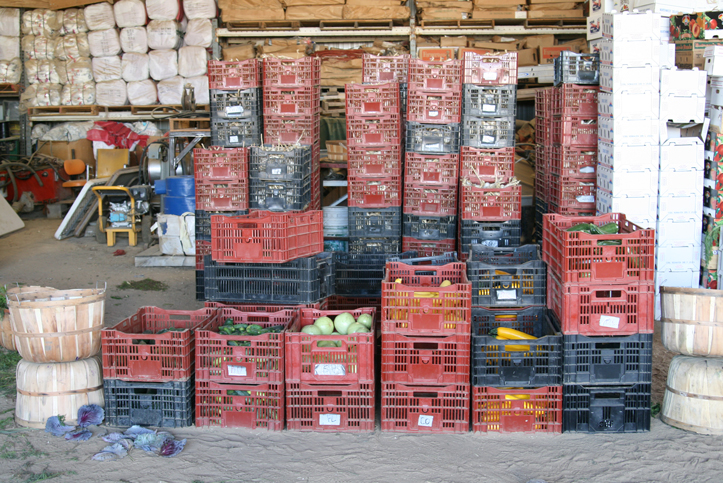
crates full of veggies by Rachel Carlson PhotographyThe employees start picking Thursday and will continue until noon on Friday for the markets. After lunch, they will wash any produce with excessive amounts of dirt on it and bunch crops such as carrots & beets. Once this is completed, Jerry gets out the worksheet for loading the trucks. We keep track of what has been placed on each truck. The truck will also need tables, tents, table clothes, plastic bags, pens, paper, signs with prices & baskets for display.

On Friday, Jerry again, begins his day with changing his water. If he can get into fields, he likes to mow the weeds. This cannot be done in fields with vining crops, such as, pumpkins, watermelon and muskmelon, or with tall crops such as tomatoes & corn. But he likes to keep them down around his irrigations ditches and in as many fields as he can. I can tell you this doesn’t happen every week and we are lucky if he can get to it once a month! The animal pens need to be checked at least every other week. Fencing never seems to stay where you want it because of wind, predators and weeds. We spend quite a bit of time checking fencing and fixing it. It is amazing how quickly the animals figure out the electric fence is down!

Friday is “technically” my day off. This is the day I try to get my house cleaned, start the laundry, grocery shopping, shopping for Alaina and Kyle (if needed), Dr. appointments, weed my flower beds and water the trees in the yard. If farmers markets tents need repairing, I do this on Friday too. Other than this, I can lay around watching soapies and eating bon-bons! (I can tell you this happens frequently! Ha-ha!)

kids feeding the pigs by Rachel CarlsonEveryone leaves Saturday morning somewhere between 4:30 and 5:30 in the morning for their destination. We attend the Cherry Creek Farmers Market, the Boulder Farmers Market and the Longmont Farmers Market on Saturday. It will take about one hour to get to a farmers market and about 1 ½ to 2 hours to set up. We will sell for 6 hours then load up anything that did not sell or give it to the Food Bank. This takes approximately one hour. When the trucks come back from Saturday farmers markets, we unload all the returning produce. This is noted on the worksheet. The produce is sorted and reloaded onto one truck. Anything that is determined to not be “good enough” for market is fed to the animals. Employees have picked just a little produce on Saturday to fill in what was sold on Sat. They have also changed Jerry’s water for him while he is at market. Half the employees have Sat. off; the other half has Sun. off. The day ends at 5 pm. for me and Jerry will be done as soon as he has checked his water.

Kyle goes to the Ft. Collins Farmers Market on Sunday. He leaves at 9 am. and returns about 5 pm. And once again, we will give excess produce to the Food Bank at the end of the day & bring back what will be fed to the animals. Crops such as potatoes can be kept until the next weekend.

Our biggest money makers are the potatoes and onions. The reason; we have these crops from the very beginning until the very end of the season. The customer favorites, however, are the strawberries, melons, tomatoes and beans.

This concludes our general daily work week. Of course there are so many other things we do during the week; so many they cannot be listed. But it gives you a good idea of what happens on a regular basis. Jerry and I work 7 days a week, March through November, then we slow down to 5 days a week during the winter. We try to take a week or two off during Christmas. Sometimes it happens and sometimes it doesn’t!

I hope you have enjoyed the farm posts!  Rach shared so many great pictures and I didn’t get to include them all… but keep an eye out, with her permission, I might just attach them to other farm posts in the future!

Categories: CSA, Food, Urban Homesteading | Leave a comment

A Week in the Life – Part 2

*Note that I wanted to post some pictures of us working on the farm, but I forgot my camera two weeks in a row! Luckily, Rachel came along this week and got some photos… Thank you to her for sharing!!!

This week, Jacquie Monroe shared with us what Tuesdays, Wednesdays and Thursdays look like on Monroe Organic Farms.

Last week I started to tell you about a week on the farm finishing only Sunday and Monday. Today I will talk about the next three days.

crates by Rachel CarlsonAs I mentioned before, I have worksheets I use to tell not only the employees what to pick each day, but also to tell the working members on Tuesday, Wednesday and Thursday what to put into each bag. This worksheet breaks down each Distribution Center into Single, Half and Full Shares; adding the totals of each category so that I know how many total Shares. Cucumbers, for example, are calculated to give the Single Share one, the Half Share two and the Full Share three. These numbers are multiplied to the total number of each category and I get a total number of how much to pick. The working members know how many cucumbers to give each share and I have a total number to be picked..all in one swoop of the pen!

I do this Sunday evening for picking on Monday for Tuesday Distribution; again on Monday night for Tuesday picking for Distribution on Wednesday and again on Tuesday night for Wednesday picking for Thursday Distribution. This is why it is so important for you to call me at least two days in advanced if there is a change to your share. If you wait until the day of or the day before Distribution to make a change, it is too late, we have already picked the produce!

Red (single), Purple (half), and White (full) shares for the members.Working Members arrive no later than 7:00. They will help unload produce into the barn, count the number of red, white and purple bags, count small and large bean bags, get the containers out to measure beans and potatoes, unload delivery trucks if needed, fill egg orders into coolers, count produce not bagged into boxes or baskets for delivery, fill bean bags; basically get everything ready for Distribution.

Team leaders give instructions to the Working Members on how many of each crop goes into a particular colored bag. There is one person stationed at each crop. The rest line up at the “potato bar” and get a bag filled with potatoes. From there they go down the line of crops each being added to the bag. They then go outside the barn and line them up in rows of 10, by bag color. When all is done, the bags are counted one more time before loading them onto the trucks, just in case we are one short! 

There is a Team Leader stationed at each vehicle. They call out the number of white, purple and red bags needed; egg coolers are loaded; fruit & honey too if available; corn, tomatoes & melons (depending on the time of year) for each Distribution Center until the entire truck is filled. During melon season, we have to pull a trailer because it cannot all fit on the truck!

Rachel helps load!After the working members get the produce on the trucks, empty bags that are put into the coolers by Distribution Centers are removed, sorted & stacked. The coolers are cleaned and stacked. The barn is raked, any produce not good enough for members is fed to the chickens (except onions and garlic). And everyone heads to the fields to work. Working Members spend early spring/early summer planting and hoeing, but by the end of summer, the Working Members spend quite a bit of time harvesting.

At 6 am, the employees have finished the animal chores and are now pulling out all the produce picked the day before; lining it up in order listed on the worksheets. Once all the produce is lined up, the employees get their instructions on what to pick for the day, all heading in different directions!  Jerry, in the mean time, has gotten up at 4:30 and has changed his water. He has given instructions to the employees and is checking in with the team leaders on what their day will consist of. Then he is off to ditch rows of crops for irrigation.

hoeing the corn by Rachel CarlsonThis will need to be done every time we have either hand hoed or used the Weeder to remove weeds from the fields. It tears down the humps of dirt needed to keep the water in each row. If each row is not intact, something will not get watered!

After greeting the Working Members and answering any questions that may arise, I am in the office writing a letter to each Distribution Center. I tell them how many bags they are getting for each share size & the color of that bag. If there is anything extra, such as corn, this number is also reflected so that when the Non-working Members arrive, the Distribution Center knows what to give each member. Newsletters are added to this letter for each Center.

At the beginning of the season, the Distribution Centers are given a list of all the Members picking up at their homes, phone numbers and information about eggs, fruit and honey. They turn this list into a check off sheet to use during Distribution. This is how they know who gets what and how much of it! If we are delivering any produce to restaurants, an invoice is typed out and added to the pile of newsletters with Distribution letters.

truck is loaded by Rachel CarlsonBetween 10 and 11 am, the trucks are ready to leave for Distribution Centers. Two trucks leave on Tuesday, one heading toward the South Denver Metro area and one heading to the West Denver Metro area. On Wednesday, two trucks leave heading toward Central Denver Metro area and the Ft. Collins area. Thursday, only one truck leaves the farm and follows the Turnpike towards the Boulder area. It will take most of the rest of the day to complete these routes, getting us home around 4pm. Where upon arrival back at the farm, Jerry will check his water and I start dinner! Wednesday I will do Distribution for the Greeley area, starting at 5:30 and I will work until dark.

The drip irrigation system is a wonderful tool we have fallen in love with. Not only does it keep down the weeds in each row/bed, it really conserves water. But at the same time, it is very labor intensive! Everything has to be hand planted into the plastic, each row has to be hand weeded, (no hoes allowed!) and the procedure for watering is extensive!

Every day that Jerry waters through the drip tape, he first has to fill the pond with water by turning on the pump at the bottom of the field where the irrigation canal is located. This canal carries the water from the reservoir throughout the entire irrigation basin. Once Jerry has chosen a field to water, there is at least one turnkey at the top of each bed. There can be as many as four rows and two drip tapes per bed with turnkeys. After turning on the water to several beds, he walks down each bed to check for leaks or breaks. He also has to walk the entire main line to check for leaks or breaks. A small leak can turn into a big problem because there is a lot of pressure in a drip irrigation system! It can wash out the crop, but more importantly, it will release the pressure and all the water will go to that spot and nothing else will get watered.

In the fall, all the drip tape and plastic has to be removed and discarded. However, when we do keep the drip tape for more than a year or two, the mice get into it and chew it up!

This really sums up the work I do as a working member. There is lots of counting! Last week after all the share bags were filled and loaded onto the trucks, we sorted garlic by sizes into crates. Some will get distributed, some stored for the winter shares, and some stored for planting in the fall. We also do things later in the season like spreading hundreds of onions on black tarps to dry in the sun for the winter shares.

This week Rachel worked really hard, and to thank her for her work, she got to take home a share of produce! She really earned it!!  Thank you again, Rach, for sharing your rockin’ photos!  p.s. – Rachel is amazing, and she can be hired to photograph you!  😉

Categories: CSA, Food, Urban Homesteading | 2 Comments

Blog at WordPress.com.