



 So this week was very productive as well. My friend, Julie, came over and I showed her how to can (with my limited experience this year). We made a batch of pickled beets (which smelled amazing!) and a batch of cucumber dills, all in two and a half hours while our kids played. Oh – and we made lunch and all sat down together to eat it as well. We were both amazed at how much we got done when doing it together, and how we weren’t even exhausted! Wow! I wish we had a community!
 We talked about how long ago, women didn’t have the option to send kiddos off to preschool or day care – but they didn’t need that option… they had friends and family close by to help them. And getting those chores done was fun and easy (or at least easier) with someone else there. And the kids were entertained and had extra eyes and hands to watch them. *sigh* I want community! Hippie commune, here I come! 😉 Ok, maybe not, but it wouldn’t be all bad.
So this week’s accomplishments:
Plant Something – none
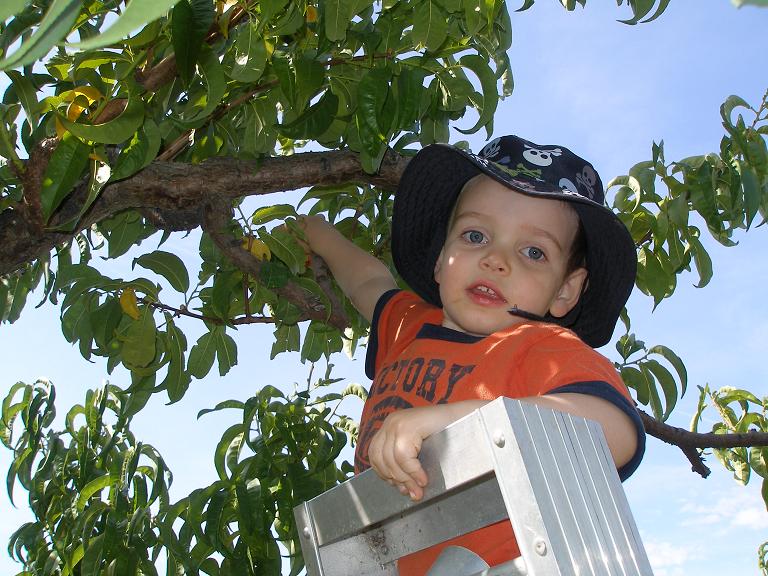
Harvest Something– picked 180+ pounds of peaches on Saturday with our friends, plus a box of tomatoes.
Preserve Something – It’s the ‘P’ week. Monday I made pickles, pepper jelly pesto and pickled peppers, and Sunday we of course processed peaches… froze most, but plan to can/jam more this week. Also froze those Roma tomatoes… I wanted to make a sauce and/or can them, but they were ready on Friday, and I didn’t have time before we left for Palisade. So they were simply frozen instead.
Waste Not – nothing to add this week.
Want Not/Prep & Storage – made some gifts for Christmas time
Build Community Food Systems – Signed up for a composting class in September, made pickled beets with my friend Julie, bartered a melon for some jalapenos.
Eat the Food – Fire & Ice Salsa!
3 cups chopped watermelon
1/2 cup chopped green bell pepper
2 tablespoons lime juice (about 1 lime)
1 tablespoons chopped fresh cilantro
1 tablespoon chopped green onion
1-2 tablespoons chopped jalapeno pepper
1/2 teaspoon garlic salt
After chopping, drain excess juice from watermelon in a colander. Combine melon in a large bowl with green pepper, lime juice, cilantro, green onion, jalapeno and garlic salt; mix well. Refridgerate 3 hours. Serve with corn or potato chips, or, like Rick, add it with shredded roasted chicken, avacado, and extra onions to warmed corn tortillas for Fire & Ice Chicken Tacos! Thanks Mom, for the recipe!
 Wow – I can’t believe I’ve been documenting this stuff for 15 weeks already! This week was particularly productive. The picture is of our freezer as it’s slowly filling. I can’t wait to show you what we have next week… we should have pickles, pesto, potatoes, peaches, peppers and more to show you. But this week….
Plant Something – none.
Harvest Something– zucchini, yellow tomatoes, Sun Gold cherry tomatoes, Sweet 100’s, carrots, eggs, Romas, Cherokee purple tomatoes…
Preserve Something – Chopped and froze beans, carrots and musk melon; dehydrated celery (for soups & such) I hope this works well… I’m new!
Waste Not – Figured out a way to get the chickens in the compost! This is great because they get extra snacks, and they scratch around in there and poop, so it helps with the making of the black gold!
Want Not/Prep & Storage – We’ve started really taking advantage of this awesome book I got: The Encyclopedia of Country Living. Rick also cleaned up a free grill we got from a friend.
Build Community Food Systems – Setting up a cheese making class for ?September. Farmers market usual, of course.
 Eat the Food – the most fun to eat this week has been the watermelon! We got red and yellow melons from the far this week! Delish! So your recipe….
Ratatouille
1 small chopped onion
2-3 cloves garlic to taste
1 TBS olive oil
1 large eggplant, peeled, sweated and then cubed
1 medium zucchini, sliced
1 cup chopped tomatoes, or 1 cup cherry tomatoes
1 medium green bell pepper, chopped
3 TBS dry white wine
3 TBS (or to taste) fresh snipped basil
black pepper
Heat oil in large skillet and saute onions and garlic until tender. Add veggies and white wine. Season with pepper to taste (should be salty enough from sweating the eggplant. If not, add salt to taste). Bring to boiling, cover, reduce heat and simmer for about ten minutes, until veggies are tender. Uncover and cook 5 minutes more, stirring occasionally, until most of the liquid is gone. Stir in basil and serve. YUM!
Plant Something– nothing this week…. we need to get ready for more late crop greens!
Harvest Something – zucchini, yellow tomatoes, Sun Gold cherry tomatoes, mint, cucumbers.
Preserve Something – cukes into pickles, jalepenos (from the Carlson’s), froze some corn.
Waste Not – Compost, recycling, etc. No big steps done in this category.
Want Not/Prep & Storage – We got a bunch of books from Rick’s aunt for the boys this weekend that their cousins have outgrown, and a few hand me down outfits for Emmett (thanks Wendi & Amy!).
Build Community Food Systems – We’re planning a trip to Palisade to pick peaches next week and have gotten some family/friends to chip in for some of the peachy goodness. Farmers market usual, of course.
Eat the Food – Grilled corn on the cob, zucchini, potatoes, onions, MUSK MELON, tomatoes, peppers, eggplant, and more. We love SUMMER! Here’s this week’s recipe:
Crispy Smashed Potatoes: Place several new potatoes in a saucepan and cover with water. Boil until softened, about 15 minutes; let cool until easy to handle.
Preheat oven to 475. Oil a rimmed baking sheet or baking stone with olive oil. Place potatoes on sheet and smash slightly with the palm of your hand (so the insides smush out a bit, but so each potato is mostly intact). Drizzle potatoes with more olive oil, and season with salt and pepper.
Bake for 20 minutes until crispy.
Well here it is… the rest of a typical week on our beloved CSA: Monroe Organic Farms. Thanks again to Jacquie for letting me share this with you all, and to my buddy Rachel for the great pictures!
We are now on Friday and Saturday of our general daily work week description. We plant extra produce, more than what the CSA needs, just in case there is a weather related or insect problem. We attend four farmers markets over the weekend. If there is a production problem, produce would be taken away from the farmers markets. We are hoping the CSA will not feel it. Think of it as an insurance policy for your CSA. This is also how you get your extras to pick for freezing & canning. We have also found that if we do not pick produce just about every day, your zucchinis would be enormous, your tomatoes would be overripe, etc.! In general, your produce would not look as nice! Whatever produce the membership is not using, we take to the farmers markets.
The employees start picking Thursday and will continue until noon on Friday for the markets. After lunch, they will wash any produce with excessive amounts of dirt on it and bunch crops such as carrots & beets. Once this is completed, Jerry gets out the worksheet for loading the trucks. We keep track of what has been placed on each truck. The truck will also need tables, tents, table clothes, plastic bags, pens, paper, signs with prices & baskets for display.
On Friday, Jerry again, begins his day with changing his water. If he can get into fields, he likes to mow the weeds. This cannot be done in fields with vining crops, such as, pumpkins, watermelon and muskmelon, or with tall crops such as tomatoes & corn. But he likes to keep them down around his irrigations ditches and in as many fields as he can. I can tell you this doesn’t happen every week and we are lucky if he can get to it once a month! The animal pens need to be checked at least every other week. Fencing never seems to stay where you want it because of wind, predators and weeds. We spend quite a bit of time checking fencing and fixing it. It is amazing how quickly the animals figure out the electric fence is down!
Friday is “technically” my day off. This is the day I try to get my house cleaned, start the laundry, grocery shopping, shopping for Alaina and Kyle (if needed), Dr. appointments, weed my flower beds and water the trees in the yard. If farmers markets tents need repairing, I do this on Friday too. Other than this, I can lay around watching soapies and eating bon-bons! (I can tell you this happens frequently! Ha-ha!)
Everyone leaves Saturday morning somewhere between 4:30 and 5:30 in the morning for their destination. We attend the Cherry Creek Farmers Market, the Boulder Farmers Market and the Longmont Farmers Market on Saturday. It will take about one hour to get to a farmers market and about 1 ½ to 2 hours to set up. We will sell for 6 hours then load up anything that did not sell or give it to the Food Bank. This takes approximately one hour. When the trucks come back from Saturday farmers markets, we unload all the returning produce. This is noted on the worksheet. The produce is sorted and reloaded onto one truck. Anything that is determined to not be “good enough” for market is fed to the animals. Employees have picked just a little produce on Saturday to fill in what was sold on Sat. They have also changed Jerry’s water for him while he is at market. Half the employees have Sat. off; the other half has Sun. off. The day ends at 5 pm. for me and Jerry will be done as soon as he has checked his water.
Kyle goes to the Ft. Collins Farmers Market on Sunday. He leaves at 9 am. and returns about 5 pm. And once again, we will give excess produce to the Food Bank at the end of the day & bring back what will be fed to the animals. Crops such as potatoes can be kept until the next weekend.
Our biggest money makers are the potatoes and onions. The reason; we have these crops from the very beginning until the very end of the season. The customer favorites, however, are the strawberries, melons, tomatoes and beans.
This concludes our general daily work week. Of course there are so many other things we do during the week; so many they cannot be listed. But it gives you a good idea of what happens on a regular basis. Jerry and I work 7 days a week, March through November, then we slow down to 5 days a week during the winter. We try to take a week or two off during Christmas. Sometimes it happens and sometimes it doesn’t!
I hope you have enjoyed the farm posts! Rach shared so many great pictures and I didn’t get to include them all… but keep an eye out, with her permission, I might just attach them to other farm posts in the future!
*Note that I wanted to post some pictures of us working on the farm, but I forgot my camera two weeks in a row! Luckily, Rachel came along this week and got some photos… Thank you to her for sharing!!!
This week, Jacquie Monroe shared with us what Tuesdays, Wednesdays and Thursdays look like on Monroe Organic Farms.
Last week I started to tell you about a week on the farm finishing only Sunday and Monday. Today I will talk about the next three days.
As I mentioned before, I have worksheets I use to tell not only the employees what to pick each day, but also to tell the working members on Tuesday, Wednesday and Thursday what to put into each bag. This worksheet breaks down each Distribution Center into Single, Half and Full Shares; adding the totals of each category so that I know how many total Shares. Cucumbers, for example, are calculated to give the Single Share one, the Half Share two and the Full Share three. These numbers are multiplied to the total number of each category and I get a total number of how much to pick. The working members know how many cucumbers to give each share and I have a total number to be picked..all in one swoop of the pen!
I do this Sunday evening for picking on Monday for Tuesday Distribution; again on Monday night for Tuesday picking for Distribution on Wednesday and again on Tuesday night for Wednesday picking for Thursday Distribution. This is why it is so important for you to call me at least two days in advanced if there is a change to your share. If you wait until the day of or the day before Distribution to make a change, it is too late, we have already picked the produce!
Working Members arrive no later than 7:00. They will help unload produce into the barn, count the number of red, white and purple bags, count small and large bean bags, get the containers out to measure beans and potatoes, unload delivery trucks if needed, fill egg orders into coolers, count produce not bagged into boxes or baskets for delivery, fill bean bags; basically get everything ready for Distribution.
Team leaders give instructions to the Working Members on how many of each crop goes into a particular colored bag. There is one person stationed at each crop. The rest line up at the “potato bar” and get a bag filled with potatoes. From there they go down the line of crops each being added to the bag. They then go outside the barn and line them up in rows of 10, by bag color. When all is done, the bags are counted one more time before loading them onto the trucks, just in case we are one short!
There is a Team Leader stationed at each vehicle. They call out the number of white, purple and red bags needed; egg coolers are loaded; fruit & honey too if available; corn, tomatoes & melons (depending on the time of year) for each Distribution Center until the entire truck is filled. During melon season, we have to pull a trailer because it cannot all fit on the truck!
After the working members get the produce on the trucks, empty bags that are put into the coolers by Distribution Centers are removed, sorted & stacked. The coolers are cleaned and stacked. The barn is raked, any produce not good enough for members is fed to the chickens (except onions and garlic). And everyone heads to the fields to work. Working Members spend early spring/early summer planting and hoeing, but by the end of summer, the Working Members spend quite a bit of time harvesting.
At 6 am, the employees have finished the animal chores and are now pulling out all the produce picked the day before; lining it up in order listed on the worksheets. Once all the produce is lined up, the employees get their instructions on what to pick for the day, all heading in different directions! Jerry, in the mean time, has gotten up at 4:30 and has changed his water. He has given instructions to the employees and is checking in with the team leaders on what their day will consist of. Then he is off to ditch rows of crops for irrigation.
This will need to be done every time we have either hand hoed or used the Weeder to remove weeds from the fields. It tears down the humps of dirt needed to keep the water in each row. If each row is not intact, something will not get watered!
After greeting the Working Members and answering any questions that may arise, I am in the office writing a letter to each Distribution Center. I tell them how many bags they are getting for each share size & the color of that bag. If there is anything extra, such as corn, this number is also reflected so that when the Non-working Members arrive, the Distribution Center knows what to give each member. Newsletters are added to this letter for each Center.
At the beginning of the season, the Distribution Centers are given a list of all the Members picking up at their homes, phone numbers and information about eggs, fruit and honey. They turn this list into a check off sheet to use during Distribution. This is how they know who gets what and how much of it! If we are delivering any produce to restaurants, an invoice is typed out and added to the pile of newsletters with Distribution letters.
Between 10 and 11 am, the trucks are ready to leave for Distribution Centers. Two trucks leave on Tuesday, one heading toward the South Denver Metro area and one heading to the West Denver Metro area. On Wednesday, two trucks leave heading toward Central Denver Metro area and the Ft. Collins area. Thursday, only one truck leaves the farm and follows the Turnpike towards the Boulder area. It will take most of the rest of the day to complete these routes, getting us home around 4pm. Where upon arrival back at the farm, Jerry will check his water and I start dinner! Wednesday I will do Distribution for the Greeley area, starting at 5:30 and I will work until dark.
The drip irrigation system is a wonderful tool we have fallen in love with. Not only does it keep down the weeds in each row/bed, it really conserves water. But at the same time, it is very labor intensive! Everything has to be hand planted into the plastic, each row has to be hand weeded, (no hoes allowed!) and the procedure for watering is extensive!
Every day that Jerry waters through the drip tape, he first has to fill the pond with water by turning on the pump at the bottom of the field where the irrigation canal is located. This canal carries the water from the reservoir throughout the entire irrigation basin. Once Jerry has chosen a field to water, there is at least one turnkey at the top of each bed. There can be as many as four rows and two drip tapes per bed with turnkeys. After turning on the water to several beds, he walks down each bed to check for leaks or breaks. He also has to walk the entire main line to check for leaks or breaks. A small leak can turn into a big problem because there is a lot of pressure in a drip irrigation system! It can wash out the crop, but more importantly, it will release the pressure and all the water will go to that spot and nothing else will get watered.
In the fall, all the drip tape and plastic has to be removed and discarded. However, when we do keep the drip tape for more than a year or two, the mice get into it and chew it up!
This really sums up the work I do as a working member. There is lots of counting! Last week after all the share bags were filled and loaded onto the trucks, we sorted garlic by sizes into crates. Some will get distributed, some stored for the winter shares, and some stored for planting in the fall. We also do things later in the season like spreading hundreds of onions on black tarps to dry in the sun for the winter shares.
This week Rachel worked really hard, and to thank her for her work, she got to take home a share of produce! She really earned it!! Thank you again, Rach, for sharing your rockin’ photos! p.s. – Rachel is amazing, and she can be hired to photograph you! 😉
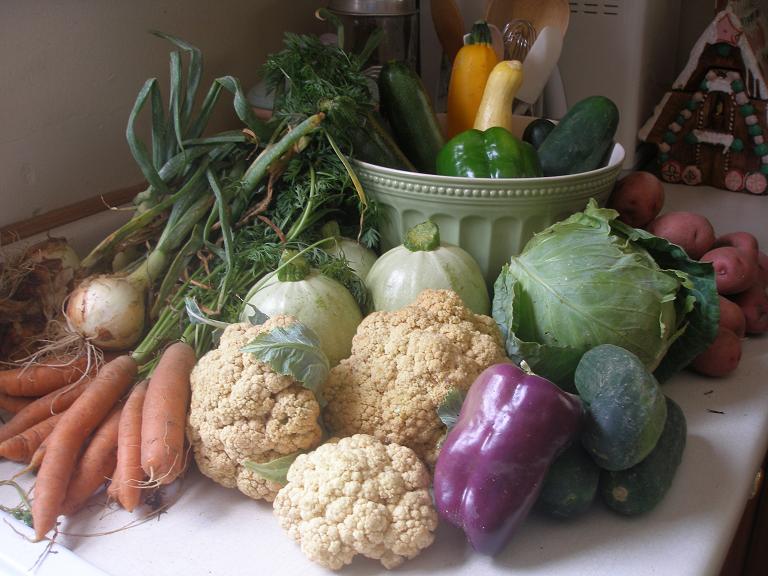 Take a look at the beautiful bounty in this week’s CSA share, waiting to be washed on my kitchen counter! From left to right there are walla walla onions, carrots, q-ball squash, cauliflower, cabbage, purple bell pepper, pickle cucumbers and red potatoes; and in the bowl: three kinds of squash (zucchini, crookneck and yellow), cucumbers, and a green bell pepper.
This was my first week back up at the farm, and I had Henry and Emmett in tow. Everyone was excited to see Emmett! And Henry had a great time catching toads and playing with the other kids, while Emmett rode in the Moby wrap as I distributed squash and sorted garlic.
This week, in our newsletter from Monroe Organic Farms, Jacquie Monroe wrote up a piece on what farm life is like. They work hard and are quite busy… she only got through two days worth!
I thought you all would also be interested to see what life looks like on our CSA farm:
A week in the life… by Jacquie Monroe
A member once asked what a week on the farm looked like? What was our routine? Well…let’s start with just a couple of days! Our week starts on Sunday at 4:30 or 5 am with Jerry setting his water on those parts of the field that need a little drink. This takes approximately 3 hours. Setting water isn’t like turning on your garden hose. The ditch fluctuates up and down according to users up stream. Once the water is set, he goes back a half hour to an hour later and checks it again. He may have to irrigate fewer rows or start additional rows depending on how much water there is at that time; then checks it one more time before he starts his next project. In the mean time, our employees get going about 6 am. They have gathered eggs, watered and fed the chickens, steers, pigs and sheep. At 8 o’clock, everyone meets at the barn. They take what produce has returned from the Saturday farmers markets and reload a truck. Kyle takes off at 9 am for the Ft. Collins farmers market. He will be there for 5 1/2 hours.
Once Kyle is set and has left, Jerry turns to the four wheeler and checks the field for mature crops. It is at this time when he decides what you will be getting each week. He come to me and gives me a list of crops and how much he believes we have. I take those numbers and apply them to the membership. Sometimes we are limited to what we have, so you will only get one, or he tells me to calculate three different numbers.
Jerry has now moved to either his cultivating tractor or the planter. If he chooses to cultivate, he will do this all day, taking out as many weeds as he can so that the hand hoeing won’t take as long. Planting is a timing thing. If Mother Nature cooperates, Jerry is pretty good at getting you crops on a pretty regular basis. To give you an idea, corn and green beans need to be planted every week; cucumbers & summer squash every three weeks; peppers, and potatoes one time; watermelons & muskmelon every four weeks; carrots, tomatoes and beets three times a summer and broccoli and cauliflower are planted five times a summer. This job requires he get on and off the tractor several times to check to see if the seed is planted at the right depth; making adjustments to the planter as needed.
Meanwhile the guys are digging up potatoes for Distribution on Tuesday. They are stored in a strawbale building. The strawbale building is approximately 20 degrees cooler than the outside temperature! They will set up sprinkler pipe to sprinkle up the seed Jerry has just planted; moving the pipe every three or four hours. This will need to be done every three days until we see a crop. Then it will be switched to row irrigation thereafter. Some of the crew will be hoeing, stacking the newly cut & baled hay and gathering eggs (which will be done at least once more before the end of the day). If there is time, three people will use the tractor and a machine called a Weeder to cultivate.
We take an hour for lunch (Jerry doesn’t come in for breakfast, too much to do & he wants to do it while it is cool!). But before he quits, he checks his water again. If it needs changing, he will do this, checking it again after lunch. Jerry wants a hot lunch so I normally fix him leftovers from the night before; afterward going back to the planter or cultivator.
I get up in the morning and check messages. (I don’t get up nearly as early as Jerry!) Get a bite to eat & read a favorite magazine for an hour. I then sit down to my computer and start writing. Sometimes these newsletters come easily to me and I will be finished by noon and sometimes they will take me all day to write. When I’m done, I count our earnings from the Saturday farmers markets and partially start a deposit, finishing it on Monday after adding Sunday farmers’ market earnings.
While I’m busy making the deposit, I start to make the copies I need of the newsletter. I will answer the messages and if I have time, (between Sunday and Monday), I look at email. It is very low priority for me, especially since I love the computer so much! I can usually find more “important” things to do! Things like laundry. It’s funny how having clean clothes really make you feel good…ha, ha!
Dinner is served somewhere between 5 and 6 pm. Jerry needs to eat early because it will take him another three hours to change his water to new locations. We end our day watching the 9 o’clock news (the weather) and going to bed.
Monday morning at 4:30, Jerry begins with setting his water. This is a daily occurrence. If he isn’t row irrigating, he is irrigating using drip. To conserve water, we use plastic tubing to move water from one place to another. This prevents water from evaporating or soaking into the dirt below the ditch. All of it stored water from reservoirs holding the spring melt off of winter snow or spring rains. We have settling ponds to remove as much of the silt (fine dirt) from the water. Before sending it into our drip irrigation system, there is a filter system that takes out quite a bit more. These filters need to be checked frequently. Anything goes wrong and it will shut down not sending water to plants in need of water!
If Jerry didn’t finish planting or didn’t plant at all, it will have to be done on Monday. If there are any equipment failures, they will be worked on either Sunday or Monday. That includes the trucks too. Trucks are cleaned out from the weekend farmers markets. Any food that is not up to snuff to resell is fed to the animals. They are like dogs, begging for treats, running after the truck!
Meanwhile the employees are doing the animal chores. From my calculations, they will start to pick what is needed for Tuesday Distribution. The harvesting will take up most of their day. Bringing everything into the barn and set up in order they will appear in your bag. Stopping only to move sprinkler pipe.
Monday, I finishing the deposits, make the worksheets out for the Tue. Working Members & finish doing my laundry. Twice a month I pay the bills and Monday is the day I usually run errands for the farm. Jerry always needs parts for equipment; I take the deposits to the bank and go to the Post Office; go to the grocery store and ending the day with a nice meal. In the evening, Jerry and I take a ride on the four wheeler and look at the farm in all its’ glory; getting excited about the next new crop we’re going to give to you!
 Well it’s time to get caught up on a few things! I last left this post on E’s birth-day, so while we’ve continued harvesting and eating and what not, I’ve not written it down!
We did get quite a few turnips and raspberries this week. More raspberries than we’ve ever gotten, in fact. There are still a few more ripening up, but I’ve been enjoying what we’ve gotten so far.
My lettuces and spinach bolted, so we’re going to be pulling those, and the peas (both the snow peas and the snap peas) are about done too. So for the last few weeks here’s our report card:
Plant Something – nada (that I can remember)
Harvest Something – Eggs, including the first mini-eggs from the pullets, turnips… lots of them!, our first zucchini, peas, radishes (a handful), raspberries…
Preserve Something – green beans, broccoli, cauliflower, carrots, potatoes, garlic, turnips, onions…
Waste Not– recycling, composting, and another big batch of turnip greens this time. Also, I packed up maternity clothes to return to my friend who lent them to me (I’m putting this in because instead of being wasteful and buying all new clothes for a few months use, I borrowed). We’ve also been eating lots of meals made by friends, and the leftover have been great for lunches.
Preparation and Storage – Rick scrubbed out the “new” freezer. We are solidifying plans for a buffalo (or at least half), as well as mulling over the idea of another pork this fall.
Build Community Food Systems – still spreading the word about the Englewood Farmers Market, Rick worked at the CSA, we shared extra zucchini that was going to go to waste, and we got to try some chicken from a co-op (thanks Genny).
Eat the Food – Since the zucchini are coming on, here’s a recipe from the Great Food Fast cookbook (also on www.marthastewart.com) that uses up a fair amount of summer’s favorite squash. I’m not a big fan of curry, but this was pretty tasty. It can be served warm or cold.
Curried Zucchini Soup
1 TBS olive oil
1 medium onion, chopped
Coarse Salt
2 cloves of garlic, minced
2 tsp curry powder
1.5 lbs zucchini (about 3 medium) sliced 1 inch thick
1 baking potato, peeled and cut into 1 inch pieces
1/3 cup sliced almonds (for garnish)
Heat oil in a large pot over medium heat. Add onion and 1 TBS salt and cook about 5 minutes, stirring occasionally until onions are soft. Add garlic and curry powder and cook, stirring constantly, until fragrant – about 1 minute.
Add zucchini and potato, and 4 cups of water. Bring to a boil, and simmer 10-15 minutes until vegetables are soft. Working in batches, puree soup in blender until smooth (don’t be tempted to skip this, it does affect the flavor of this soup). Serve warm, or refrigerate until cool. Top with sliced almonds.
Note that I paraphrased the instructions, since I didn’t want to write it word for word. But it’s pretty basic. 🙂 Enjoy!
Rick also thought that it’d be smart to make a large batch of this soup and freeze it for the winter when you have no zucchini. He’s a pretty smart fella, I think.

From gardens, bees and backyard chickens in the heart of Denver to starting from scratch in San Antonio. Our family of five is striving to find the simple life - the easy way.






 The Lazy Homesteader