Sustainability

Frugal Friday: Composting

YUCK!  What is that??
compost

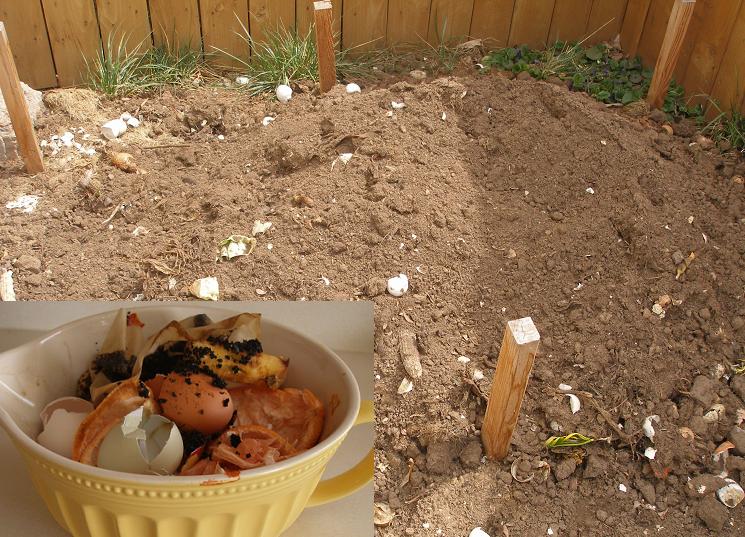
It’s my compost.  That’s the bowl on my counter, super-imposed over the pile outside.  🙂

Week two of my Gardening  Thrifty Thursday Frugal Friday tips (sorry, I just didn’t feel like writing yesterday) is about composting.

I was actually lobbying for a compost pile for a long time before we got one.  A couple of years.  Rick grew up thinking that they were smelly heaps of rotting food that attracted neighborhood cats, and provided little benefit, except for those hippies.  He also grew up dusting baby tomato plants with pesticides and dousing them with chemical fertilizers.

I had to change his thinking!  I wanted to compost to reduce the need for those pesticides and fertilizers.  I wanted to foster a garden that could support and sustain it’s self!  And, my dad was a “worm grower” (throwing coffee grounds and eggs shells in the garden, to grow big, fat, night crawlers to use for fishing bait), so I knew the compost bin/pile needn’t be complicated or smelly.

In order to compost, you need only a few basic things:
– Green material (like veggie scraps, coffee grounds, etc.)
– Brown Material (dried leaves, straw, dried grass clippings, etc.)
– Water
– Somewhere to let it do it’s thing (a bin or pile)

After showing Rick some of the facts about composting, and pointing out to him that he had been doing it every fall all along (digging holes and filling then with layers of leaves, dirt and water, and then leaving the to rot through the winter to improve the soil in the veggie garden), he did a little research of his own and jumped in with both feet.

Rick  decided to save money by building his own bins, following a plan we found online, just by Googling it.  So far, he has the layout done, and we’ve been composting without walls for the last year or so.  He will eventually put in walls around the pile, where the steaks are, so we can transfer from one side to the other easily.

But why should you start composting?  I mean, who wants a pile of rotting organic matter sitting around the outside of their house?  Really?  Here are a few reasons why (from earth911.com)….

Benefits of Using Compost

  • Improves the soil structure, porosity, and density, thus creating a better plant root environment.
  • Increases moisture infiltration and permeability of heavy soils, thus reducing erosion and runoff.
  • Improves water-holding capacity, thus reducing water loss and leaching in sandy soils.
  • Supplies a variety of macro and micronutrients.
  • May control or suppress certain soil-borne plant pathogens.
  • Supplies significant quantities of organic matter.
  • Improves cation exchange capacity (CEC) of soils and growing media, thus improving their ability to hold nutrients for plant use.
  • Supplies beneficial micro-organisms to soils and growing media.
  • Improves and stabilizes soil pH.
  • Can bind and degrade specific pollutants.


In other words, it’s good for your garden, your plants, and the Earth!  This short list doesn’t even mention that the EPA estimates that 24% of what ends up in landfills is made up of yard trimmings and food residuals.  All of which can go into your home compost pile/bin and be used to enhance your own soil for your own veggie and flower gardens.

Wait… I thought this was supposed to be a tip about saving money.  How does composting do that?  Well those points up there basically equate to this:  Using compost reduces the amount of water, fertilizer, pesticides, and soil modification needed to grow a great garden.  It also reduces the amount of garbage you send off to the landfill, and combined with diligent recycling, that could even lead to eliminating the trash bill  completely!  So what, exactly, is the savings?  Well, I don’t have that broken down.  It all depends on what you grow, and what you need to make it grow.  But I can tell you this.  We don’t need to buy fertilizer, peat moss (for soil modification), manure, or pesticides any more.  We haven’t bought those things in a long time.  🙂

It’s easy to do.  We just keep a bowl on the kitchen counter to collect our food scraps, egg shells, coffee grounds & filters, veggie peeling, etc.  We dump that into the pile when ever we fill it up (once or twice a week).  This accounts for most of the “green matter” in the pile.  We add grass trimmings and dried leaves, the used pine shavings from the chicken house and paper from our shredder to account for the “brown materials.”  The only other things needed are water and time.

Be sure to check out these helpful sites for more reasons to compost, details on what should and should not be composted, compost uses, and methods of composting:
U.S. Environment Protection Agency
Earth911.com
Washington State University County Extension

Also, before I wrap this up I wanted to share a link to KGI’s post about the Obama’s first planting in their new garden!  Check it out! http://www.kitchengardeners.org/

Be sure to check around for other Thrifty Thursday tips this week. Katie Jean posted about the Value of Memberships! Check also with  Tracy, Crystal and Genny(though I know Genny is taking a break to prepare for the home birth of their baby!, and some of the others have been busy with other life things as well).  🙂

Categories: Compost, Food, Garden, Sustainability, Thrift, Urban Homesteading | 3 Comments

Sustainable Food Budget Challenge

susbudgetHow many times have you thought about eating organic and locally grown food, only to convince yourself it’s too expensive?  Or maybe you do eat locally and organically grown food, and try to convert your friends, but you can’t seem to get them to believe it’s something they can afford. 

For the month of April, The Crunchy Chicken is issuing the Sustainable Food Budget Challenge

I hear so many times, from many friends that “they just can’t afford to eat natural/organic.”  This way of thinking really discourages me.  Rick and I have a very tight grocery budget.  We do not spend our whole paycheck at Whole Foods, nor do we think anyone should.  Yes, our grocery shopping is supplemented with our garden and hunting, but those things aren’t free either, and take lots of work.  Not counting the garden, the CSA, and hunting, we spend between $60-100/week on groceries during the winter, and only $30-60/week during the summer.  I will calculate out the cost of meat, as well as garden & CSA veggies to add into that later, to give you an accurate reflection of what we truly spend per month to eat locally, organic, sustainable food. 

But first, the details on the challenge:  The idea here is to feed yourself and your family on sustainable food sources while staying within a set, tight budget (more on this below).   So what is “sustainable food?”   To me, it is food that has the least impact on the environment, while having the most impact on your health.  Locally grown organic veggies are at the very tip top of this list.  For example, a tomato from your garden, grown without fertilizers or pesticides, using grey water or a drip system, has a very low impact on the environment (no fossil fuels were used to get it to you!) and you get all the health benefits of an organic tomato.

So besides a garden, where do you find this stuff?  Start at the farmer’s market, food co-op, U-pick farm stands and local food stores.  Then move  on to the grocery chains and big-box last.  Local food store will often carry more locally grown food then the bigger chains and big-box stores.  And, usually at cheaper prices.  You will need to weigh the benefits of buying locally (but maybe not organic) versus buying organic produce flown half-way around the world to your local Wal-Mart.   Crunchy Chicken has a follow up post here about what sustainable means as well.  This is a helpful clarification since many of us live in areas where the farmer’s markets aren’t yet open. 

Crunchy Chicken raises the question: “is it possible…?” as well as lays out the rules for the challenge:

So, the question remains… is it possible to eat an organic or sustainably grown diet on a budget? A few years ago, there was the argument that those individuals who received food assistance from the government didn’t receive enough money to be able to afford healthy food. Some took it further and argued that poor Americans really were excluded from being able to eat sustainably strictly because of the higher costs. There are a number of factors at play here, the majority of which have to do with food availability such as the fact that not many supermarkets remain in some inner city areas and it’s difficult to travel out to the suburbs to shop at stores that sell the kinds of foods we are talking about here.

But, for the rest of us, can it be done? For those of us who live in areas where ample farmers markets, farms and grocery stores selling sustainably grown food exist, is it affordable?

I’d like to challenge us all to see if we can eat sustainably using the Food Stamp Allotment Program guidelines. It will take a lot of careful planning, but the end result is that we can save a lot of money on our food budget by trying to spend within this framework for a month.

Challenge Guidelines
So, here’s the skinny. Based on the following allotment chart, you are to stick to the corresponding amount for food for the month of April. The challenge is that you must buy according to the following guidelines (from Locavores). Do not include non-food items or home grown items into your budget, but do include seeds and plants which produce food for the household to eat. Make sure you include all the food costs from eating out, trips to coffee shops, etc.


These are fairly loose rules, but the goal is to buy sustainably grown food:

1. If not LOCALLY PRODUCED, then Organic.
2. If not ORGANIC, then Family farm.
3. If not FAMILY FARM, then Local business.
4. If not a LOCAL BUSINESS, then Terroir: purchase foods famous for the region they are grown in.
5. Hit the farmers market before the supermarket.


Household Maximum Monthly Allotment Chart:
1 person – $176
2 people – $323
3 people – $463
4 people – $588
5 people – $698
6 people – $838
7 people – $926
8 people – $1,058
Each additional person – $132
 

Here is the break down of where Rick and I are starting from, as well as a receipt info from today’s shopping trip on April 1st. 

Today I spent $84.51 at Sunflower Farmers Market (a local grocery chain) for food items for the week.  We plan on having Buttermilk Baked Chicken, Mediterranean Salad, Homemade pizzas, Elk chili, Chicken Satay, Mediterranean Chicken Packets, and Broccoli Tomato Stromboli’s this week.  The chicken I bought at the store was not organic or local (normally I buy organic chicken only once a month from Costco, where it is cheaper), but I refuse to pay $16.00 for one Rosie chicken (read the Omnivore’s Dilemma by Pollan and you will too!).  I bought salami from who-knows-where, and I’m certain it’s not organic either, but it was the only kind they had.  Nearly all the produce I bought, as well as the beans and flour were organic, though not local.  But the eggs and milk were Colorado proud, and hormone free.  The bread was both local and organic. 

The pizzas will have pork sausage, the cost of which is approx. $1.97.  We bought a whole local 4-H hog last fall for less than two bucks a pound.  The elk meat for the chili was given to us by a relative, harvested in Kremmling, CO.  Rick has not gotten an elk yet, but he’s applied for many a license, so the cost of that, to be fair would have been… well, whatever the heck $39 for a license plus the fuel cost to get to Kremmling, and the cost of one .306 bullet; divided by how ever many hundred pounds of meat an elk gives us… for one pound.  I’ll be extra  generous and say it was a $1.00.  Rick’s family processes their own meat, so that would have been free (just costs time, anyway).  We will also be using some frozen tomatoes left over from the farm last summer.  I am not going to figure out the cost of two or three tomatoes, but if we weren’t using those I would have bought a big can of Muier Glen Organic tomatoes for about $2.29, those in the freezer probably didn’t cost half that, but to be generous and fair again, we’ll say they were half: $1.15.

So, for this week:
-Grocery Store – mixed: $84.51
-Pork – local and sustainable: $1.97
-Elk – local and sustainable: $1.00
-Tomatoes – local and sustainable: $1.15
Total: $88.63

If we keep on track with this amount for the month, we’ll spend about $356 on groceries.  This is below the amount allotted for a family of three, and WAY below the amount allotted for a family of four (which we qualify as, since I’m pregnant) for Food Stamps.  Not too bad. Let’s see if we can pull it off! 

This month will bring a couple of exciting opportunities for us though as well.  Like the pick your own asparagus at the farm in a couple of weeks.  I can’t wait.  Look for more info on CSA’s in tomorrow’s Thrifty Thursday tip.  A lot of the produce we use (though, none planned for this week, besides those tomatoes) comes from there, and I will have cost breakdowns for that.

My goal for the challenge is to see just HOW sustainbly we can eat, for the least amount possible.  I have a feeling Rick will like this challenge.  He’s always complaining about the grocery bill! 

What about you?  Do you think you can do the challenge?  And if you’re already eating well on a budget, do you think you can stretch it further?  Will you join us???  Leave me a comment below with thoughts, questions, ideas, etc.!

Categories: CSA, Food, Garden, Recommended Reading, Sustainability, Thrift, Urban Homesteading | 3 Comments

Freeze Yer Buns

freezeyerbunsYesterday, I joined the Freeze Yer Buns challenge put out by Crunchy Chicken.

This challenge is to lower the thermostat, don your socks and sweaters and save a little energy (and money!).  Read all about the challenge by clicking on the graphic in this post or following this link: Freeze Yer Buns! 

For us, we normally have the thermostat set at 65 during the day and 60 at night. But I’m kind of a wimp, and here all day in this drafty old house, so I usually crank it up to 67 or 68 during the day. After reading some of the responses of the people already doing the challenge, I realized what a wimp I’ve been (I’m mean, I AM a Colorado native after all… suck it up, girl!).  So I dropped it down to 64 yesterday. My goal is to get it a little lower over the next few weeks and see what kind of money it saves us!

Crunchy Chicken shared this quote by one of our presidents.  Does anyone know who said it?  What were the circumstances?  Why would he issue such a challenge, and did we the people listen? 

“I again ask every American to lower the thermostat settings in all homes and buildings to no more than 65 degrees during the daytime and to a much lower setting at night. This single step, if carried out by all our people, can eliminate half the current shortage of natural gas and put thousands of Americans back to work.

I have turned the thermostat down in the White House and have ordered it reduced in all Government buildings. And I ask everyone in the country to cooperate so that no one will have to go without crucial heat.

Finally, I must say to you quite frankly that this is not a temporary request for conservation. Our energy problems will not be over next year or the year after. Further sacrifices in addition to lowering thermostats may well be necessary. But I believe this country is tough enough and strong enough to meet that challenge. And I ask all Americans to cooperate in minimizing the adverse effect on the lives of our people.” 

So… can you take the challenge? Feel free to join here or on the Crunchy Chicken blog.  Just post a comment with your guess about the presidential quote (no cheating!!) and where you are going to set the thermostat in your home.  I plan to check up with all of you, and to share our progress in the next few months since the challenge goes until April.

And, for a little more incentive,  posters on my blog to guess that quote correctly (and commit to the challenge) will get entered into a drawing for some winter woolies in the mail from me!

*Oops!  I forgot to set a deadline for entering the drawing!  The drawing will end at 10am MST on Wednesday, February 18th!  See, I told you all that I was new at this give-away thing! *

Categories: Recommended Reading, Sustainability, Thrift, Urban Homesteading | 9 Comments

Create a free website or blog at WordPress.com.